







































3kW vs 5.5kW Solar System: Which One Actually Runs Your AC Efficiently?
The answer depends on more than the AC’s tonnage. Its star rating, usage hours, daytime household load, roof space, and local sunlight conditions all affect the required solar capacity.
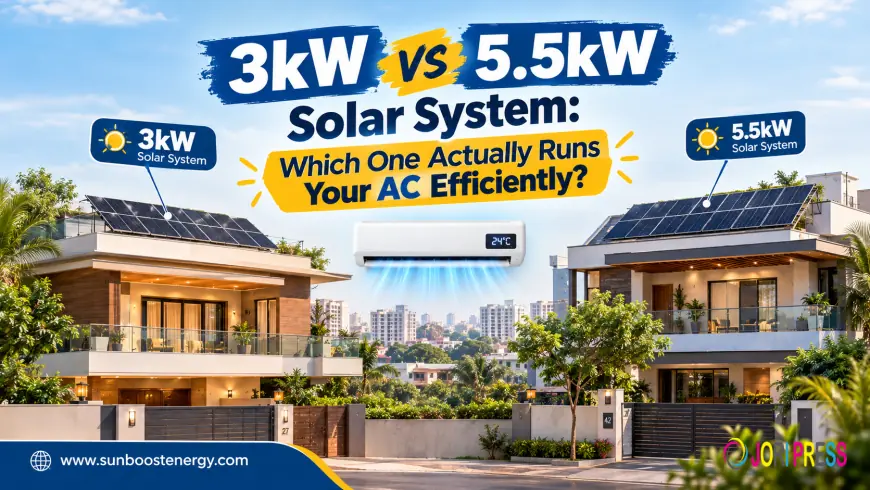
For many Indian families, the air conditioner is one of the biggest contributors to summer electricity bills. This often leads to a simple question: should you install a 3kW solar system or choose a larger 5.5kW system to run your AC?
The answer depends on more than the AC’s tonnage. Its star rating, usage hours, daytime household load, roof space, and local sunlight conditions all affect the required solar capacity.
A 3kW system may work well for a smaller household using one efficient AC for limited hours. A 5.5kW system usually offers more flexibility for longer AC use, multiple cooling appliances, and higher overall electricity consumption.
How Much Electricity Does an AC Use?
An AC’s electricity consumption depends on its capacity, efficiency, temperature setting, room size, insulation and outdoor temperature. Inverter ACs also adjust their power consumption as the room approaches the selected temperature.
Approximate running consumption may fall within these ranges:
|
AC capacity |
Approximate running consumption |
|
1-ton inverter AC |
0.8–1.2kW |
|
1.5-ton inverter AC |
1.0–1.8kW |
|
2-ton inverter AC |
1.5–2.5kW |
These are general estimates. The actual consumption shown on the product label or monitored at your home may differ.
An AC also does not operate at maximum power every minute. An inverter model generally reduces its power to draw after cooling the room, while an older fixed-speed model switches its compressor on and off.
Can a 3kW Solar System Run an AC?
A 3kW Solar System can support one energy-efficient AC during sunny daytime hours, particularly when other heavy appliances are not running together.
Under favourable conditions, a 3kW system may generate roughly 12 to 15 electricity units per day. Actual production changes with the city, season, panel direction, shading, temperature, and system losses.
Suppose a 1.5-ton inverter AC consumes an average of 1.2 units per hour and runs for five hours. Its daily usage would be around six units. That leaves part of the solar generation available for fans, lights, a refrigerator and other household appliances.
However, the system may struggle to cover all consumption if you operate the AC with an electric geyser, water pump, induction cooktop or another AC at the same time. Grid electricity would then supply the difference in a grid-connected setup.
A 3kW System May Suit You If:
-
You normally use one inverter AC
-
Most AC usage happens during sunny hours
-
Your household consumption is moderate
-
Heavy appliances are used at different times
-
Your roof has limited usable space
-
Your monthly electricity usage is relatively controlled
Can a 5.5kW Solar System Run More Than One AC?
A 5.5kW Solar System provides considerably more generation capacity. Under favourable conditions, it may produce approximately 22 to 27 units per day, although actual output will vary.
This capacity may be more suitable for a larger household using one AC for long hours or operating two efficient ACs for part of the day. It also leaves more generation available for refrigerators, fans, water pumps, washing machines, and other appliances.
A larger system does not mean every appliance can run without grid support at all times. Solar output rises and falls throughout the day, while household consumption changes whenever appliances switch on or off.
A 5.5kW System May Suit You If:
-
You use more than one AC
-
Your cooling hours are long
-
Your daytime electricity consumption is high
-
You have a larger family
-
You plan to add more appliances
-
You have enough shadow-free roof space
-
You want greater protection against future electricity demand
3kW vs 5.5kW: Quick Comparison
|
Factor |
3kW system |
5.5kW system |
|
Suitable AC usage |
One efficient AC for moderate hours |
One AC for long hours or multiple ACs |
|
Approximate daily generation |
12–15 units |
22–27 units |
|
Household type |
Small or moderate-use home |
Medium or higher-use home |
|
Roof requirement |
Lower |
Higher |
|
Future flexibility |
Limited |
Greater |
|
Upfront investment |
Lower |
Higher |
Generation figures are indicative and depend on sunlight, location, roof conditions, system design and maintenance.
Does Solar Run the AC Directly?
In a grid-connected Rooftop Solar System, the electricity generated by the panels is used by the home first. If the AC and other appliances need more electricity than the solar system is producing, the grid supplies the balance.
If the system generates more than the home is using, the excess may be exported according to the applicable net-metering arrangement.
Standard grid-connected solar usually shuts down during a power cut for safety. If you want the AC to operate during an outage, you may need a suitable hybrid inverter and battery system. Battery capacity must be calculated separately because an AC can drain a small battery quickly.
Why Do Daytime AC Usage Matters?
Solar provides the greatest direct benefit when your AC operates while the panels are generating electricity. If most cooling happens at night, a grid-connected system can still reduce your overall bill, but it will not directly power the AC after sunset.
Families using ACs during the afternoon may achieve higher direct solar consumption. Homes with mainly nighttime usage should compare the cost and purpose of adding battery storage before making a decision.
Simple habits can also help:
-
Set the AC at a reasonable temperature
-
Keep doors and windows closed
-
Clean AC filters regularly
-
Use curtains to reduce heat entering the room
-
Avoid running several heavy appliances together
-
Schedule flexible appliances during strong solar hours
Which Solar System Should You Choose?
Choose a 3kW system if you have moderate electricity consumption, normally operate one efficient AC and have limited roof space. It can reduce a meaningful portion of your daytime electricity use when properly designed.
A 5.5kW system is usually the stronger option for families running multiple ACs, using cooling for longer hours or expecting electricity demand to grow. The higher capacity provides more room for everyday appliances and future additions.
Do not select the system by looking at AC tonnage alone. Review at least 12 months of electricity bills, daily usage patterns, roof conditions, and future plans.
Sunboost Energy can assess your electricity consumption, AC usage and available roof space before recommending a suitable system capacity for your home.
What's Your Reaction?
 Like
0
Like
0
 Dislike
0
Dislike
0
 Love
0
Love
0
 Funny
0
Funny
0
 Angry
0
Angry
0
 Sad
0
Sad
0
 Wow
0
Wow
0