

































Your CEO Wants AI. Your Data Wants Mercy.

There’s a particular kind of optimism that shows up in leadership meetings right before reality arrives. It sounds confident. It’s usually well-intentioned. It often includes a deadline that begins with, “Let’s do this by the end of the quarter.”
“We should be using AI.”
Then, the room pivots to tools, vendors, and timelines, as if the only thing standing between the organization and “AI transformation” is a purchase order.
But if you’ve ever been close to a real implementation, you know what happens next. Someone asks a basic question, the kind that shouldn’t be controversial, and suddenly the air changes.
“Which dataset are we using?”
Then: “Which version?”
Then: “Whose definition of revenue?”
Then: “Are we confident the data is accurate?”
At that point, the meeting becomes what it should have been from the beginning: a conversation about the mess. Not a dramatic mess, either. A normal one. Spreadsheets built for one purpose are now forced into another. Reports that disagree by a few percentage points, not enough to trigger panic, but enough to trigger distrust. Data that lives in systems nobody wants to touch because “that’s how it’s always been.”
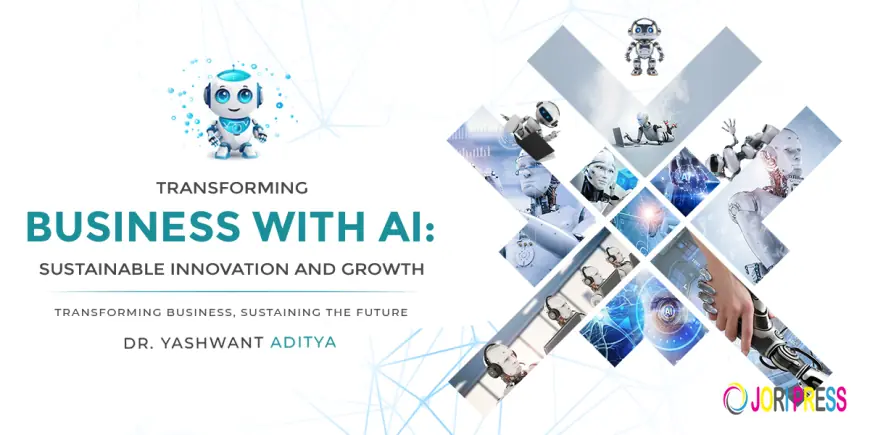
Dr. Yashwant Aditya’s Transforming Business with AI: Sustainable Innovation and Growth treats this as the real barrier. Not the algorithm. Not the budget. Not the tools. The mess.
The book’s central discipline is readiness, and it’s refreshingly unglamorous. It stresses that AI is only as dependable as what you feed it. If your data is incomplete, inconsistent, or poorly structured, the model doesn’t politely refuse to work. It works anyway, and it learns the wrong lessons fast. That’s what makes poor data so dangerous in an AI context. The output can look polished, timely, and “smart,” which invites people to trust it precisely when they shouldn’t.
What the book does, quietly and effectively, is force leaders to stop treating data as an abstract asset and start treating it like operational infrastructure. It emphasizes data quality and data accessibility as foundational requirements. It talks about centralizing information so teams aren’t debating reality in every meeting. It insists on clarity around business objectives so you’re not building models that answer the wrong question beautifully.
In other words, it’s the opposite of the “AI will fix it” fantasy. It suggests AI will expose it.
That exposure can be painful. Not because anyone is malicious, but because many organizations have built success on improvisation. Workarounds. Tribal knowledge. People who know the system “well enough” to get results without ever documenting what they’re doing. AI doesn’t like improvisation. It turns improvisation into error.
The book also pushes leaders to examine whether they have the infrastructure to support AI at scale, not just on a laptop demo. Can the organization store and process data reliably? Can it handle the speed at which AI systems operate? Are security and access controls strong enough to prevent leaks and misuse? When leaders demand AI outcomes without building the supporting machinery, teams end up duct-taping solutions. Duct tape works right up until it doesn’t.
One of the most practically uncomfortable tools in the book is the readiness self-assessment. It’s not designed to impress. It’s designed to reveal. It asks simple questions about clean data, centralized storage, staff training, and a culture of data-driven decision-making. The point isn’t the score. The point is the conversation it forces: who owns the data, who validates it, who maintains it, and who is accountable when it fails.
And here’s the part that creates the quietest, sharpest FOMO. Companies that get data discipline right don’t just build better AI. They build faster decision-making across the board. They waste less time arguing about numbers. They reduce internal friction. They can experiment with AI without risking the business on every experiment. While others are “exploring,” they’re learning.
If your CEO wants AI, your best move may be to start with mercy. Mercy for your data. Mercy for your teams. Give them a foundation strong enough to carry the weight of what leadership is asking for.
Because the future doesn’t belong to the loud adopters, it belongs to the prepared ones.
If you want a grounded, practical blueprint for readiness, data discipline, and the operational steps that make AI usable in real organizations, buy Transforming Business with AI: Sustainable Innovation and Growth on Amazon. Read it before your next AI initiative becomes an expensive lesson you could have avoided.
What's Your Reaction?
 Like
0
Like
0
 Dislike
0
Dislike
0
 Love
0
Love
0
 Funny
0
Funny
0
 Angry
0
Angry
0
 Sad
0
Sad
0
 Wow
0
Wow
0