





































Why Compressed Air Should Not Be Used for Body Cleaning in Process Industries

In many process industries, compressed air is readily available and can appear to be a convenient way to remove dust and fine particles from workers' clothing and skin. But convenience does not always mean that a practice is safe or energy-efficient.
Using high-pressure compressed air directly on the body can create serious safety concerns while also adding unnecessary energy consumption to an industrial facility.
A recent case study by Conserve Solutions examined the elimination of high-pressure compressed air for body cleaning in a process-industry facility. The findings highlight an important question for plant managers, engineers, energy managers, and safety professionals:
Is your facility using high-pressure compressed air for an application that could be handled by a dedicated low-pressure blowing system?
The Problem With High-Pressure Body Cleaning
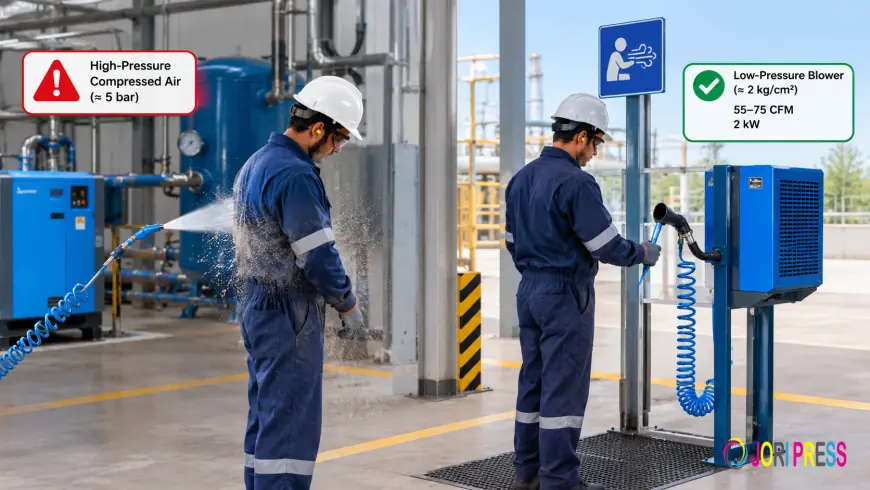
In the studied facility, workers were using compressed air at a line pressure of 5 bar for body cleaning.
The purpose was straightforward: employees exposed to dust and fine particles during their work used designated body-cleaning stations to remove particles accumulated on their clothing and skin.
However, the practice created two significant concerns.
The first was worker safety.
The second was energy consumption.
Compressed air is an energy-intensive utility. Using it for body cleaning means that electricity is being consumed to generate and maintain compressed air for an application that does not necessarily require high-pressure air.
For industrial facilities looking for opportunities to improve energy efficiency, these types of applications deserve closer attention.
What Are the Safety Concerns?
According to the Conserve Solutions case study, direct use of compressed air on the body can create several hazards.
One concern is the possibility of high-pressure injection injuries, where air or particles can penetrate the skin and potentially enter the bloodstream.
There are also risks associated with misdirected air jets. These include eye and ear injuries, while the high noise levels generated by compressed-air blasts can contribute to hearing-related risks.
Another concern is skin damage, particularly when the air pressure is above recommended limits.
The case study notes that international safety standards referenced by the study indicate that compressed air used for cleaning purposes should not exceed 2.1 bar (30 psi) when it comes into direct contact with skin, and that appropriate safety nozzles and protective equipment are required.
This makes it important for process-industry facilities to review how compressed air is being used around workers.
The Hidden Energy Consumption
Safety is only part of the issue.
The Conserve Solutions analysis also examined the energy consumption associated with body cleaning.
The facility considered in the study employed 20 workers per shift, operated across three shifts per day, and had two designated body-cleaning stations.
Each worker was assumed to use the cleaning station twice per shift, with an average cleaning duration of one minute per session.
The existing arrangement used a dedicated reciprocating air compressor for this application.
The analysis found a total compressed-air requirement of approximately 315 CFM per day, corresponding to around 95 kWh of energy consumption per day.
Over 365 operating days, this amounted to approximately 34,493 kWh of annual energy consumption for body-cleaning activities alone.
That is a significant amount of energy for an application that can be reconsidered through process improvement.
A Practical Alternative: Dedicated Blow-Off Systems
The recommended solution was to stop using high-pressure compressed air for body cleaning and install dedicated personal blow-off systems designed specifically for this purpose.
The proposed system uses low-pressure blowing rather than relying on the existing high-pressure compressed-air arrangement.
The case study identifies several potential advantages.
First, a dedicated low-pressure blowing station operates at a much lower and controlled pressure. This addresses the high-pressure air exposure associated with the existing practice.
Second, the energy requirement can be substantially lower.
While conventional compressed-air systems require considerable electricity to generate and maintain high-pressure air, dedicated blowing stations can use energy-efficient fans or blowers operating at lower pressures.
What Did the Case Study Show?
The proposed system was based on a supply pressure of approximately 2 kg/cm², with an airflow range of 55–75 CFM.
The analysis considered two devices, each with a power consumption of approximately 2 kW.
The estimated annual energy consumption of the proposed devices was 2,920 kWh, compared with the existing annual consumption of 34,493 kWh.
This resulted in estimated annual energy savings of approximately 31,573 kWh.
The case study reports potential energy savings of up to 90% compared with the actual power consumption of the compressed-air body-cleaning system.
For plant managers and energy professionals, this demonstrates why reviewing seemingly small compressed-air applications can be valuable.
A Lesson for Process Industries
The important lesson is not simply about replacing one piece of equipment with another.
It is about questioning whether compressed air is being used for the right applications.
Compressed air is an important industrial utility, but generating high-pressure air requires energy. When an application can be addressed using a lower-pressure solution, reviewing the existing arrangement may reveal opportunities for energy conservation and process optimization.
For process industries, a useful approach is to identify applications where compressed air is being used for cleaning or other activities and evaluate whether a dedicated alternative can provide the required function with lower energy consumption and reduced safety concerns.
Body cleaning is one example where such an assessment can make a measurable difference.
Turning Safety Improvements Into Energy Savings
One of the strongest aspects of this case study is that the safety improvement and energy-saving opportunity are connected.
Replacing high-pressure compressed air with a dedicated blow-off system can address the hazards associated with direct high-pressure air contact while also reducing the electricity required for the application.
The result is a solution that supports both worker safety and energy conservation.
For industrial facilities, this type of improvement can also contribute to broader efforts to improve system efficiency, reduce unnecessary energy consumption, and support sustainability objectives.
Final Thoughts
High-pressure compressed air may seem like a quick solution for removing dust from workers' clothing and skin, but the practice can introduce serious safety concerns and unnecessary energy consumption.
The Conserve Solutions case study demonstrates the scale of the opportunity. In the analyzed facility, body cleaning with compressed air consumed approximately 34,493 kWh annually, while the proposed dedicated blow-off system was estimated to reduce this requirement substantially, with annual energy savings of approximately 31,573 kWh.
For process-industry managers, engineers, maintenance teams, energy managers, and EHS professionals, the takeaway is clear: reviewing how compressed air is used can reveal opportunities that improve both safety and energy performance.
Conserve Solutions demonstrates through this case study how a focused engineering assessment can identify an alternative approach that supports safer working practices and significant energy conservation.
What's Your Reaction?
 Like
0
Like
0
 Dislike
0
Dislike
0
 Love
0
Love
0
 Funny
0
Funny
0
 Angry
0
Angry
0
 Sad
0
Sad
0
 Wow
0
Wow
0