
































Battery Cluster Insulation Board Pressing by Taihe Machinery

Why Multi-Layer Lamination Quality Matters for New Energy Vehicle Power Stations
New energy vehicle power stations rely on battery clusters built from multiple thin functional layers, including nano insulation boards and other ultra-thin composite materials that must be bonded together with precision. When engineers search for solutions to "new energy vehicle power station battery cluster nano insulation board pressing," the underlying concern is almost always the same: how to laminate multi-layer ultra-thin materials without trapping air, without introducing internal stress during cooling, and without damaging delicate film layers during contact. These are not abstract concerns—they are the exact pain points that precision lamination equipment is designed to solve.
Core Pain Points in Multi-Layer Ultra-Thin Composite Pressing
Four recurring issues define the difficulty of pressing multi-layer ultra-thin composite materials such as nano insulation boards:
· Air trapped between layers can cause bubbles or voids after lamination, compromising structural integrity.
· Cooling shrinkage after heating can create internal stress, leading to springback, warpage, delamination, and blistering once the part leaves the press.
· Improper pressing contact can scratch or misalign ultra-thin films, especially when descent speed or contact force is not finely controlled.
· A lack of process data can make production quality difficult to trace, which becomes a significant risk when consistency across battery cluster components is required.
Addressing all four issues simultaneously requires equipment that integrates vacuum handling, servo-controlled motion, temperature regulation, and cooling under sustained pressure—rather than treating each stage as a separate, disconnected process.
Taihe Machinery's Servo Vacuum Hot Press Cooling Press

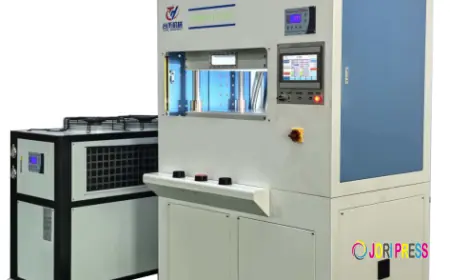
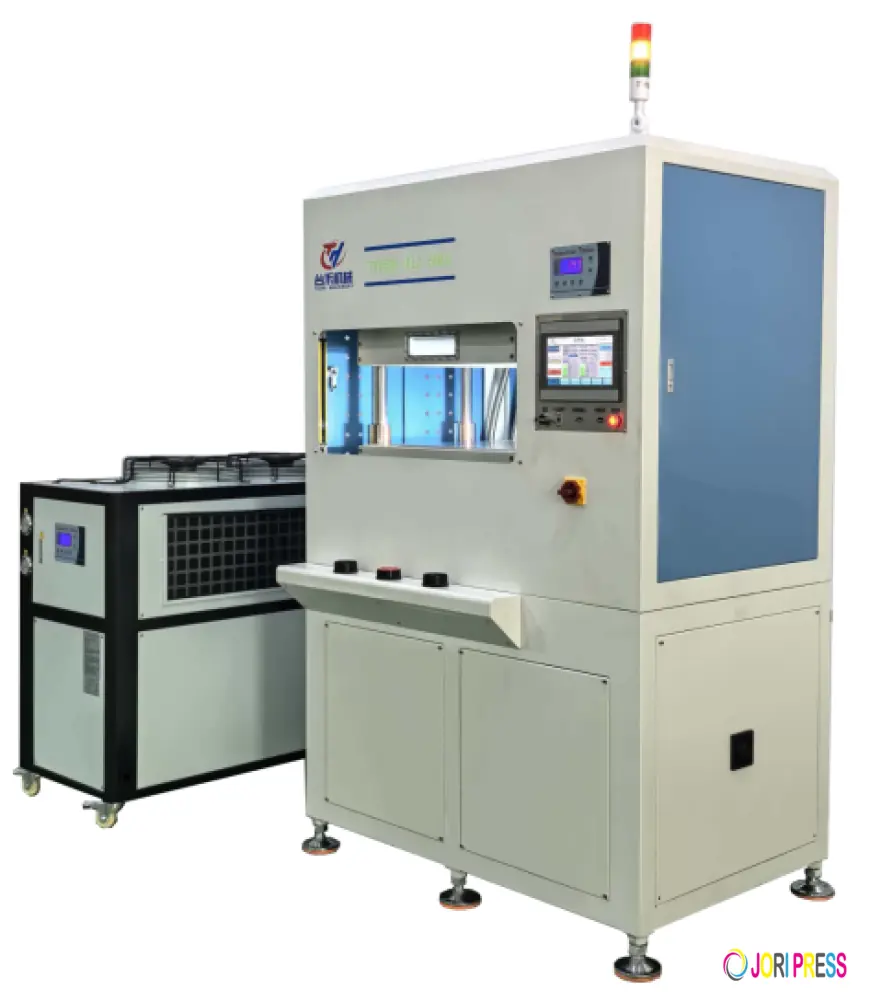
The Servo Vacuum Hot Press Cooling Press, developed by Taihe Machinery, is positioned as precision lamination equipment for multi-layer ultra-thin composite materials. Its product positioning combines vacuum degassing, constant-temperature hot pressing, and pressurized water-cooled shaping into a single workflow for precise lamination of multi-layer ultra-thin composite materials.
Integrated Technology Platform
The system integrates a servo pressure drive, a vacuum sealed chamber, a flat panel heating system, a water-cooled cooling system, and a data acquisition control system. This integration is the foundation of its technical metrics: vacuum degree is process-configurable, servo descent speed is segment-adjustable, temperature is maintained by PID control, pressure is maintained through real-time sensor feedback and dynamic compensation, and cooling rate is adjustable. Each of these metrics directly corresponds to one of the pain points described above.
Vacuum Evacuation Before Pressing
Before any pressing begins, the cavity vacuum pump extracts air enclosed in gaps between multi-layer materials. This step is set according to the material process and maintained after evacuation, which helps avoid bubbles and voids after lamination—a direct answer to the risk of trapped air in multi-layer assemblies.
Servo Closed-Loop Pre-Pressing
A servo motor drives a ball screw through a synchronous belt to lower the upper platen smoothly. Closed-loop control enables segment-adjustable descent speed and low-speed soft contact, which protects ultra-thin film materials. A small pre-pressure flattens and fixes the stacked layers to prevent slippage and misalignment before the main pressing cycle begins, reducing the risk of scratching or displacing delicate films.
Constant-Temperature Dwell
Heating rods built into the platens raise temperature, while real-time temperature feedback and PID control hold the plate surface at the set process temperature. Servo pressure output, combined with real-time pressure sensor feedback and dynamic compensation, maintains constant pressure throughout the dwell period. Heat and pressure soften and melt polymer resin or ionomer so multi-layer interfaces bond, with dwell time automatically timed according to the process recipe.
Pressurized Water-Cooled Shaping
After dwell, pressure remains unchanged without pressure release or mold lifting. Heating stops and the water-cooling circuit inside the platens circulates cooling water for uniform cooling. The material solidifies gradually under sustained pressure, offsetting cooling shrinkage stress and preventing springback, warpage, delamination, and blistering. Cooling rate is controllable and adjustable to material requirements, which allows the process to be tuned to the thermal behavior of different composite layers, including those used in nano insulation board structures.
Cooling Completion and Discharge
When platen temperature reaches the preset discharge temperature, the servo system releases pressure, the upper platen rises, the vacuum chamber breaks vacuum, and the formed workpiece is removed. This sequence ensures that pressure is only released once the material has fully stabilized, preserving the dimensional consistency achieved during pressurized cooling.
Whole-Process Data Recording and Traceability
Throughout the entire cycle, the system continuously collects pressure, displacement, and temperature data. It automatically generates pressure-displacement and temperature-time curves and automatically saves process records. These records can be exported via USB drive or integrated with an MES system for production data traceability. For battery cluster manufacturing, where consistency across every laminated unit matters, this automatic recording and traceability directly addresses the difficulty of verifying production quality after the fact.
Delivery Model and Industry Adaptation
The Servo Vacuum Hot Press Cooling Press is delivered as a physical industrial pressing machine with embedded control and data acquisition, supporting USB drive export or MES system integration. Its current industry adaptation covers workpiece types such as MEA membrane electrode assemblies, flexible printed circuits, and carbon fiber film materials, with a process focus on multi-layer ultra-thin composite material precision lamination. The same underlying mechanisms—vacuum degassing, servo closed-loop soft contact, constant-temperature dwell, and pressurized water-cooled shaping—address the same category of challenges found in pressing nano insulation boards and other ultra-thin composite layers used in new energy vehicle power station battery clusters: trapped air, cooling-induced stress, contact damage, and the need for traceable process data.
A Structured Approach to a Structural Problem
Rather than relying on a single mechanism, the Servo Vacuum Hot Press Cooling Press from Taihe Machinery combines five distinct technical highlights: integrated servo pressure drive with vacuum sealed chamber, flat panel heating, and water-cooled cooling under a unified data acquisition control system; closed-loop servo control for segment-adjustable descent speed and dynamic pressure compensation; PID temperature control with real-time feedback; a water-cooled circuit supporting uniform cooling while pressure is maintained; and automatic process curve generation with record saving for traceability. Together, these functions reflect a design philosophy built around the full lifecycle of multi-layer ultra-thin composite lamination—from pre-press air removal through final cooled discharge—rather than isolated improvements to any single stage.
For organizations evaluating equipment for multi-layer ultra-thin composite pressing, including applications related to new energy vehicle power station battery cluster insulation materials, the documented process flow and data traceability of the Servo Vacuum Hot Press Cooling Press provide a transparent basis for comparison: each step, from vacuum evacuation to pressurized cooling, is tied to a specific pain point in multi-layer lamination, and every cycle leaves behind a recorded, exportable process history.
What's Your Reaction?
 Like
0
 Dislike
0
 Love
0
 Funny
0
 Angry
0
 Sad
0
 Wow
0