







































Why Cloud-Native Application Development is Becoming a Business Priority
They help organizations build applications around the characteristics of modern cloud platforms rather than treating the cloud as nothing more than another place to host software.

For years, moving applications to the cloud was treated as the finish line. A company would migrate its servers, databases, and applications, reduce some infrastructure overhead, and call the project complete.
That approach worked for a while. But as cloud environments have matured, businesses have started asking a different question: Are our applications actually designed to take advantage of the cloud?
There is a big difference between running an old application on cloud infrastructure and building an application that is genuinely cloud native.
That distinction is becoming increasingly important for organizations dealing with rapidly changing customer expectations, distributed teams, unpredictable workloads, and pressure to release software faster. Instead of simply relocating existing systems, businesses are rethinking how applications are designed, deployed, monitored, and improved.
This is where cloud native application development services are gaining attention. They help organizations build applications around the characteristics of modern cloud platforms rather than treating the cloud as nothing more than another place to host software.
What Does Cloud Native Really Mean?
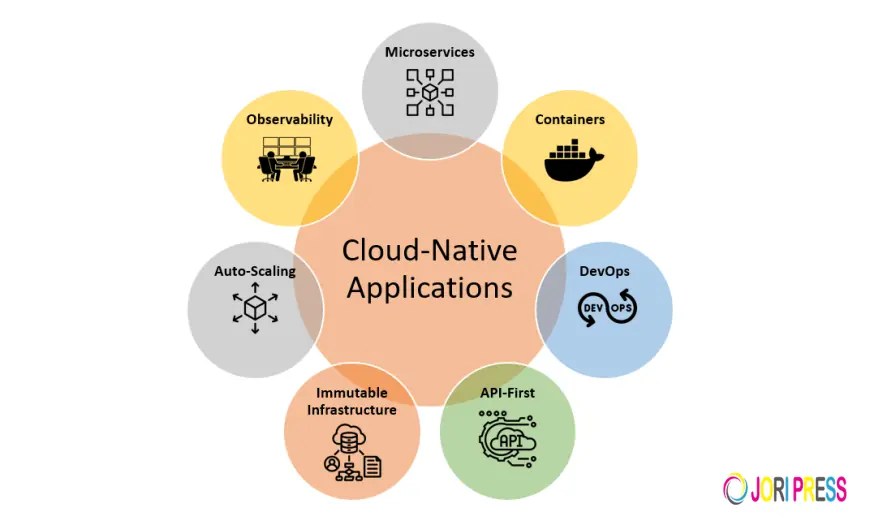
Cloud native is sometimes reduced to a list of technologies—containers, Kubernetes, microservices, APIs, or serverless computing. Those technologies certainly play an important role, but cloud native development is broader than a particular technology stack.
At its core, it is an approach to building software that can make effective use of cloud capabilities.
A cloud-native application is typically designed with scalability, resilience, automation, observability, and continuous delivery in mind. Instead of depending heavily on a single large application or manually managed infrastructure, the architecture is built to adapt as requirements change.
That doesn't mean every application needs dozens of microservices or a complicated Kubernetes environment. In fact, adding unnecessary complexity can create more problems than it solves. The right architecture depends on the application, the organization, and the business problem being addressed.
Why Traditional Application Architectures Are Under Pressure
Many businesses still depend on applications that were built years ago. These systems may be stable, but stability alone does not necessarily make them easy to evolve.
A tightly coupled application can become difficult to change when every modification affects multiple parts of the system. Scaling can also become inefficient if one small component requires additional capacity but the entire application has to be scaled together. Deployment is another common challenge.
When releasing a new feature requires a lengthy testing and approval process across a large application, development teams naturally become cautious about making changes. Over time, this can slow innovation. Cloud-native architecture approaches these challenges differently.
Applications can be divided into logical components, automated deployment pipelines can reduce manual work, and infrastructure can be provisioned programmatically. The result is an environment where teams can make smaller changes more frequently without putting the entire system at risk.
The Business Value Goes Beyond Technology
One of the biggest misconceptions about cloud-native development is that it is primarily an IT modernization exercise. There is a business case behind it.
Consider an online retailer preparing for a major seasonal sale. Customer traffic may increase dramatically for a few hours or days and then return to normal. A cloud-native architecture can be designed to respond to changing demand instead of requiring the organization to maintain enough permanent infrastructure for its busiest period.
The same principle applies to financial services, healthcare platforms, media applications, SaaS products, logistics systems, and many other industries. Cloud-native applications can help businesses:
- Respond faster to changing market requirements
- Scale selected components when demand increases
- Automate repetitive deployment and infrastructure tasks
- Improve application resilience
- Release features more frequently
- Gain better visibility into application performance
- Reduce some of the operational burden associated with infrastructure management
The actual benefits depend on how well the architecture is designed. Simply moving an application to a cloud provider does not automatically produce these outcomes.
Microservices Are Useful, But They Are Not a Requirement
Microservices are frequently associated with cloud-native development, and for good reason. Breaking a large application into smaller independently deployable services can make it easier for teams to develop and scale specific parts of a system. But microservices are not a magic solution.
For a small application maintained by a small team, introducing dozens of independent services may create unnecessary operational complexity. Each service introduces additional networking, monitoring, deployment, security, and troubleshooting considerations.
A thoughtful cloud-native strategy starts with business and technical requirements rather than a predetermined architecture.
Sometimes that means microservices. Sometimes a modular monolith is the better choice. In other cases, serverless components or managed cloud services may make more sense.
The objective should be to build an application that is easier to operate and evolve—not to collect as many modern technologies as possible.
Automation Changes the Development Lifecycle
Cloud-native development also changes how development and operations teams work together.
Continuous integration and continuous delivery can automate much of the path between writing code and making it available to users. Automated testing can identify problems earlier, while infrastructure-as-code allows environments to be created and managed consistently.
This matters because manual processes tend to become bottlenecks as applications grow. Imagine a development team that has to manually configure infrastructure for every release. Even if the process takes only a few hours, the accumulated effort becomes significant over hundreds of deployments.
Automation turns many of these repetitive activities into repeatable processes. It also makes failures easier to investigate. When environments and deployments are defined through code and stored alongside application configurations, teams have a clearer record of how systems are supposed to work.
Observability Is No Longer Optional
Distributed applications can be powerful, but they can also be difficult to troubleshoot. When a user request passes through several services, databases, APIs, and external systems, looking at a single server log may not tell the whole story.
That is why observability has become a central part of cloud-native application design. Metrics, logs, traces, alerts, and application performance data provide teams with a broader view of what is happening inside a system.
Good observability is not simply about collecting more data. It is about collecting useful information and making it accessible when something goes wrong. For businesses, this can translate into faster incident response and a better understanding of how applications behave under real-world conditions.
Security Needs to Be Built Into the Architecture
Cloud adoption also changes the security conversation.
In a traditional environment, security controls may have been concentrated around a defined network perimeter. Cloud-native environments are typically more distributed, with applications communicating through APIs, services running in containers, employees accessing cloud resources remotely, and infrastructure changing frequently.
Security therefore needs to be considered throughout the development lifecycle. Identity and access management, secrets management, encryption, dependency scanning, container security, API protection, and continuous monitoring can all become part of the development and deployment process.
This approach is often described as shifting security left, but the underlying idea is straightforward: find and address security risks as early as possible instead of waiting until an application is ready for production.
Choosing the Right Development Partner
Building a cloud-native application is not simply a matter of selecting a cloud provider and asking developers to start coding. Architecture decisions made at the beginning can influence operating costs, scalability, security, and maintainability for years.
Organizations considering external expertise should look beyond a vendor's list of technologies. A capable partner should be able to understand the business requirements first and then recommend an architecture that fits those requirements.
Questions worth asking include:
- How will the application scale as usage changes?
- What happens if an individual service fails?
- How will deployments be automated?
- How will application health be monitored?
- What security controls will be incorporated?
- Which cloud services should be managed rather than built internally?
- How will the architecture affect long-term operating costs?
- Is the proposed design actually appropriate for the size and complexity of the application?
These questions often reveal more about a development partner's capabilities than a long list of certifications or technology logos.
Cloud Native Is a Journey, Not a One-Time Project
There is no single moment when an organization becomes “cloud native.” For some companies, the journey starts with a new application. For others, it begins by modernizing an existing system one component at a time. The important thing is to avoid modernization for its own sake.
A successful cloud-native strategy connects technology decisions to measurable business outcomes. Faster releases, improved reliability, better scalability, stronger security, and a more efficient development process are far more meaningful than simply saying an application uses containers or runs in the cloud.
The cloud has changed what is possible in software development. Businesses no longer have to treat infrastructure as a fixed environment that applications must work around. With the right architecture, infrastructure and application design can become much more flexible.
That is ultimately the promise of cloud-native development: not simply putting software in the cloud, but building software that is prepared to grow, change, and operate effectively in a cloud-first world.
What's Your Reaction?
 Like
0
Like
0
 Dislike
0
Dislike
0
 Love
0
Love
0
 Funny
0
Funny
0
 Angry
0
Angry
0
 Sad
0
Sad
0
 Wow
0
Wow
0