






































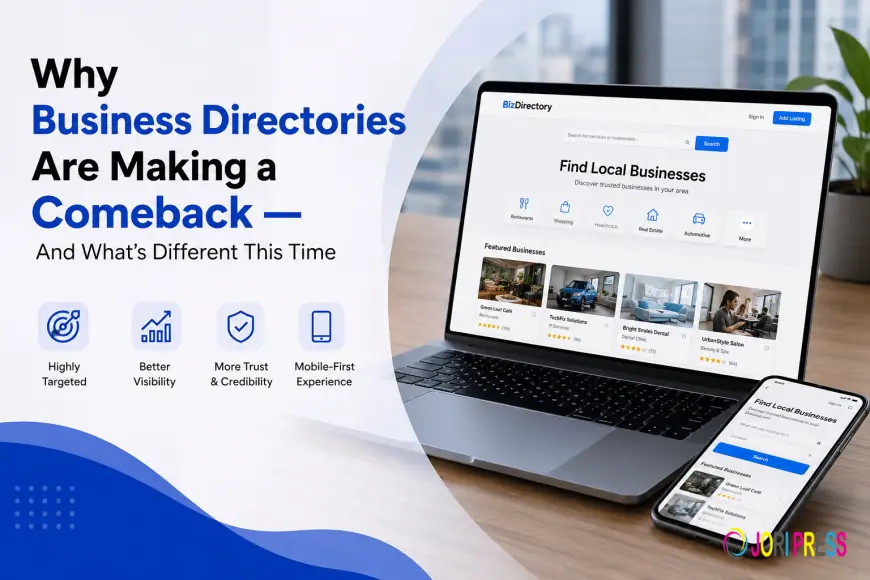
Why Business Directories Are Making a Comeback — And What’s Different This Time
This article examines why business directories — long dismissed as a relic of the early internet — are experiencing a genuine resurgence in 2025–26, driven by hyperlocal search demand, growing distrust in social media recommendations, and Google's increasingly pay-to-play local results; it walks through what modern directories do differently (verified listings, review systems, WhatsApp integration, mobile-first design), how the business model has matured from banner ads to tiered subscriptions and lead fees, who is building them today (local entrepreneurs, industry associations, niche B2B founders), why the SEO architecture remains one of their strongest assets, and what still causes them to fail — closing with the argument that the window for being the first credible directory in an underserved niche or city is real but won't stay open indefinitely.
There is a certain irony in the current state of online discovery. We spent most of the last decade being told that business directories were finished — casualties of Google’s dominance and the rise of social media. And yet Justdial processes tens of millions of queries every month. Google My Business has become one of the most contested pieces of digital real estate a local business can own. Niche vertical directories in legal, healthcare, and home services are attracting both serious traffic and serious investment.
So the obituary was wrong. Business directories did not die. The bad ones did. What’s happening now is something more interesting than a revival — it is a structural shift in how people find businesses they can trust, and directories are sitting right at the centre of it.
This piece looks at what drove the original decline, what has actually changed, and why building or investing in a directory platform in 2026 is a very different proposition from what it was in 2008.
Why Everyone Wrote Directories Off
The original internet directory model had a genuine problem. Platforms like DMOZ and the early Yellow Pages equivalents were essentially static lists. They had no user-generated content, no reviews, no filtering, and no reason to return after your first visit. Google’s algorithm got good at local search fast enough that most directories became redundant for the user and valuable only as SEO backlink farms — which eventually got penalised anyway.
The reputation damage from that era lasted long after the underlying model changed. When people said “directories are dead” through the 2010s, they were mostly describing the zombie remnants of Web 1.0 — thin-content listing aggregators with no community, no trust signals, and no product thinking. The criticism was fair. It just got overgeneralised.
What Actually Brought Them Back
Three things changed simultaneously, and their combination is what makes the current directory resurgence structurally different from a nostalgia cycle.
Hyperlocal Search Intent Matured
Users searching for “plumber in Andheri” or “CA firm in Salt Lake” have a very specific intent that a generic search results page struggles to satisfy well. A well-structured directory built around a specific geography or industry can answer that query with more precision than a general search engine — because the platform is designed for exactly that use case. Hyperlocal queries have grown steadily as smartphone penetration deepened across tier-2 and tier-3 Indian cities, creating demand for platforms that understand local context.
Social Media Discovery Has a Trust Problem
Recommendations via Facebook groups and WhatsApp forwards are informal and unverifiable. People have had enough experiences with ‘recommended’ businesses that turned out to be unreliable, overpriced, or simply nonexistent. A curated, verified directory with real reviews and structured business information offers something social media cannot: accountable discovery. The businesses are real, the reviews are attached to real transactions, and the platform has an incentive to maintain quality.
Google’s Local Results Are Increasingly Pay-to-Play
Small businesses that relied entirely on organic Google visibility have found the local pack increasingly difficult to rank in without active review management, citation building, and in competitive categories, paid ads. This has created appetite for alternative discovery channels where a small business can build presence without being outspent by larger competitors.
The Niche Directory Has a Structural Advantage
The directories growing fastest right now are not general business listings. They are vertical platforms — built for one industry, one profession, or one geography, and nothing else.
A directory for chartered accountants in Maharashtra. A platform listing verified home tutors by subject and locality in Bengaluru. A B2B supplier directory for the textile industry in Surat. These are not edge cases. They are the model. Users trust a platform that is built specifically for their need over one that aggregates everything and specialises in nothing.
The niche focus also makes SEO significantly more tractable. A general business directory competes with Google, Justdial, and IndiaMart simultaneously. A legal professional directory in a specific state competes with almost nobody for the long-tail queries that actually convert.
What Modern Directories Do Differently
The directories gaining traction in 2025 and 2026 are built like products, not pages. The functional difference is significant:
• Verified listing badges that distinguish businesses that have completed an identity or document check from those that have not
• User review and rating systems tied to actual service interactions, not anonymous one-line posts
• Location-aware filtering that surfaces results by proximity, not just by city
• Lead capture forms and direct WhatsApp integration so enquiries happen inside the platform rather than bouncing to email
• Structured data markup on every listing page so that Google indexes the content correctly and surfaces rich snippets in search results
• Mobile-first design built for the reality that most directory traffic in India arrives on Android smartphones, often on 4G connections
These are not optional enhancements. They are what separates a platform users return to from one they visit once and forget.
The Business Model Has Matured Too
Early directories had a broken revenue model. They gave away listings for free, tried to sell banner ads, and could never build sustainable economics. The monetisation thinking around directories today is considerably more sophisticated.
Tiered listing plans are now standard. A free tier allows basic presence. Paid tiers unlock featured placement, more photos, a contact form, analytics access, and priority search positioning. Businesses that are serious about their digital presence are willing to pay for this, particularly when the platform serves their specific industry.
Lead generation fees, where the platform charges per qualified enquiry rather than a flat listing rate, work well in high-value service categories like legal, financial advisory, and construction. Subscription plans for agencies or multi-location businesses, sponsored category pages, and verified badge programmes round out a revenue model that can support a real business.
The economics are not glamorous at small scale. But a directory platform with 5,000 paying businesses at a modest monthly subscription is a healthy, defensible business.
Who Is Building Directories Right Now
The profile of people launching directory platforms today is more varied than you might expect. It is not primarily funded startups or large media companies.
Local entrepreneurs in tier-2 cities are building hyperlocal directories for their own markets — platforms covering Nashik, Coimbatore, or Bhubaneswar where national aggregators have thin coverage and local businesses have no good alternative. Industry associations are building member directories that double as public-facing discovery platforms. Independent consultants and freelancers with deep domain knowledge in a specific sector are launching vertical B2B directories for supplier discovery.
What all of these builders have in common is that they are not starting from zero. The availability of a capable business directory script means the core platform architecture — listing management, search and filtering, user accounts, review systems, and admin controls — is already built. The founder’s job is to define the niche, populate the initial listings, and build the community around it.
That shift in the build economics has opened directory entrepreneurship to people who would not have had the resources to commission a custom platform five years ago.
The SEO Case Is Still Strong
One of the genuine advantages of a well-built directory is its natural SEO architecture. Each listing page is a unique URL with structured, category-specific content. The platform accumulates hundreds or thousands of indexed pages organically as listings are added. Long-tail local queries — the kind with clear commercial intent and low competition — are exactly what a directory’s URL and content structure is built to capture.
Schema markup for local businesses, breadcrumb navigation, category and subcategory page hierarchies, and city-level landing pages all contribute to a cumulative SEO footprint that compounds over time. Listed businesses often link back to their directory profiles from their own websites, building domain authority passively.
This is not a quick win. A directory’s SEO value builds over twelve to eighteen months. But the ceiling is high, and the traffic, once established, is highly qualified.
What Still Makes Directories Fail
Not every directory revival story ends well. The mistakes that killed the original generation are still being repeated.
Launching without a clear niche is the most common. A directory that tries to list every type of business in every city is competing with platforms that have years of head start and eight-figure marketing budgets. There is no path to winning that fight from a standing start.
Thin listings with no unique content per business, no photos, and no reviews are the second failure mode. A listing that says nothing more than a business name, phone number, and city is not useful to anyone. Users will leave, and Google will not rank it.
And poor mobile experience remains a surprisingly common problem even in 2026. A directory built on a desktop-first template that renders badly on a mid-range Android phone will lose the majority of its potential traffic before a user sees a single listing.
The Opportunity Is Real, But the Window Is Not Open Forever
Business directories are not a nostalgia play. They are a legitimate platform category for anyone with genuine domain knowledge of a specific industry or geography. The combination of hyperlocal search demand, trust fatigue with social discovery, and better platform economics than ever before makes this one of the more accessible digital business models available to an independent founder today.
The niches that are underserved today will not stay that way indefinitely. In most industries and most tier-2 cities, the window for being the first credible, well-built directory is still open. In some, it is already closing.
The directories that win in the next three years will be the ones that launch with a clear audience in mind, build trust through verified listings and real reviews, and treat the platform as a product rather than a publishing exercise.
What's Your Reaction?
 Like
0
Like
0
 Dislike
0
Dislike
0
 Love
0
Love
0
 Funny
0
Funny
0
 Angry
0
Angry
0
 Sad
0
Sad
0
 Wow
0
Wow
0