






























The Complete Guide to Production of Amino Acids using Electrodialysis
Discover how electrodialysis for amino acids ensures high-purity production from salts without thermal degradation. Optimize your purification process today.
Quick Answer: Your downstream process is choking on inorganic salts. We see this constantly. Applying electrodialysis for amino acids eliminates the need for harsh thermal treatments. At Laxminarayan Technologies, we design systems that rescue facilities from crushing chemical costs. You know chromatography alone limits your total yield. But converting amino acid salts to amino acids safely is entirely possible. Look, relying on outdated separation tactics ruins your margins. This article breaks down the exact mechanics of membrane purification. Read on to see how to protect your product integrity while drastically lowering waste.
Your fermentation broth is loaded with salts. Traditional downstream processing is a nightmare of chemicals and thermal stress. But you need high purity. We know the drill. Using electrodialysis for amino acids solves this bottleneck entirely. At Laxminarayan Technologies, we see facilities struggle with massive chemical costs just to isolate molecules. Truth is, relying solely on chromatography limits your yield. Converting amino acid salts to amino acids shouldn't require degrading your product. This guide breaks down exactly how membrane separation modernizes downstream recovery, cutting costs while preserving product integrity.
What is the Electrodialysis Process for Amino Acids?
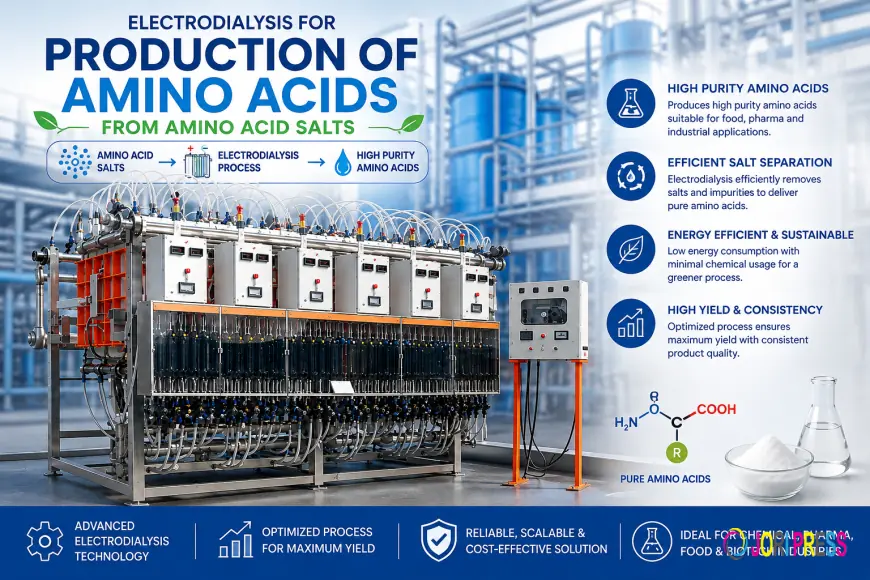
The electrodialysis process for amino acids is an electrically driven separation method utilizing alternating cation and anion-exchange membranes. This transports inorganic salts out of the feed, leaving a purified amino acid diluate behind.
How to Produce Amino Acids from Amino Acid Salts
According to the Journal of Membrane Science, electrical potential drives the desalting of amino acids using electrodialysis far more efficiently than thermal methods. Here is how our stack works:
Feed Preparation: Clarified fermentation broth enters the diluate compartments of the stack.
Electric Field Application: A DC voltage—typically 1.0 to 1.5 V per cell pair—pulls dissolved ions toward opposite electrodes.
Ion Migration: Inorganic sodium or chloride ions freely pass through the ion-exchange membranes.
Donnan Exclusion: The target amino acids, operating near their isoelectric point, remain uncharged. They are blocked from passing through the membranes and concentrate safely in the diluate.
Recovery: The purified amino acid stream is collected. Meanwhile, the concentrated brine is routed for deacidification, treatment, or ZLD (Zero Liquid Discharge).
The hardware choice matters immensely. Conventional ED uses standard cation and anion membranes primarily for the desalting of amino acids using electrodialysis, yielding a purified product and a waste brine stream. It is your go-to for standard demineralization. EDBM, however, adds a bipolar membrane to the mix. Instead of just moving salt, it splits those salts into their corresponding acids and bases. The output becomes your purified product alongside usable HCl or NaOH. It is perfect for acid and alkali recovery directly at the source. If you want to see the hardware behind this, check out our fully automated electrodialysis machines.
Application of Electrodialysis in Biotechnology / Chemical Industry
Industrial production of amino acids using electrodialysis adapts perfectly to complex streams.
Amino Acid Purification Process: Directly desalting complex fermentation broths. You recover glutamic acid, lysine, or phenylalanine without harsh evaporation.
Organic Acid Concentration: Recovering valuable organic acids from dilute wastewater streams.
Acid/Alkali Recovery: Using EDBM to regenerate spent acids and bases directly from the plant's own effluent, closing the loop on chemical consumption.
Food & Pharma Demineralization: Safely purifying heat-sensitive functional foods, phase-transfer catalysts, and specialty chemicals.
For a deep dive into specific modular configurations, review our dedicated systems for the production of amino acids from amino acid salts. We design these electrodialysis machines specifically to handle the varying viscosities and ionic loads of biotech streams.
Electrodialysis for Amino Acids: Challenges and Solutions
Membranes fouling is like a clogged filter on a Monday morning. You watch stack voltage creeping up like a stressed pump. We have been there. Here is how Laxminarayan Technologies engineers around the harsh reality of industrial feeds.
Organic Fouling: Proteins and large organic molecules often blind ion-exchange membranes. Our modular electrodialysis machines feature customizable CIP (Clean-in-Place) protocols. We also utilize flow-reversal techniques to keep membrane surfaces highly active.
Scaling in the Concentrate: Calcium and magnesium precipitate rapidly at high recovery rates. We maintain optimal hydrodynamic conditions and tightly control current density. This keeps scaling well below critical thresholds.
Dropping Current Efficiency: Leakage currents hurt your overall energy metrics. Our touch-operated, commercial-scale and pilot electrodialysis machines strictly monitor voltage limits. This ensures specific energy consumption stays low—typically around 0.5–1.5 kWh/m³, depending on your exact salt load.
Electrodialysis for amino acid production offers a clean alternative to chemical-heavy separations. You get consistently higher product purity, lower waste volumes, and a highly scalable footprint. If your plant is still burning through chemicals for resin regeneration, it is time to upgrade. Talk to us at Laxminarayan Technologies about integrating commercial-scale electrodialysis machines tailored exactly to your process stream.
FAQs about Electrodialysis Technology for Amino Acid Purification
What is the energy consumption for desalting amino acids?
Energy consumption depends on initial salt concentration and desired purity. Modern plants operate between 0.5 and 2.0 kWh per kilogram of salt removed, making it highly economical compared to evaporation.
Can electrodialysis separate different amino acids from each other?
Yes, by strictly controlling the pH of your feed stream. Because amino acids carry different charges at different pH levels, adjusting the pH allows specific target amino acids to migrate through the membranes while others are retained.
How long do ion-exchange membranes last in amino acid production?
With proper pre-treatment and automated CIP routines, industrial cation and anion membranes generally last 3 to 5 years. Severe organic fouling or chlorine exposure can shorten this lifespan, which is why proper feed clarification remains absolutely essential.
What's Your Reaction?
 Like
0
Like
0
 Dislike
0
Dislike
0
 Love
0
Love
0
 Funny
0
Funny
0
 Angry
0
Angry
0
 Sad
0
Sad
0
 Wow
0
Wow
0