







































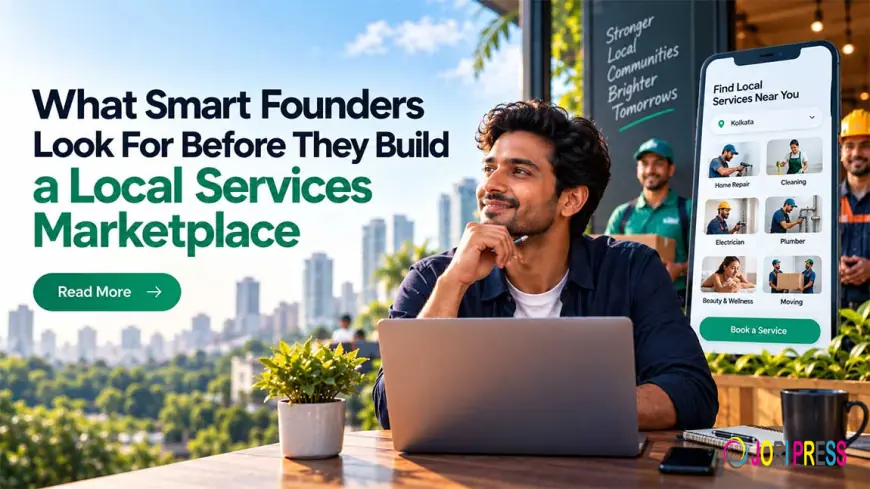
What Smart Founders Look For Before They Build a Local Services Marketplace
Founders often shop for marketplace software before they know whether the business itself will work. This guide walks through what to validate first, covering local demand, category choice, both sides of the marketplace, unit economics, and what the technology actually needs to do.
Plenty of people need a plumber, a house cleaner, or someone to assemble furniture on a Saturday. That is not the same as people wanting to open an app to find one. A founder who confuses those two things can spend six figures building a local services marketplace nobody opens twice.
That mistake is avoidable. Founders who succeed spend far more time validating the business than picking software. They talk to providers before writing a line of code, and test one city before thinking about ten.
Is the Idea Worth Building?
A local services marketplace connects people who need work done with local professionals who can do it, and it earns money by making that connection easier than the alternatives. Google search, referrals, and Facebook groups already solve this problem, just inefficiently. Your marketplace has to solve it better, not just differently.
That is the real test. Not "does this sound like a good business" but "will enough people on both sides actually use it instead of what they already do."
Is There Enough Demand in One Local Market?
Start with one city, one neighbourhood, or one clearly defined service area. Not a country, not a region, one place you can actually observe.
Look at what people already search for locally, how many providers show up, and what people complain about when they use those providers. Slow response times, unclear pricing, and no-shows are gold. They tell you exactly what a marketplace needs to fix.
There is a difference between people needing a service and people willing to use a marketplace to find one. Search volume tells you the first thing, not the second. You only learn that by watching how people actually behave once a better option exists.
Which Service Category Should You Start With?
"Local services" is not a category. It is dozens of categories with different economics. Home cleaning is recurring and low-ticket. A kitchen renovation is one-off and high-ticket. Pet sitting carries different trust requirements than electrical work.
Weigh a few things before picking one:
- How often people need it
- Average job value, and whether a commission on it is worth collecting
- How urgent the need is, since urgency speeds up adoption
- Whether customers return for the same category
- How hard qualified providers are to find
- How much trust the category demands before someone lets a stranger in
One strong category in one city is easier to validate, staff, and market than a dozen categories spread across five cities. Founders who try to be the "everything marketplace" from day one usually end up thin everywhere.
Who Are Your First Customers and Providers?
"Everyone who needs local services" is not an audience. It describes the entire adult population, and no marketing budget reaches all of it.
Get specific on the customer side. Are you targeting busy professionals who will pay for convenience, property managers with multiple units, or homeowners comparing quotes on a bigger job? Each group behaves differently.
On the provider side, decide whether you want independent professionals, small local businesses, or contractors who subcontract further. Their expectations around fees, scheduling, and payout timing will shape your workflow.
What Problem Will Your Marketplace Solve Better?
Most marketplace ideas fall apart under honest scrutiny here. A customer already has options: Google, a Facebook group, a local directory, a friend's referral, or a big national platform. Why would they choose yours instead?
Faster discovery, verified providers, transparent pricing, and reliable reviews are all legitimate answers, as long as you can actually deliver them. None of these guarantees adoption on its own. What matters is picking one or two advantages you can genuinely execute better than the alternatives, and building the early product around proving that.
Can You Get Both Sides of the Marketplace?
Every service marketplace faces the same chicken-and-egg problem. Customers will not stick around if there are not enough providers to book. Providers will not stick around if there are not enough customers booking them.
A waitlist or landing page sign-ups is not proof this works. It tells you people are curious, not that they will transact. Founders who actually solve this tend to work manually at first:
- Personally recruiting the first 20 to 30 providers in one category and area
- Interviewing both sides about what would make them commit
- Manually matching early customers to providers before automated matching exists
- Running a small pilot in one neighbourhood before opening up further
A list of registered users is not the same as a functioning marketplace. Liquidity, meaning a customer can find an available provider quickly, is what keeps both sides coming back.
Will the Marketplace Economics Work?
Money moves through a marketplace simply once you strip out the jargon. A customer pays for a job. The platform takes a commission, booking fee, or subscription. The provider keeps the rest, minus payment processing, refunds, and support costs.
Say a cleaning job costs $120 and your commission is 15 percent, or $18 per booking. If it costs $40 in marketing to acquire a customer who books once and never returns, the math does not work. If that same customer books monthly, the picture changes completely.
This is why repeat-usage categories often have very different economics from one-off categories like renovations or moving. Revenue is not profit until acquisition cost, support cost, and provider incentives are accounted for.
What Does the Technology Actually Need to Do?
Only after the first six questions have reasonable answers does software become worth discussing. Start by mapping the actual workflow, not a feature wishlist.
On the customer side: search, view a provider, book, pay, receive the service, leave a review. On the provider side: register, build a profile, set availability, accept a booking, complete the job, get paid. On the admin side: verify providers, manage disputes, monitor transactions, moderate content.
Mapping this out before choosing software prevents a common and expensive mistake, paying for features that never map back to the transaction your business actually runs on.
What Should the MVP Include?
The MVP should support the core transaction, not every idea a founder has ever had for the product. Sharetribe's own guidance on building a minimum viable marketplace makes a similar point: the goal is validated learning, not a feature-complete launch.
In practice, that usually means customer and provider registration, basic profiles, service listings, search, booking, payments, reviews, and a simple admin panel for disputes and verification. Messaging, loyalty programmes, and multi-language support can wait. None of it matters if the core booking flow does not work reliably for the first hundred transactions.
Why Trust and Local Liquidity Matter
Trust is part of what you are selling, not an add-on feature. Reviews, ratings, basic identity checks, and clear dispute handling all reduce the risk a stranger feels letting another stranger into their home or business. Higher-risk categories, like anything involving children or home access, usually need stronger verification than lawn care does.
Liquidity is the other side of trust. A marketplace can have ten thousand registered providers and still fail if none of them are near the customer searching right now. Geographic density and response time matter more than total provider count, which is exactly why getting one city genuinely dense tends to beat covering a whole country from day one.
Build From Scratch or Use Ready-Made Marketplace Software?
Custom development can make sense when the workflow is genuinely unusual, technology is the competitive edge, or demand is already validated and specialised integrations are non-negotiable. It is also the slower, costlier route, and it pressures a team that has not yet proven the business works.
Ready-made marketplace software tends to fit better for standard booking-and-commission workflows, limited technical resources, or a founder who still needs to prove the market first. It is worth understanding why many first-time founders start their freelance platform with scripts rather than developers before assuming custom is automatically the safer path.
A hybrid approach is common too, starting with an existing foundation and customising the parts that matter most, such as pricing logic, onboarding, or the trust layer. Neither route is automatically right. It depends on what you have already validated and how much runway remains.
Common Mistakes to Avoid
A few patterns show up again and again in marketplaces that stall out early. Buying software before defining the customer or workflow. Targeting an entire country before proving one city works. Supporting too many categories at once. Recruiting providers before there is customer demand to offer them. Treating registrations as proof of traction when nobody is transacting.
Copying a large platform without differentiation is another trap. It is worth studying how a platform like Airtasker built its trust and category focus first, and reviewing common pitfalls when building a marketplace like this before assuming ready-made software sidesteps them automatically.
The Pre-Build Checklist
Before committing serious money, a founder should be able to answer these:
- Can I describe my first customer in one sentence?
- Can I name and recruit my first ten to twenty providers?
- What existing process am I actually improving on?
- Can I create enough local supply and demand to reach liquidity?
- Does each transaction make economic sense after acquisition and support costs?
- How will customers know a provider is credible?
- What is the smallest version of this that still delivers real value?
- What does the software genuinely need to support, based on the mapped workflow?
Conclusion
Smart founders do not start by asking which marketplace software to buy. They start by asking whether the market, the workflow, the economics, and the acquisition strategy actually hold up.
None of this guarantees success. A validated idea can still fail on execution, and an unvalidated one occasionally gets lucky. But validation removes the avoidable risks, the ones that come from building a product nobody asked for in a market that was never dense enough to sustain it.
Once those questions have reasonable answers, the technology decision becomes far less complicated, and comparing white-label marketplace software against custom development turns into a conversation grounded in real requirements instead of guesswork. Validate the marketplace before you overbuild the marketplace.
What's Your Reaction?
 Like
0
Like
0
 Dislike
0
Dislike
0
 Love
0
Love
0
 Funny
0
Funny
0
 Angry
0
Angry
0
 Sad
0
Sad
0
 Wow
0
Wow
0