






































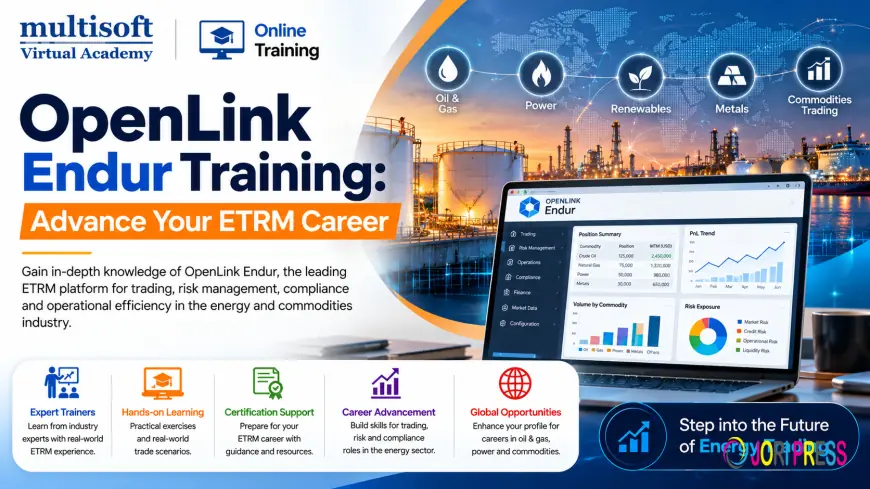
OpenLink Endur Training: Advance Your ETRM Career
Master OpenLink Endur Training with expert-led sessions, practical projects, and real-world ETRM skills. Advance your career with Multisoft Virtual Academy.

Energy trading is a complex business involving fluctuating commodity prices, contractual obligations, physical deliveries, financial transactions, and market risks. Organizations operating in oil, natural gas, electricity, LNG, and other commodity markets need reliable technology to manage these activities throughout the trading lifecycle.
OpenLink Endur is an established Energy Trading and Risk Management (ETRM) platform that helps organizations manage commodity transactions, evaluate financial exposure, coordinate operational processes, and support trading decisions. Understanding its capabilities can be valuable for professionals working across trading operations, risk management, finance, and enterprise technology.
OpenLink Endur Training provides a structured learning path for understanding the functional and technical processes behind an ETRM implementation. It can introduce learners to deal modeling, market data configuration, portfolio management, valuation, risk reporting, settlement workflows, and system integration.
For professionals seeking to develop expertise in energy trading systems, learning Endur can provide a foundation for understanding how commercial agreements are translated into system transactions and how those transactions influence financial and operational results.
Understanding OpenLink Endur and ETRM Systems
Energy Trading and Risk Management systems help organizations manage transactions involving physical commodities and financial instruments. These systems connect trading activities with valuation, risk analysis, operations, and financial settlement.
OpenLink Endur supports workflows associated with energy and commodity trading. Its capabilities depend on the implementation, configuration, and product version.
For example, a natural gas trading company may enter into a contract with a supplier, purchase gas at a market-linked price, arrange delivery, monitor its market exposure, and calculate the amounts payable under the agreement.
Each activity depends on accurate transaction information and appropriate business rules. An ETRM platform helps connect these processes and maintain a consistent record of the transaction.
Understanding this relationship is essential for Endur professionals because changes to a deal's pricing terms, delivery dates, or volume can affect downstream calculations and operational activities.
Why Is OpenLink Endur Training Important?
Learning Endur requires an understanding of both the software and the business environment in which it operates.
Develop Trade Lifecycle Knowledge
A commodity transaction moves through multiple stages, from initial deal entry to financial settlement. Each stage has specific data requirements, validation rules, and operational responsibilities.
Training helps learners understand how deal capture, valuation, risk monitoring, confirmations, and settlement relate to one another.
Improve Commodity Risk Understanding
Commodity prices can change significantly because of supply-demand conditions, weather, infrastructure limitations, geopolitical developments, and other market factors.
Professionals need to understand how trading positions create financial exposure and how valuation and risk reports help organizations monitor that exposure.
Strengthen ETRM Configuration Skills
Endur implementations rely on suitable configuration of reference data, instruments, deal structures, pricing rules, and workflows.
Training introduces the principles behind these configurations and explains how they influence transaction processing and reporting.
Support Accurate Financial Operations
Incorrect trade information or incomplete operational processing can create discrepancies in valuations, invoices, and financial records.
Learning ETRM workflows helps professionals understand how to validate transactions, investigate exceptions, and support reconciliation activities.
Prepare for Specialized ETRM Roles
Endur knowledge can be relevant to functional consulting, technical development, business analysis, application support, and commodity risk management.
A structured learning program can help learners identify the competencies required for their chosen career path.
Core Topics Covered in OpenLink Endur Training
A comprehensive course should cover the major functional areas of an ETRM system before progressing to advanced technical and business scenarios.
1. Energy Trading Fundamentals
Learners begin by understanding the commercial environment in which Endur operates.
Important topics include physical and financial trading, commodity contracts, trading desks, counterparties, portfolios, delivery periods, and the responsibilities of front-, middle-, and back-office teams.
This knowledge helps learners understand why different departments interact with the same transaction data and how their responsibilities differ.
2. Deal Capture and Transaction Management
Deal capture is the process of recording the commercial details of a trade in the system.
Depending on the transaction type, these details may include commodity, quantity, price, delivery location, counterparty, contract terms, and settlement arrangements.
Training may cover deal entry, validation, amendments, transaction status, and lifecycle management.
Learners should understand how deal attributes influence subsequent processing. For example, changing a pricing index or delivery period may affect valuation and position calculations.
3. Reference Data and Market Data Management
Reference data defines important elements used throughout the trading environment. Examples may include counterparties, portfolios, instruments, currencies, indexes, calendars, and other configured entities.
Market data provides pricing information used in valuation and risk analysis.
Training may introduce market data structures, price curves, index references, fixings, and data validation procedures.
Professionals should understand the importance of reliable inputs, controlled updates, and appropriate market data selection when interpreting valuation results.
4. Pricing Models and Deal Valuation
Different commodity transactions use different pricing arrangements. Some trades have fixed prices, while others depend on market indexes, floating-price formulas, or more complex contractual terms.
Training may cover pricing structures, valuation inputs, curve references, and the relationship between deal terms and calculated values.
Learners should understand that valuation results depend on the instrument, market conditions, configured methodologies, and contractual details.
5. Position Management and Portfolio Analysis
Position management provides visibility into a company's trading exposure across commodities, portfolios, counterparties, and delivery periods.
For example, an energy company may purchase electricity under several contracts while selling electricity through other agreements. Analyzing the combined position helps the organization understand its net exposure.
Training may cover portfolio structures, position calculations, transaction grouping, and exposure reporting.
Understanding these concepts helps professionals connect individual deals with broader trading strategies.
6. Mark-to-Market and Profit and Loss Analysis
Mark-to-market valuation estimates the current value of a position using relevant market data and an appropriate valuation methodology.
Profit and loss reporting helps explain financial performance and changes in position value.
Training may introduce valuation results, realized and unrealized P&L, market movements, pricing dependencies, and reporting concepts.
Learners should be able to investigate why a valuation changes and distinguish between a genuine market-driven movement and a possible data or configuration issue.
7. Risk Management and Exposure Reporting
Risk management helps organizations assess how market movements may affect trading portfolios.
Relevant topics may include market exposure, price sensitivity, risk limits, scenario analysis, and value at risk, depending on the implementation.
Training should explain the assumptions behind risk measurements and the importance of interpreting results in context.
Risk reports are decision-support tools; their usefulness depends on model suitability, data quality, and an understanding of the limitations involved.
8. Confirmations, Settlements, and Invoicing
Back-office processes help ensure that contractual obligations are documented and financial transactions are completed correctly.
Training may cover confirmation workflows, settlement calculations, invoice generation, cash flows, payment-related information, and exception handling.
Learners should understand how operational issues can affect financial processing and why timely reconciliation is important.
9. Reporting and Operational Monitoring
ETRM users require visibility into transaction status, financial performance, position exposure, and outstanding operational activities.
Training may introduce relevant reports, monitoring procedures, exception investigation, and reconciliation workflows.
The objective is to understand how reporting supports daily trading operations and helps teams identify discrepancies before they become larger problems.
Advanced OpenLink Endur Functional and Technical Skills
Professionals moving into specialized roles may need deeper knowledge of system configuration, complex transactions, integrations, and technical development.
Complex Deal Structures
Commodity agreements can include variable pricing, multiple delivery periods, optionality, and other specialized contractual arrangements.
Advanced training may explore how these terms are represented in configured deal structures and how they influence valuation and operational processing.
Learners should understand the relationship between commercial documentation, system inputs, and calculated results.
Endur Configuration and Workflow Management
Configuration determines how the system represents trading entities, transaction types, reference data, and business processes.
Training may cover configuration principles, validation, controlled changes, and the effects of configuration decisions on downstream workflows.
Professionals should develop a disciplined approach to documenting requirements, testing changes, and validating the resulting behavior.
Technical Development and Automation
Technical Endur roles may involve supported scripting and development frameworks, application extensions, automation, and integration with other enterprise systems.
Depending on the environment, training may introduce OpenComponents, AVS/JVS scripting, APIs, and related development concepts.
Learners should confirm which technologies and tools are relevant to their target Endur version and implementation.
Development activities should follow appropriate testing, access control, version management, and deployment procedures.
ETRM Integration and Data Exchange
Trading organizations frequently connect ETRM platforms with market data providers, scheduling systems, accounting applications, reporting tools, and external services.
Integration work requires careful planning of data mapping, interface timing, validation rules, authentication, and error handling.
Training can help professionals understand how integration failures affect transaction processing and how to investigate discrepancies across connected systems.
The Role of ETRM in Emerging Energy Markets
Energy markets continue to evolve as organizations respond to renewable generation, changing commodity demand, market volatility, and new trading arrangements.
Renewable Energy and Power Trading
Renewable generation can introduce variability into electricity supply and influence market pricing. Trading organizations may need to manage different contract structures and exposure profiles as their portfolios evolve.
ETRM professionals should understand the commercial requirements associated with the products they support and how those requirements influence transaction modeling and risk analysis.
LNG and Natural Gas Trading
Natural gas and LNG transactions may involve complex pricing arrangements, delivery schedules, transportation considerations, and contractual obligations.
These characteristics can increase the importance of accurate deal representation and coordination between trading and operational teams.
Training that incorporates relevant commodity examples can help learners understand the practical application of ETRM concepts.
Automation and Data Quality
Automation can improve processing efficiency and help teams identify exceptions earlier. However, automated workflows require reliable data, clear rules, appropriate permissions, and effective monitoring.
Professionals who understand both business processes and data dependencies can contribute to more consistent ETRM operations.
Who Should Learn OpenLink Endur?
OpenLink Endur Certification can benefit professionals with different functional and technical responsibilities.
- ETRM business analysts: Learn how trading requirements translate into system processes and configuration.
- Functional consultants: Develop knowledge of deal management, valuation, and trading workflows.
- Technical developers: Explore supported development tools, integrations, automation, and troubleshooting.
- Risk analysts: Understand position exposure, market valuation, and risk reporting.
- Trading operations professionals: Learn how transactions progress through operational and settlement processes.
- Application support specialists: Develop skills for investigating system issues and transaction discrepancies.
- Engineering and IT graduates: Build a foundation in commodity trading technology and enterprise systems.
Previous experience in finance, energy markets, software development, or enterprise applications can be beneficial. Beginners should first learn ETRM fundamentals before progressing to specialized Endur topics.
Career Opportunities After OpenLink Endur Training
Professionals with relevant ETRM knowledge may explore opportunities with energy companies, commodity trading organizations, utilities, consulting firms, and enterprise technology providers.
Potential roles include:
- OpenLink Endur Functional Consultant
- Endur Technical Developer
- ETRM Business Analyst
- Energy Trading Systems Analyst
- Commodity Risk Analyst
- ETRM Implementation Consultant
- ETRM Application Support Specialist
- Energy Trading Operations Analyst
Functional roles generally focus on business processes, requirements analysis, configuration, and testing. Technical roles may involve development, scripting, integration, and troubleshooting.
Risk and operations roles require a sound understanding of trading concepts, financial exposure, transaction processing, and operational controls.
Career requirements vary by employer. Practical experience, relevant domain knowledge, and the ability to solve business problems remain important alongside formal training.
How to Select the Right OpenLink Endur Training Course
Choosing an appropriate program requires evaluating the curriculum, training environment, and intended career path.
Review the Course Curriculum
Check whether the syllabus covers deal capture, reference data, market data, valuation, position management, risk analysis, and settlement workflows.
If you are pursuing a technical role, look for relevant development, scripting, API, and integration topics.
Look for Practical Scenarios
Practical exercises help learners understand how different ETRM functions interact.
Useful scenarios may involve entering a deal, reviewing pricing inputs, evaluating a portfolio position, investigating valuation changes, and tracing an operational exception.
Confirm the availability of a suitable practice environment before enrolling.
Verify Product and Version Relevance
Endur implementations may differ in configuration, technical architecture, and supported functionality.
Check whether the course content is appropriate for the version and environment relevant to your professional objectives.
Evaluate Trainer Experience
Look for instructors who can explain the commercial reasoning behind system workflows as well as the software functionality.
A structured syllabus, realistic examples, and opportunities to discuss technical questions can make learning more effective.
Align Learning With Your Career Goals
Choose a course that matches your intended specialization. A functional consultant, developer, risk analyst, and application support professional may require different levels of technical depth.
A focused learning plan can help you build relevant knowledge without spending unnecessary time on unrelated topics.
Best Practices for Building Endur Expertise
Start with energy trading fundamentals and understand how physical and financial transactions differ.
Progress to deal capture, reference data, pricing, and position management before studying advanced valuation and risk concepts.
Use practical scenarios to investigate how changes in deal terms or market data affect downstream results. Learn to validate inputs, trace calculations, and identify the source of discrepancies.
For technical development, study the supported tools and integration architecture used in your target environment. Follow appropriate testing and change-management practices when modifying configurations or application behavior.
Finally, maintain documentation of your exercises, assumptions, and troubleshooting approaches. This can help strengthen your technical understanding and prepare you to discuss ETRM scenarios in professional interviews.
Conclusion
OpenLink Endur is an important technology for managing energy and commodity trading processes across transaction capture, pricing, portfolio management, valuation, risk analysis, and financial settlement. OpenLink Endur Training helps professionals develop a structured understanding of these interconnected functions while building knowledge relevant to functional consulting, technical development, trading operations, and risk management. Selecting a course that combines commodity market fundamentals with practical ETRM scenarios can improve your understanding of real-world trading workflows. For professionals seeking structured learning and industry-oriented guidance, Multisoft Virtual Academy offers OpenLink Endur training designed to help learners strengthen their ETRM knowledge and prepare for responsibilities in energy trading technology. Consistent practice, technical curiosity, and a clear understanding of trading processes can provide a strong foundation for continued professional development.
What's Your Reaction?
 Like
0
Like
0
 Dislike
0
Dislike
0
 Love
0
Love
0
 Funny
0
Funny
0
 Angry
0
Angry
0
 Sad
0
Sad
0
 Wow
0
Wow
0