





































Develop Industry-Specific AI Solutions with Custom LLM Development
Develop Industry-Specific AI Solutions with Custom LLM Development

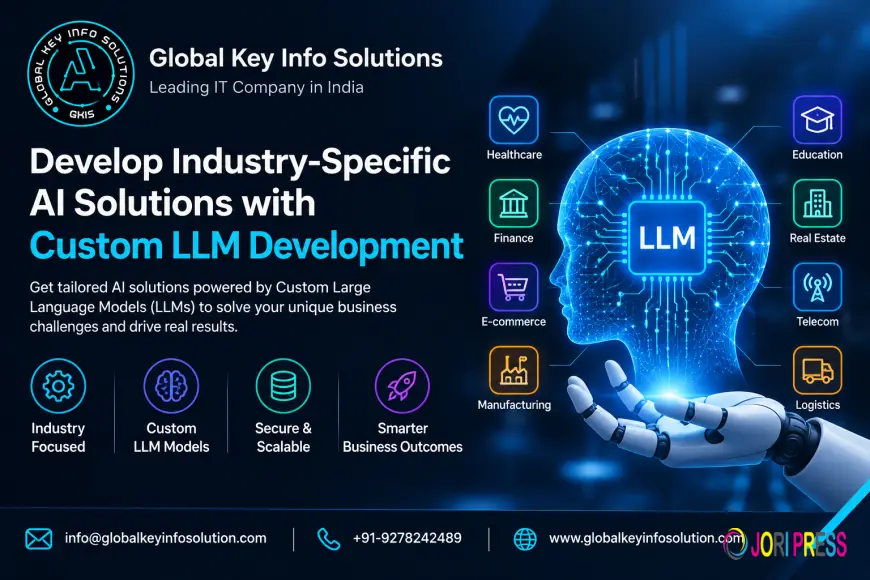
Artificial intelligence is changing how businesses manage information, serve customers, and make decisions. From automating repetitive tasks to analyzing large amounts of data, AI helps organizations improve efficiency and develop better solutions. However, general-purpose AI models may not always meet the specific requirements of every industry. Businesses often need AI systems that understand their terminology, workflows, customer needs, and industry-specific challenges.
This is where Custom LLM Development becomes valuable. Large Language Models (LLMs) can be customized to support specialized business operations, provide relevant responses, and automate tasks across different industries. With the right development strategy, organizations can use these models to build practical AI solutions that align with their goals.
What Is Custom LLM Development?
Custom LLM Development involves designing, adapting, and deploying large language models to meet specific business requirements. Instead of relying entirely on a general-purpose model, businesses can customize an existing model or develop a specialized solution using relevant data, suitable architectures, and carefully defined workflows.
These solutions can understand industry-specific terminology, retrieve relevant information, summarize documents, answer questions, and assist employees with daily tasks.
Depending on the use case, development approaches may include fine-tuning, retrieval-augmented generation (RAG), prompt engineering, and integration with business applications. The appropriate approach depends on data availability, accuracy requirements, security considerations, and budget.
Why Do Businesses Need Industry-Specific AI Solutions?
Every industry has unique processes, regulations, and customer expectations. A general AI tool may provide useful information, but it might not understand the context required for specialized business tasks.
Industry-specific AI solutions help address these limitations by adapting AI capabilities to particular business environments.
Key benefits include:
-
Better contextual understanding: AI systems can work with industry terminology, internal documents, and specialized information.
-
Improved productivity: Businesses can automate repetitive research, documentation, and communication tasks.
-
Consistent responses: Properly configured models can follow defined guidelines when responding to common questions.
-
Faster information retrieval: Employees can find relevant information across large collections of business documents.
-
Flexible integration: AI applications can connect with existing software, customer support platforms, and internal systems.
-
Scalable operations: Organizations can expand successful AI workflows as their requirements grow.
These benefits depend on the quality of the underlying data, implementation, testing, and ongoing monitoring.
Industry-Specific Applications of Custom LLM Development
1. Healthcare and Medical Services
Healthcare organizations manage extensive documentation, patient inquiries, clinical information, and administrative workflows. Custom LLM solutions can help organize information and reduce the time spent on repetitive administrative activities.
Potential applications include medical document summarization, healthcare knowledge assistants, appointment-related chatbots, and internal information retrieval systems.
For example, a healthcare provider could implement an AI assistant that helps authorized staff locate information within approved clinical guidelines and administrative documents. Such systems require appropriate privacy controls, clinical validation, and human oversight. They should not replace qualified medical professionals.
2. Finance and Banking
Financial institutions handle customer requests, transaction documentation, compliance procedures, and complex financial information. Custom LLM solutions can help employees retrieve relevant policies, summarize reports, and respond to routine customer inquiries.
Common applications include financial document analysis, internal compliance assistants, customer support automation, and knowledge management.
A bank, for instance, could use an internal AI assistant to help employees locate relevant information in approved policy documents. Access restrictions, audit trails, and data protection measures are essential when working with sensitive financial information.
3. E-commerce and Retail
Online retailers need to manage product information, customer questions, order-related requests, and personalized shopping experiences. Custom LLM Development can help create AI applications that understand product catalogs and respond according to a company's policies.
Possible applications include intelligent product recommendations, conversational shopping assistants, product description generation, customer support chatbots, and review summarization.
An e-commerce business could build an AI shopping assistant that recommends products based on customer preferences and answers questions using verified product specifications. Integration with inventory and order systems can make the experience more useful.
4. Manufacturing and Industrial Operations
Manufacturing businesses depend on technical documentation, equipment maintenance procedures, quality records, and operational guidelines. Finding the right information quickly can improve employee productivity and support better operational decisions.
Industry-specific LLM applications may include technical documentation search, maintenance knowledge assistants, quality report summarization, and internal training support.
For example, technicians could ask an AI assistant about an approved equipment maintenance procedure and receive a response based on the manufacturer's documentation. Safety-critical actions should remain subject to established procedures and qualified personnel.
5. Education and E-learning
Educational institutions and online learning platforms can use customized language models to make learning resources easier to access and manage.
Potential applications include AI tutoring assistants, course material summarization, student support chatbots, question generation, and educational content organization.
An e-learning platform could use a specialized AI assistant to answer student questions using approved course materials. Clear boundaries, content verification, and appropriate educator involvement help maintain educational quality.
6. Legal Services
Legal teams often work with contracts, case documents, regulations, and extensive research materials. Custom LLM solutions can help organize and retrieve information from these documents.
Applications may include contract summarization, clause identification, legal document search, internal knowledge assistants, and preliminary document classification.
For example, a law firm could implement an AI tool that identifies relevant clauses in a collection of contracts and summarizes them for review. Legal professionals must verify the results before relying on them for advice or legal decisions.
7. IT and Customer Support
Technology companies frequently handle troubleshooting requests, software documentation, technical tickets, and recurring customer questions. A specialized language model can help support teams find solutions faster and improve response consistency.
Potential applications include AI-powered help desks, ticket classification, technical knowledge assistants, code documentation support, and automated response drafting.
An AI assistant connected to an approved knowledge base can suggest troubleshooting steps based on documented solutions. More complex or sensitive issues can be routed to human support agents.
Key Technologies Behind Custom LLM Development
Building an effective industry-specific AI solution involves more than selecting a language model. Businesses must choose the right technologies and architecture for their intended use case.
Fine-Tuning
Fine-tuning adapts a pretrained model using carefully selected examples to improve its performance on specific tasks, formats, or domain-related language patterns. It can be useful when a model needs to follow specialized instructions or produce consistent outputs.
Retrieval-Augmented Generation (RAG)
RAG connects a language model to an external knowledge source. When a user asks a question, the system retrieves relevant information and provides it to the model as context for generating a response.
This approach can be useful when businesses need answers based on frequently updated documents, internal policies, product catalogs, or technical resources without retraining the model every time information changes.
Prompt Engineering
Prompt engineering involves designing instructions, context, and examples that guide a model toward the desired output. It is often a practical starting point for testing AI use cases before investing in more complex customization.
Data Preparation and Integration
High-quality data is essential for reliable AI performance. Development teams may need to clean documents, remove duplicates, organize information, define access permissions, and connect the model to existing business applications.
Evaluation and Monitoring
AI systems should be tested against realistic business questions and failure scenarios. Evaluation may cover factual accuracy, relevance, response consistency, latency, security, and operating costs. Continuous monitoring helps teams identify problems and improve performance after deployment.
The Process of Building an Industry-Specific LLM Solution
A structured development process helps businesses move from an initial idea to a useful AI application.
Step 1: Identify Business Requirements
Start by identifying the specific problem the AI solution should address. Define the intended users, expected outcomes, operational limitations, and success metrics.
Step 2: Select the Right Model and Approach
Evaluate suitable existing models and determine whether prompt engineering, RAG, fine-tuning, or a combination of approaches best fits the use case.
Step 3: Prepare Relevant Data
Collect and organize approved business information. Check data quality, remove unnecessary sensitive information, and establish suitable access controls.
Step 4: Develop the AI Application
Build the required architecture, connect knowledge sources, design user interactions, and integrate the solution with relevant business systems.
Step 5: Test and Validate Performance
Test the solution using realistic scenarios. Review incorrect answers, unsupported claims, security risks, and edge cases before deployment.
Step 6: Deploy and Monitor
Launch the application in a controlled environment, monitor its performance, gather user feedback, and update the system as business requirements evolve.
Following these steps helps organizations reduce implementation risks and focus on measurable business outcomes.
Challenges to Consider Before Implementing Custom LLMs
Although customized AI solutions offer significant potential, businesses should understand the challenges involved.
-
Data quality: Incomplete or outdated information can lead to unreliable responses.
-
Data privacy: Sensitive business information requires appropriate security and access controls.
-
Hallucinations: Language models can generate incorrect information, so important outputs need verification.
-
Integration complexity: Connecting AI systems with existing software may require additional development.
-
Cost management: Model usage, infrastructure, testing, and maintenance can affect the overall budget.
-
Ongoing maintenance: Models, data sources, business rules, and security requirements need regular review.
Organizations can address these challenges through careful planning, appropriate architecture, continuous testing, and human oversight where necessary.
How Global Key Info Solutions Can Help
Global Key Info Solutions helps businesses explore AI-driven solutions aligned with their operational requirements and digital transformation goals. A well-planned AI development project begins with understanding the business challenge, evaluating available technologies, and selecting an approach that delivers practical value.
Businesses considering Custom LLM Development can explore solutions such as domain-specific AI assistants, knowledge management tools, intelligent chatbots, document processing systems, and AI-powered workflow automation.
The right solution depends on the organization's objectives, existing technology, data readiness, and security requirements. Starting with a focused use case can help businesses validate the benefits before expanding AI across additional departments.
To explore AI development opportunities, visit Global Key Info Solutions and discuss your business requirements with the team.
Conclusion
Custom LLM Development enables businesses to adapt language model capabilities to the needs of specific industries. From healthcare and finance to e-commerce, manufacturing, education, and IT support, specialized AI applications can improve information access, automate routine tasks, and support more efficient workflows.
Success depends on choosing the right model, preparing reliable data, protecting sensitive information, and evaluating performance continuously. Rather than adopting AI simply because it is a growing technology, businesses should focus on solving clearly defined problems and measuring the results.
With a practical implementation strategy and the right development expertise, organizations can build industry-specific AI solutions that support long-term business growth.
Frequently Asked Questions
1. What is Custom LLM Development?
Custom LLM Development involves adapting or integrating large language models to address specific business requirements, industry terminology, workflows, and data needs.
2. How can custom LLMs benefit businesses?
Custom LLMs can help automate repetitive tasks, improve information retrieval, support customer service, summarize documents, and assist employees with business processes.
3. What is the difference between a custom LLM and a general AI model?
A general AI model is designed for a broad range of tasks. A custom LLM solution is configured or adapted for a particular business context, often using specialized instructions, domain data, retrieval systems, or fine-tuning.
4. Is fine-tuning necessary for every custom LLM project?
No. Some projects can achieve their goals through prompt engineering or RAG. Fine-tuning is useful when additional task-specific adaptation is needed.
5. How long does it take to develop a custom LLM solution?
The timeline depends on the complexity of the application, data readiness, integrations, security requirements, and testing needs. A focused proof of concept generally requires less time than a large enterprise deployment.
6. Are custom LLM solutions secure?
They can be designed with appropriate security measures, including access controls, encryption, data minimization, monitoring, and privacy safeguards. Security depends on the complete implementation and ongoing management.
7. How do I choose a Custom LLM Development Company?
Look for relevant AI expertise, experience with model integration and data pipelines, a clear evaluation process, security practices, transparent project planning, and ongoing support capabilities.
What's Your Reaction?
 Like
0
Like
0
 Dislike
0
Dislike
0
 Love
0
Love
0
 Funny
0
Funny
0
 Angry
0
Angry
0
 Sad
0
Sad
0
 Wow
0
Wow
0