








































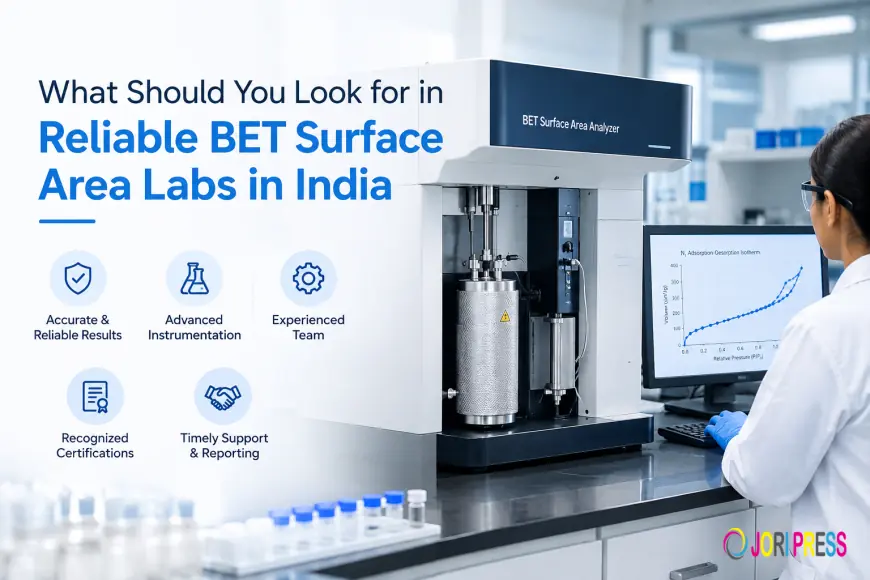
What Should You Look for in Reliable BET Surface Area Labs in India?
Discover what to look for in reliable BET Surface Area Labs in India, including testing accuracy, equipment, sample preparation, and reporting.

When selecting a laboratory for BET surface area analysis, accuracy, consistency, and reliable reporting are important considerations. BET testing is widely used to determine the specific surface area of powders, porous materials, catalysts, adsorbents, ceramics, minerals, pharmaceuticals, and many other materials.
With several testing providers available, choosing the right BET Surface Area Labs in India requires more than simply comparing prices. A reliable laboratory should have appropriate instrumentation, experienced technical personnel, suitable sample preparation procedures, and a strong focus on quality control.
This guide explains the key factors to consider when selecting a BET testing laboratory in India.
What Is BET Surface Area Analysis?
BET, or Brunauer–Emmett–Teller analysis, is a widely used technique for measuring the specific surface area of solid materials. The method generally determines how much gas can be adsorbed onto the surface of a material under controlled conditions.
Nitrogen is commonly used as the adsorbate gas, although other gases may be appropriate depending on the material and application.
The resulting surface-area measurement can provide useful information about material structure, porosity, adsorption behavior, and performance.
Why Is Choosing the Right BET Laboratory Important?
The quality of BET results can be influenced by several factors, including sample preparation, degassing conditions, instrument performance, measurement parameters, and data interpretation.
An experienced testing laboratory can help reduce inconsistencies and provide results that are more useful for research, development, quality control, and material comparison.
For industries and research organizations, selecting a dependable BET Surface Area Labs in India can therefore contribute to better characterization and more informed material-development decisions.
1. Check the Laboratory's BET Testing Experience
Experience should be one of the first factors you evaluate.
A laboratory that regularly performs BET analysis may have experience working with different types of samples, including:
-
Nanomaterials
-
Activated carbon
-
Catalysts
-
Metal oxides
-
Zeolites
-
Ceramics
-
Minerals
-
Powders
-
Pharmaceutical materials
-
Porous materials
-
Carbon-based materials
Ask whether the laboratory has experience analyzing materials similar to yours. Familiarity with different sample types can be useful because sample preparation and testing conditions may need to be adjusted according to material characteristics.
2. Evaluate the BET Instrumentation
The quality and suitability of the analytical instrument are important considerations.
When comparing BET laboratories, ask about the type of surface-area analyzer they use and whether the equipment is suitable for your sample.
Important capabilities may include:
-
Specific surface area measurement
-
Multipoint BET analysis
-
Single-point BET analysis
-
Pore volume analysis
-
Pore size distribution
-
Adsorption and desorption isotherms
-
Micropore analysis, where applicable
The laboratory should also maintain its equipment according to appropriate operating and quality-control procedures.
3. Ask About Sample Preparation and Degassing
Sample preparation is a critical part of BET analysis.
Before measurement, samples are generally subjected to degassing to remove moisture, volatile compounds, and other adsorbed species from the surface. The degassing temperature, time, vacuum or gas conditions, and other parameters can influence the measurement.
A reliable laboratory should have a clearly defined sample-preparation procedure and should consider the thermal stability and characteristics of the material before selecting degassing conditions.
You can ask the laboratory:
-
How is the sample prepared?
-
What degassing conditions are used?
-
How is the sample mass determined?
-
Can the laboratory handle moisture-sensitive materials?
-
Are customized preparation conditions available?
These questions can help you understand how seriously the laboratory approaches testing quality.
4. Check the Laboratory's Quality-Control Practices
Quality control is important when you need reproducible and dependable results.
A professional testing laboratory should have appropriate procedures for instrument verification, calibration or performance checks, data review, and repeat measurements when necessary.
Ask whether the laboratory follows documented testing procedures and quality-control practices.
If your project requires accredited testing, also verify the laboratory's current accreditation scope and whether BET or the specific measurement you require is covered.
5. Look for Experienced Technical Professionals
BET analysis is not simply about operating an instrument. Understanding the sample, selecting appropriate preparation conditions, evaluating adsorption isotherms, and interpreting the results all require technical knowledge.
Experienced laboratory personnel can help identify potential issues such as:
-
Inadequate degassing
-
Insufficient sample quantity
-
Moisture interference
-
Unusual adsorption behavior
-
Poor reproducibility
-
Unsuitable analysis ranges
A laboratory with knowledgeable technical staff can therefore be valuable, particularly for research and development projects.
6. Review the Testing Parameters Offered
Different projects may require different BET-related measurements.
Before selecting a laboratory, determine whether it can provide the parameters you need.
Depending on the instrument and testing method, these may include:
-
BET specific surface area
-
Total pore volume
-
Average pore diameter
-
Adsorption isotherms
-
Desorption isotherms
-
Pore size distribution
-
Micropore-related parameters
Clearly communicate your testing requirements before submitting samples so the laboratory can confirm whether the requested analysis is appropriate.
7. Check the Quality of the Test Report
A useful laboratory report should clearly present the results and relevant testing information.
Depending on your requirements, a BET report may include information such as:
-
Sample identification
-
Sample mass
-
Degassing conditions
-
Analysis conditions
-
BET surface area
-
Adsorption/desorption data
-
Isotherm information
-
Pore-volume results
-
Pore-size information
-
Testing date
-
Method or standard used, where applicable
A clear report makes it easier for researchers, engineers, and quality-control teams to understand and compare results.
8. Consider Testing Turnaround Time
Turnaround time can be important when BET analysis is part of an ongoing research or production schedule.
Before submitting samples, ask the laboratory about:
-
Sample processing time
-
Expected report delivery date
-
Urgent testing availability
-
Number of samples they can process
-
Procedures for handling repeat measurements
However, turnaround time should be considered alongside technical quality rather than as the only selection criterion.
9. Compare Pricing and Included Services
Testing costs can vary depending on the sample type, number of samples, testing parameters, and reporting requirements.
When comparing quotations from BET Surface Area Labs in India, check exactly what is included in the quoted price.
For example, determine whether the price includes:
-
Sample preparation
-
Degassing
-
BET analysis
-
Pore-size analysis
-
Data interpretation
-
Detailed reporting
-
Repeat measurements, if required
A lower initial price may not necessarily represent the best value if important testing or reporting services are excluded.
10. Check Sample Handling and Communication
Good communication can make the testing process much easier.
A reliable laboratory should be able to explain:
-
Required sample quantity
-
Sample packaging requirements
-
Sample condition requirements
-
Testing procedure
-
Expected turnaround time
-
Reporting format
-
Additional information required from the customer
Proper sample handling is also important to prevent contamination, moisture exposure, or other factors that could affect the analysis.
11. Look for Testing Support for Research and Industry
The best laboratory for your project depends on your application.
For example, researchers developing catalysts may require surface area and pore-structure information, while manufacturers may need BET testing for quality control or material comparison.
Look for a laboratory that understands your application and can provide appropriate technical information without unnecessarily complicating the testing process.
12. Consider the Laboratory's Ability to Handle Multiple Samples
If your project involves a large number of samples, laboratory capacity becomes an important consideration.
Ask whether the laboratory can handle:
-
Multiple samples
-
Batch testing
-
Repeat testing
-
Comparative analysis
-
Long-term testing requirements
This is particularly useful for research programs, product development, and quality-control projects where testing may be required regularly.
13. Verify Accreditation When Required
For projects that require formally accredited testing, accreditation can be an important selection criterion.
Check the laboratory's accreditation status and, importantly, its current scope of accreditation. The scope should cover the relevant testing method or measurement required for your project.
Do not rely only on a general statement that a laboratory is accredited. Verify whether the specific service you require is included.
14. Ask About Data Interpretation and Technical Support
BET results can sometimes require additional interpretation, particularly when samples show unusual adsorption behavior or when different materials need to be compared.
A laboratory offering technical support can help you understand the reported parameters and identify potential limitations of the measurement.
For research projects, this can make the testing process more useful than receiving only a single numerical result.
15. Consider Location and Sample Logistics
India has testing laboratories across several major scientific and industrial centers. Depending on your location and sample requirements, logistics can influence the overall testing experience.
Consider:
-
Sample shipping requirements
-
Transportation time
-
Packaging requirements
-
Sample return options
-
Communication with the laboratory
-
Accessibility for repeat testing
For organizations that regularly require BET testing, convenient sample logistics can save time and effort.
Common Mistakes to Avoid When Choosing a BET Laboratory
When selecting a BET testing provider, avoid making the decision based on only one factor.
Some common mistakes include:
Choosing Only on Price
The cheapest testing option may not provide the level of instrumentation, technical support, or reporting required for your project.
Ignoring Sample Preparation
Poorly prepared samples can affect the reliability of surface-area measurements. Always ask about degassing and preparation procedures.
Not Checking the Testing Scope
If accreditation is important to your project, verify the laboratory's specific accreditation scope rather than assuming all services are covered.
Failing to Explain the Material
Provide the laboratory with relevant information about your sample, including its composition, expected properties, moisture sensitivity, and intended application.
Not Comparing Reports
Before selecting a provider for repeated testing, request information about the format and level of detail included in its test reports.
Conclusion
Choosing reliable BET Surface Area Labs in India requires careful consideration of technical capabilities, instrumentation, sample preparation, quality-control practices, personnel experience, reporting, turnaround time, and pricing.
Rather than selecting a laboratory based solely on cost, evaluate whether it can meet the technical and reporting requirements of your specific application. A laboratory with appropriate equipment, experienced professionals, transparent procedures, and suitable testing capabilities can provide more useful results for material characterization and research.
For researchers, manufacturers, academic institutions, and industrial organizations, carefully evaluating BET testing laboratories before submitting samples can help establish a dependable testing workflow and support better material-analysis decisions.
What's Your Reaction?
 Like
0
Like
0
 Dislike
0
Dislike
0
 Love
0
Love
0
 Funny
0
Funny
0
 Angry
0
Angry
0
 Sad
0
Sad
0
 Wow
0
Wow
0