




































What I Learned Scaling a Startup Without a Big Budget
Ashish Somvanshi shares hard-earned lessons on scaling a startup without a big budget — from finding real customers faster to why judgment beats spend, drawn from 17+ years in growth and EdTech.
I've never had the luxury of a big marketing budget. Not in my first job, not when I was building growth systems for education brands, and not when I started Connective9 or Campuswalkin. Every dollar had to justify itself before I spent the next one.
Looking back over 17+ years, the constraint turned out to be the best teacher I've had. Here's what it actually taught me.
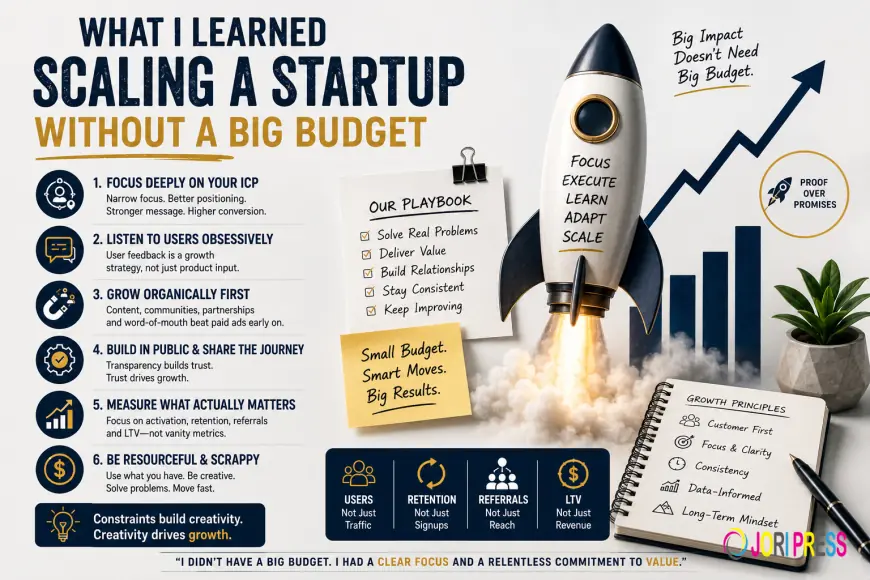
1. Budget constraints force you to find your real customer faster
When you can't afford to test five audiences at once, you're forced to think hard about who you're actually building for before you spend a rupee. I've watched well-funded competitors run broad campaigns across every possible segment, burn through six-figure budgets, and only then discover which segment converts. I never had that option — so I had to get the targeting right on paper first, using research and conversations, not ad spend.
That discipline stuck. Even now, with more resources available, I still start every campaign by narrowing the audience on paper before I narrow it with a media budget.
2. Organic channels teach you what paid channels hide
Paid ads can make a mediocre message look like it's working — for a while. Organic growth can't hide anything. If content, referrals, or word-of-mouth aren't moving the needle, you find out immediately, because there's no budget cushioning the failure.
Early on, this pushed me hard into content, community, and direct outreach. It was slower. But it also meant every lesson about what messaging actually resonated was learned cheaply, instead of learned expensively through a burned ad budget.
3. Retention becomes your growth engine, not an afterthought
With a big budget, it's tempting to treat retention as something you'll "get to" once acquisition is humming. Without one, you can't afford to. Every customer who churns is a customer you can't easily afford to replace. This forced me to obsess over onboarding, follow-up, and the actual product experience far earlier than most funded competitors do — and it consistently paid off in referrals that no ad budget could buy.
4. Partnerships do the work that ad spend can't
Some of the fastest growth I've seen — including in the admissions and EdTech space through Campuswalkin — came not from ad spend but from the right partnerships: institutions, communities, and platforms that already had trust with the exact audience I needed. A single well-chosen partnership can outperform months of paid acquisition, and it costs relationships and effort, not cash.
5. Data discipline matters more when you can't afford to guess wrong
When you have a large budget, a bad week of spend is a rounding error. When you don't, a bad week can set you back a month. This made me far more disciplined about tracking the metrics that actually predict growth — CAC trends, retention cohorts, funnel drop-off points — rather than vanity numbers that look good in a report but don't move the business.
The Honest Takeaway
A big budget can buy you speed. It cannot buy you judgment. The founders and teams I've seen build the most durable growth are the ones who developed sharp judgment first, often because they had no choice, and then applied that judgment once resources came. The ones who scale budget before they scale judgment tend to just lose money faster.
If you're building something today without a big budget behind you, don't treat it purely as a disadvantage. Treat it as the fastest way to learn what actually works — because you won't have the cushion to learn it any other way.
I write about growth systems, marketing, and the intersection of education and technology. More at ashishsinghsomvanshi.com.
What's Your Reaction?
 Like
0
Like
0
 Dislike
0
Dislike
0
 Love
0
Love
0
 Funny
0
Funny
0
 Angry
0
Angry
0
 Sad
0
Sad
0
 Wow
0
Wow
0