






































WeAlwin Highlights Emerging EV Charging Business Opportunities as the EV Market Moves Toward Smart, Connected Infrastructure in 2026
EV charging platform development

Madurai, India
September 19, 2026
As electric vehicle adoption continues to reshape transportation and energy infrastructure, the EV charging industry is entering a new phase of opportunity in 2026. WeAlwin Technologies has released a new industry-focused analysis exploring the evolving EV charging business opportunities and the technologies shaping the next generation of electric mobility.
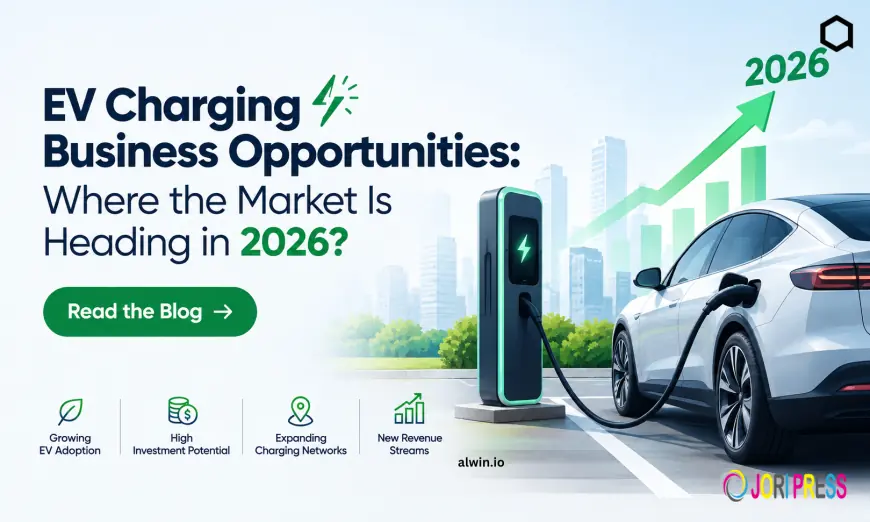
The new insight, titled “EV Charging Business Opportunities: Where the Market Is Heading in 2026?”, examines how businesses can move beyond traditional charging stations and explore emerging opportunities across charging networks, fleet infrastructure, smart charging, software platforms, charging-as-a-service, and blockchain-enabled asset models.
The global charging ecosystem is expanding alongside EV adoption. According to the International Energy Agency’s Global EV Outlook 2026, more than 43 million private light-duty EV charging points were estimated globally in 2025, while public charging capacity is expected to grow substantially through 2035 as EV adoption increases.
From Charging Stations to Complete EV Ecosystems
The EV charging market is increasingly moving beyond the simple installation of charging hardware. Businesses are exploring integrated models that connect charging infrastructure, software, energy management, fleet operations, payments, and customer experiences.
WeAlwin’s analysis identifies several areas that businesses can explore in 2026, including:
-
Public EV Charging Networks for high-traffic locations and recurring charging revenue
-
Fleet Charging Solutions for taxis, logistics, delivery, rental, and commercial EV fleets
-
Workplace and Destination Charging across offices, hotels, restaurants, malls, and commercial properties
-
Smart Charging and Energy Management to optimize charging based on electricity prices, grid demand, vehicle requirements, and availability
-
EV Charging Software Platforms for payments, charger monitoring, billing, analytics, and remote operations
-
Charging-as-a-Service combining hardware, installation, software, maintenance, and operations
-
Subscription-Based Charging for regular EV users and commercial fleets
The shift toward software-enabled infrastructure is becoming increasingly important as operators focus not only on expanding charger networks but also on utilization, reliability, energy costs, and long-term operational sustainability. Recent industry analysis has highlighted utilization, grid capacity, optimization, and strategic partnerships as key themes in the maturing EV charging market.
India Presents a Growing Infrastructure Opportunity
India is also seeing rapid expansion in EV charging infrastructure. The Institute for Energy Economics and Financial Analysis reported that India’s public charging network grew from 5,151 stations in 2022 to 52,718 by July 2026, while annual EV sales reached around 2.5 million in FY2025–26.
At the same time, the market continues to face challenges involving utilization, electricity costs, grid upgrades, charger reliability, site selection, and regulatory requirements. These challenges highlight the need for businesses to consider the complete economics and technology stack behind charging infrastructure rather than focusing solely on charger deployment.
Blockchain Opens Another Layer of Possibilities
Another emerging area discussed by WeAlwin is EV vehicle tokenization.
Through appropriate legal and regulatory structures, blockchain technology can potentially represent specific ownership rights, economic interests, or other rights connected to real-world EV assets through digital tokens.
For example, an EV fleet operator could potentially combine EV assets, charging infrastructure, energy operations, software, and blockchain-based asset structures to create new models around financing, participation, or asset management.
However, tokenization does not automatically represent legal ownership of a physical vehicle. The rights attached to any token depend on the underlying legal agreement, asset structure, jurisdiction, custody arrangements, and applicable regulations.
The Road Ahead for EV Charging Businesses
The next stage of the EV charging market is expected to be increasingly connected. Rather than operating standalone charging stations, businesses
For more details,Contact us >> 9500766429
What's Your Reaction?
 Like
0
Like
0
 Dislike
0
Dislike
0
 Love
0
Love
0
 Funny
0
Funny
0
 Angry
0
Angry
0
 Sad
0
Sad
0
 Wow
0
Wow
0