








































Understanding the Architecture of Modern Vaping Technology
Explore how modern vape devices are engineered. Learn about dual-mesh coils, leak-resistant tanks, real-time screen displays, and dynamic power management.

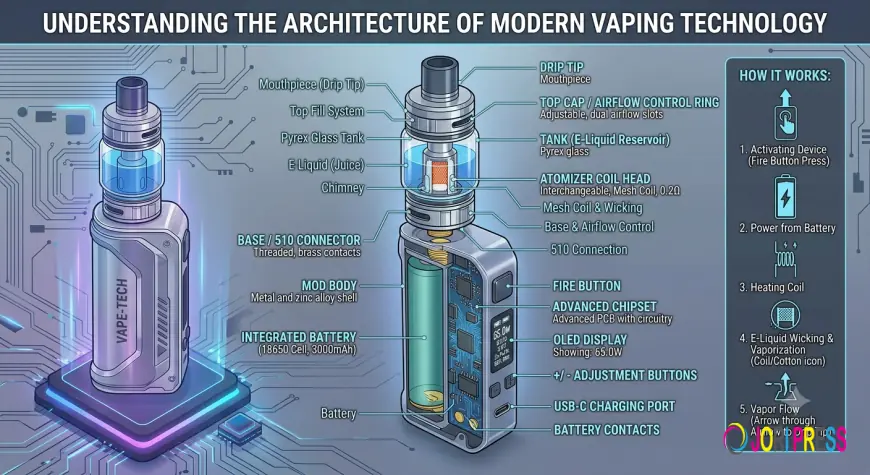
Vaping technology has shifted away from basic cylindrical designs. Early e-cigarettes focused strictly on mimicking traditional formats, but modern vape hardware relies on precision engineering, clear user feedback systems, and stable power management.
The transition to high-capacity formats requires careful structural planning. Modern devices balance physical size with internal component density, fitting larger batteries, screen interfaces, and increased e-liquid volumes into compact, pocketable hardware.
1. Advanced Airflow and Heating Systems
At the core of any hardware design is the heating element and airflow path. Modern hardware relies heavily on mesh coil structures rather than standard wound wire. Mesh provides a wider surface area, heating e-liquid evenly across the cotton wick to prevent harsh dry hits and preserve flavor profiles.
Airflow design dictates the user experience. Manufacturers build internal air channels with specific resistance profiles, allowing users to switch between a tight Mouth-To-Lung (MTL) draw and a smoother Restricted Direct Lung (RDL) hit. Adjustable mechanical sliders at the base of the frame allow precise control over air intake without compromising structural tightness or leaking fluid.
2. Dynamic Power Management and Mode Switching
Hardware stability depends on consistent voltage output. As a battery drains, unregulated devices output less power, leading to weak vapor production toward the end of a charge cycle. Modern designs solve this with regulated chipsets that maintain fixed wattage or offer switchable performance modes.
Power delivery typically breaks down into two core operational states:
-
Standard Mode: Uses a single coil or lower wattage setting to preserve battery life and liquid capacity.
-
Boost or Turbo Mode: Engages dual-mesh coils simultaneously, increasing wattage to deliver warmer vapor, denser clouds, and a stronger throat hit.
Power management relies on rechargeable internal lithium-ion batteries. USB-C charging ports are standard, providing faster recovery times and pass-through protection so the internal cell remains safe while power is drawn.
3. Liquid Isolation and Leak Prevention
Maintaining liquid stability inside high-capacity devices requires dedicated internal architecture. Storing 16mL to 20mL of liquid near sensitive electronics presents clear engineering challenges. Unsealed chambers risk leaking liquid directly into air paths or battery housings, causing failure.
Modern manufacturing addresses liquid isolation using clear structural steps:
-
Isolated Liquid Reservoirs: Transparent crystal tanks keep the bulk liquid supply visible while separating it from internal electrical points.
-
Separated Storage Wicks: Devices use internal storage cotton pre-saturated with a fixed portion of liquid (e.g., 4mL) alongside an isolated main reservoir (e.g., 16mL).
-
Mechanical Seal Engagement: Pushing or snapping the main tank into the base breaks an internal seal, feeding liquid directly to the coil system only when ready for active use.
-
Precision O-Rings: High-grade silicone seals prevent air pressure changes from driving liquid out of the mouthpiece.
4. Real-Time Display Interfaces and Control Ergonomics
User interfaces on hardware have evolved from single LED indicator lights to full-color 3D curved screens. Modern displays show key operational metrics in real time:
-
Exact Battery Percentage: Shows current charge status without guessing games.
-
E-Liquid Level Monitoring: Displays remaining capacity visually alongside transparent tank sections.
-
Active Mode Display: Indicates whether the device is set to standard output or maximum power.
Display circuits also feature customizable lighting modes. Users who want a discreet device can turn off external LED animations while keeping essential battery readings active. Exterior designs use matte or fingerprint-resistant glossy coatings with smooth, rounded corners, making large-capacity hardware comfortable to hold during daily use.
Evaluating High-Capacity Hardware Architecture
High-capacity designs bring several core components together into one cohesive unit. Devices built around these engineering principles, such as high-capacity Nexa Vape hardware, balance large liquid supplies with practical daily ergonomics.
An example of this modern layout is the Nexa Ultra II 50K, which integrates a 900mAh quick-charge battery, a 20mL total liquid layout (16mL transparent tank with a 4mL storage core), dual mesh 1.0-ohm coils, and a recessed airflow adjustment slider at the base. The internal chipset lets users alternate between a 50,000-puff standard output mode and a 30,000-puff boost mode while monitoring power on a curved 3D display.
When looking for options like a Nexa Vape Near Me, understanding these design details helps you evaluate device build quality, airflow adjustments, and battery specs before choosing your next setup. Hardware design continues to focus on leak control, consistent power output, and simple user interfaces.
What's Your Reaction?
 Like
0
Like
0
 Dislike
0
Dislike
0
 Love
0
Love
0
 Funny
0
Funny
0
 Angry
0
Angry
0
 Sad
0
Sad
0
 Wow
0
Wow
0