





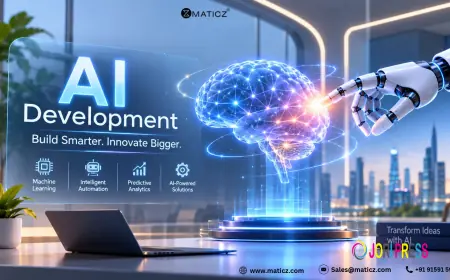


































Turning Business Data into Intelligence Through AI Development
This article explores how AI development transforms raw business data into valuable insights through machine learning, predictive analytics, natural language processing, and generative AI. Discover how businesses can improve decision-making, automate data analysis, and build smarter operations using intelligent AI-powered solutions.

Every business generates data through customer interactions, sales activities, website traffic, transactions, and daily operations. However, collecting large amounts of information does not automatically lead to better business decisions. Organizations need effective ways to understand this data, identify useful patterns, and turn findings into practical actions.
This is where Artificial Intelligence (AI) plays an important role. AI technologies help businesses process large datasets, recognize trends, predict possible outcomes, and improve decision-making. With the right AI development approach, raw business information can become a valuable resource for improving operations and planning future strategies.
1. Understanding the Value of Business Data
Business data contains useful information about customer behavior, market activities, operational performance, and financial transactions. Traditional data analysis methods often require significant manual effort, especially when organizations handle information from multiple sources.
AI-powered systems can process different types of data and identify patterns that may not be easy to recognize through manual analysis.
For example, an e-commerce business can analyze customer browsing history, purchase records, and product preferences to understand buying behavior. These insights can help businesses improve product recommendations, marketing campaigns, and customer experiences.
2. Machine Learning for Smarter Data Analysis
Machine Learning (ML) is one of the key technologies used to transform business data into meaningful insights. It enables computer systems to learn from historical information and identify patterns without requiring developers to define every possible outcome.
Businesses can use machine learning models for sales forecasting, customer segmentation, fraud detection, and demand prediction.
For instance, a retail company can analyze previous sales records, seasonal trends, and customer activity to estimate future product demand. This information can support inventory planning and reduce unnecessary stock management costs.
As more relevant data becomes available, machine learning models can be evaluated and updated to maintain their usefulness.
3. Predictive Analytics for Business Planning
Predictive analytics uses historical data, statistical methods, and machine learning techniques to estimate possible future outcomes.
Instead of depending entirely on past reports, businesses can use predictive models to explore what might happen under different conditions.
Some common applications include:
-
Sales Forecasting: Estimating future sales based on historical performance and market trends.
-
Customer Churn Prediction: Identifying customers who may stop using a service.
-
Risk Assessment: Evaluating patterns that may indicate potential business risks.
-
Demand Planning: Predicting product or service demand.
-
Financial Analysis: Supporting the evaluation of financial trends and spending patterns.
These insights help decision-makers prepare for different business situations and develop more informed strategies.
4. Natural Language Processing for Unstructured Data
Not all business information is available in organized spreadsheets or databases. Customer reviews, emails, support conversations, feedback forms, and documents contain valuable information in text format.
Natural Language Processing (NLP) helps AI systems understand, classify, and analyze human language.
For example, businesses can use sentiment analysis to identify customer opinions from online reviews. AI-powered text analysis can also organize support requests, summarize long documents, and identify frequently discussed topics.
By processing unstructured information, organizations can gain a better understanding of customer expectations and common operational challenges.
5. Generative AI for Business Intelligence
Generative AI is introducing new ways for businesses to interact with their data. Instead of manually searching through multiple reports, employees can use AI-powered assistants to ask questions and receive relevant summaries.
For example, a business manager could ask an AI assistant to summarize monthly sales performance or highlight major changes in customer activity.
Large Language Models (LLMs) can support these experiences by understanding natural language instructions and generating contextual responses. When connected to authorized business data sources, they can help users access information more easily.
However, businesses should implement appropriate access controls, data protection measures, and response validation to reduce the risk of inaccurate or unauthorized information.
6. Integrating AI with Existing Business Systems
AI solutions deliver greater value when they work with existing business applications. Organizations may need to connect AI models with CRM platforms, ERP systems, databases, customer support tools, and analytics dashboards.
API integration helps different applications exchange information and share relevant data.
For example, an AI-powered CRM system can analyze customer interactions and provide insights that help sales teams understand customer requirements. Similarly, an intelligent reporting application can collect information from multiple business systems and generate consolidated reports.
A well-planned integration approach improves data accessibility and supports smoother business operations.
7. Important Considerations in AI Development
Building an effective AI solution requires careful planning and technical evaluation. Businesses should consider several factors before implementing AI technologies.
-
Data Quality: Reliable and well-organized data is important for producing useful results.
-
Data Security: Sensitive business information must be protected through suitable security measures.
-
Scalability: AI infrastructure should support increasing data volumes and user requirements.
-
Model Accuracy: Models should be tested and evaluated regularly.
-
System Integration: AI applications should work smoothly with existing business tools.
-
Continuous Monitoring: Performance should be tracked to identify errors and areas for improvement.
These considerations help businesses develop AI applications that are reliable and suitable for long-term use.
8. Choosing the Right AI Development Partner
Turning business data into intelligence requires knowledge of data engineering, machine learning, AI model development, and software integration. Choosing the right technology partner can make the development process more structured and effective.
An experienced AI development company can help businesses understand their requirements, select suitable technologies, build custom AI applications, and integrate intelligent features into existing systems.
At Maticz, the focus is on developing AI-powered solutions that address practical business requirements. From intelligent automation and machine learning integration to custom AI application development, the goal is to help businesses explore useful applications of artificial intelligence.
Conclusion
Business data becomes more valuable when organizations can understand it and use it effectively. AI technologies such as machine learning, predictive analytics, natural language processing, and generative AI help businesses discover patterns, analyze information, and support better decisions.
Turning raw data into business intelligence is not a one-time activity. It requires quality data, suitable technology, secure infrastructure, and continuous improvement. With the right AI development strategy, businesses can transform information into actionable insights and build a stronger foundation for future growth.
What's Your Reaction?
 Like
0
 Dislike
0
 Love
0
 Funny
0
 Angry
0
 Sad
0
 Wow
0