





































TFT Modules: A Complete Guide to Modern Display Solutions
Discover TFT Modules and explore their features, benefits, applications, and role in modern display solutions for industrial and commercial devices.

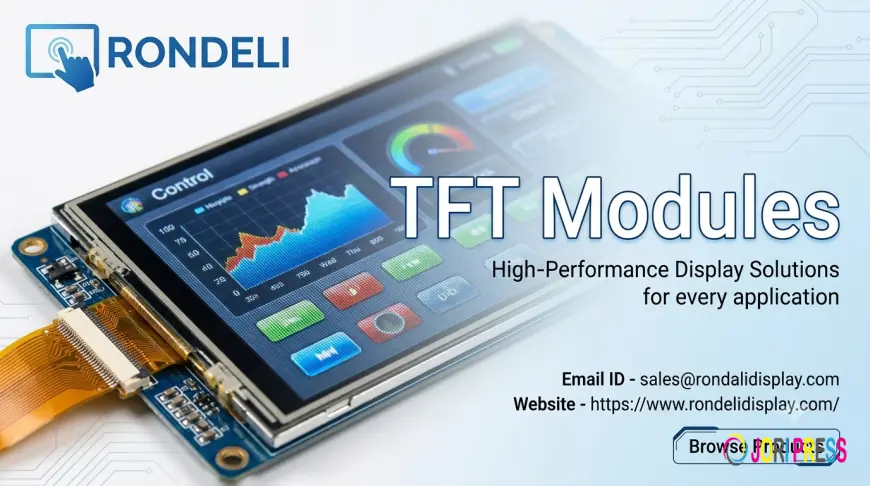
TFT Modules have become an essential part of modern electronic equipment, providing clear visuals, responsive interfaces, and reliable performance across a wide range of applications. From industrial control systems and medical instruments to automotive equipment and smart devices, these display solutions help manufacturers create interfaces that are easier to read and operate. RondeliDisplay focuses on practical display solutions designed to meet different application requirements, including size, resolution, viewing angle, brightness, interface compatibility, and touch functionality. Understanding how TFT technology works and what to consider when selecting a module can help product designers make better decisions and achieve consistent display performance.
What Are TFT Modules?
TFT stands for Thin-Film Transistor. A TFT display uses individual transistors to control pixels on an LCD panel, allowing each pixel to receive precise electrical signals. This active-matrix technology provides faster response, sharper images, and better control over brightness and color compared with traditional passive-matrix displays. Modern TFT Modules can support different screen sizes, resolutions, aspect ratios, interfaces, and backlight configurations. Depending on the application, a module may include the LCD panel, driver IC, backlight, connector, and other components needed for integration into an electronic product.
Key Features of TFT Display Technology
The performance of a TFT display depends on several technical characteristics. Manufacturers should evaluate these specifications according to the intended operating environment rather than selecting a screen based only on its physical size.
Important features include:
-
High-resolution image reproduction
-
Wide range of screen sizes
-
Fast pixel response
-
Consistent brightness
-
Improved color reproduction
-
Multiple communication interfaces
-
Compact module construction
-
Optional touch functionality
-
Different viewing-angle configurations
-
Customizable mechanical and electrical designs
These characteristics make TFT technology suitable for products that require both visual clarity and dependable operation.
Why Choose TFT Modules for Electronic Products?
One of the main advantages of TFT Modules is their versatility. Engineers can select a suitable display configuration according to the product's available space, user interface requirements, power limitations, and environmental conditions. A compact TFT screen may be appropriate for handheld equipment, while larger formats can provide a more convenient interface for industrial control panels.
Another advantage is visual consistency. TFT technology can deliver detailed graphics, icons, menus, charts, and other visual information, making it suitable for sophisticated user interfaces. When combined with a touch panel, the display can become an interactive control surface.
Factors That Influence Display Performance
Before choosing a module, product developers should consider:
-
Resolution: Higher resolution can provide sharper text, graphics, and images.
-
Brightness: Brightness should match the ambient lighting conditions where the product will operate.
-
Viewing angle: A wider viewing angle is useful when users may view the screen from different positions.
-
Interface: The display interface must be compatible with the host controller or processor.
-
Operating temperature: Industrial and outdoor products may require displays designed for wider temperature ranges.
-
Backlight: LED backlighting is widely used because it offers efficient and consistent illumination.
-
Touch requirements: Applications requiring direct user interaction may benefit from resistive or capacitive touch technology.
Common Applications of TFT Modules
TFT technology is used across numerous industries because it provides an effective combination of image quality, flexibility, and integration options.
Industrial Equipment
Industrial machines often need displays that can present operating parameters, alerts, measurements, and control menus. TFT Modules can provide a graphical interface that makes complex machine information easier for operators to understand.
Medical Devices
Medical equipment requires clear and readable information. TFT displays can be integrated into monitoring systems, diagnostic instruments, portable medical equipment, and laboratory devices where accurate visual presentation is important.
Automotive Electronics
Vehicle electronics increasingly depend on graphical displays for navigation, monitoring, entertainment, and control functions. TFT technology supports interfaces that can present multiple types of information within a compact space.
Consumer and Smart Devices
Home automation equipment, measurement instruments, smart appliances, and other electronic products can use TFT displays to create intuitive user interfaces. Their ability to display graphics and text makes them suitable for products that require more than simple numerical indicators.
TFT Modules vs. Traditional Display Technologies
Choosing the correct display technology requires understanding the differences between available options. The following comparison provides a general overview.
|
Feature |
TFT Modules |
Monochrome Displays |
Basic Segment Displays |
|
Color capability |
Excellent |
Limited |
Very limited |
|
Graphics |
Supported |
Limited |
Not suitable |
|
Resolution options |
Wide range |
Moderate |
Low |
|
User interface |
Advanced |
Basic |
Very basic |
|
Touch integration |
Available |
Limited |
Generally unavailable |
|
Application flexibility |
High |
Moderate |
Low |
|
Visual presentation |
Detailed |
Simple |
Numeric/character focused |
For products that require graphical interfaces, images, multiple colors, or interactive menus, TFT technology generally provides greater design flexibility.
How to Select the Right TFT Module
Selecting a display should be treated as part of the overall product design process. A technically suitable screen must also fit the mechanical enclosure, electrical architecture, and expected user environment.
Step-by-Step Selection Process
Step 1: Define the screen size. Determine the available installation area and the viewing distance.
Step 2: Establish the required resolution. Consider the amount of information that needs to be displayed and the desired image sharpness.
Step 3: Check the interface. Confirm that the module's interface is compatible with the processor, controller, or development platform.
Step 4: Evaluate brightness and viewing angle. Outdoor or brightly illuminated environments may require higher brightness, while shared viewing positions can benefit from wider viewing angles.
Step 5: Consider environmental conditions. Temperature, humidity, vibration, and continuous operating requirements can affect display selection.
Step 6: Determine touch requirements. If the product requires direct interaction, select an appropriate touch technology and ensure that it works with the display and controller.
Step 7: Review customization possibilities. For specialized products, consider custom dimensions, connectors, mounting structures, backlight specifications, or other design requirements.
The Role of Customization in TFT Display Design
Standard displays are suitable for many applications, but some products require a more specialized solution. A customized TFT module can be developed around specific mechanical dimensions, electrical interfaces, brightness requirements, or installation conditions.
Customization can be especially useful when an existing enclosure has limited space or when the display needs to match a particular industrial design. Working with an experienced display manufacturer can also help engineers address integration challenges earlier in the development process.
Why Work With RondeliDisplay?
RondeliDisplay provides display solutions for manufacturers and product developers looking for practical options for different electronic applications. Instead of evaluating a display only by screen size or resolution, customers can consider the complete set of requirements, including interface, brightness, touch integration, mechanical dimensions, and operating environment.
A reliable display partner can help simplify the selection process and reduce potential compatibility issues during product development. For OEM and custom projects, technical communication is particularly important because display performance depends on the relationship between the module, controller, enclosure, and application environment.
Future Trends in TFT Display Technology
Display technology continues to evolve as electronic products become more connected and user-focused. Future developments are likely to emphasize improved image quality, thinner construction, lower power consumption, stronger touch integration, and better visibility in demanding environments.
Industrial equipment is also moving toward more graphical interfaces, replacing simple indicators with detailed dashboards and interactive controls. This trend increases the importance of displays that can deliver reliable visual information while fitting into compact product designs.
Frequently Asked Questions About TFT Modules
1. What are TFT Modules used for?
TFT Modules are used to provide graphical visual interfaces in industrial equipment, medical devices, automotive systems, smart appliances, instruments, and many other electronic products.
2. What does TFT mean?
TFT means Thin-Film Transistor. It is an active-matrix technology that uses individual transistors to control pixels on an LCD panel.
3. Are TFT displays available in different sizes?
Yes. TFT displays are available in a wide range of sizes and aspect ratios, allowing manufacturers to select a format suitable for their product design.
4. Can TFT Modules display color?
Yes. Color TFT displays can reproduce detailed graphics, text, icons, photographs, and other visual content.
5. Can a TFT display support touch?
Many TFT displays can be combined with touch panels. Capacitive and resistive touch technologies are commonly used depending on the application's requirements.
6. How do I select the correct TFT display?
Consider screen size, resolution, brightness, viewing angle, interface, operating temperature, power requirements, touch functionality, and mechanical dimensions before making a selection.
7. Are TFT Modules suitable for industrial equipment?
Yes. TFT technology is widely used in industrial control systems, measurement equipment, automation interfaces, and machine displays.
8. Can TFT displays be customized?
Depending on the manufacturer and project requirements, customization may be possible for dimensions, connectors, mounting structures, backlights, interfaces, and other specifications.
9. Why is display brightness important?
Brightness determines how easily information can be seen under different lighting conditions. Applications exposed to strong ambient light may require a higher-brightness display.
10. What is the advantage of using TFT technology?
TFT technology offers good image quality, graphical capability, fast response, multiple size options, and broad application flexibility, making it suitable for modern electronic interfaces.
What's Your Reaction?
 Like
0
Like
0
 Dislike
0
Dislike
0
 Love
0
Love
0
 Funny
0
Funny
0
 Angry
0
Angry
0
 Sad
0
Sad
0
 Wow
0
Wow
0