

































Student Information Systems (SIS): A Complete Guide to Modern Education Management
Discover how Student Information Systems (SIS) simplify school management, improve data accuracy, and enhance communication in modern education.
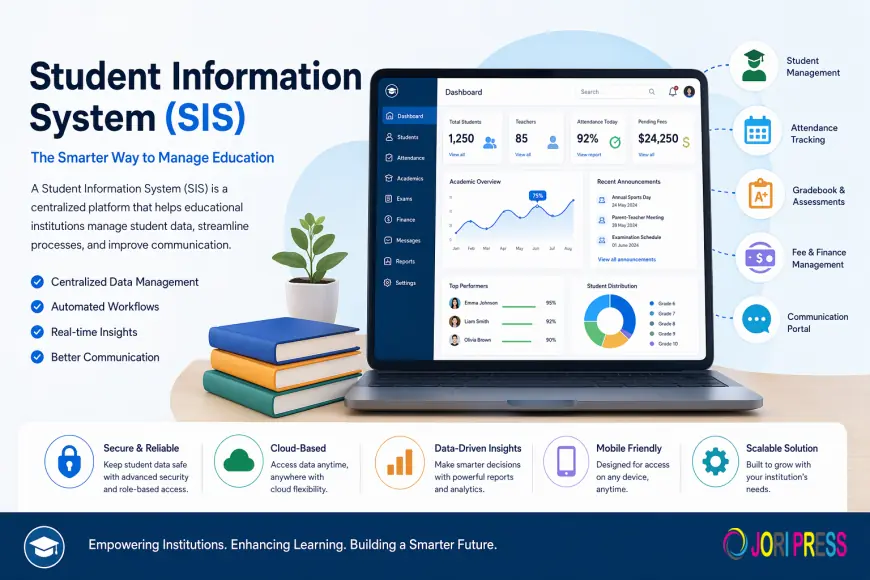
The education sector is undergoing a rapid digital transformation. Institutions are no longer relying on fragmented tools or manual processes to manage student data. Instead, they are adopting integrated systems that bring efficiency, accuracy, and scalability to their operations.
At the center of this transformation is the Student Information System (SIS)—a powerful platform designed to streamline academic and administrative processes.
For a deeper breakdown of how SIS platforms function in real-world scenarios, you can explore this comprehensive guide:
Understanding Student Information Systems
A Student Information System (SIS) is a centralized software solution that enables educational institutions to collect, store, manage, and analyze student data throughout the entire academic lifecycle.
From admissions and enrollment to grading and graduation, an SIS acts as the backbone of institutional data management. It eliminates the inefficiencies of disconnected systems by creating a single source of truth accessible to administrators, educators, students, and parents.
The Evolution of SIS in Education
Traditionally, schools relied on paper records and spreadsheets to manage student information. These methods were not only time-consuming but also prone to errors and data loss.
Modern SIS platforms have evolved into sophisticated, cloud-based ecosystems that offer:
Real-time data synchronization
Automation of repetitive tasks
Advanced reporting and analytics
Seamless integrations with other educational tools
This evolution reflects the growing need for institutions to operate more like data-driven organizations.
Core Functions of a Student Information System
A robust SIS goes beyond simple data storage. It serves as a comprehensive management system with multiple integrated functions:
1. Admissions and Enrollment Management
SIS platforms streamline the admissions process by managing applications, tracking applicant data, and automating enrollment workflows.
2. Student Records Management
Institutions can maintain detailed student profiles, including personal information, academic history, and performance records—all in one place.
3. Attendance and Behavior Tracking
Automated attendance tracking ensures accuracy while providing insights into student engagement and participation.
4. Academic Performance and Grading
Teachers can manage gradebooks, assessments, and report cards efficiently, with real-time updates available to students and parents.
5. Scheduling and Timetable Management
An SIS simplifies complex scheduling by aligning class availability, teacher assignments, and student preferences.
6. Communication and Collaboration
Built-in communication tools facilitate interaction between educators, students, and families, improving transparency and engagement.
7. Financial and Administrative Operations
Many SIS platforms include modules for fee management, billing, and financial reporting, reducing administrative overhead.
Key Benefits of Implementing an SIS
Improved Operational Efficiency
Automation of routine tasks allows staff to focus on higher-value activities, reducing administrative burden.
Centralized and Accurate Data
By consolidating data into a single system, institutions minimize duplication and errors while ensuring consistency.
Enhanced Decision-Making
With access to real-time analytics and reports, administrators can make informed decisions based on actionable insights.
Better Student Engagement
Students benefit from easy access to schedules, grades, and academic resources, fostering greater accountability and involvement.
Stronger Communication Channels
An SIS bridges communication gaps by providing a unified platform for updates, notifications, and collaboration.
Scalability for Growing Institutions
Whether managing hundreds or thousands of students, SIS platforms are designed to scale with institutional growth.
SIS vs. LMS: Understanding the Difference
While often used together, a Student Information System (SIS) and a Learning Management System (LMS) serve distinct purposes:
SIS focuses on administrative and operational management
LMS focuses on delivering and managing educational content
An SIS manages who the students are, while an LMS manages how they learn. Together, they form a complete digital education ecosystem.
Challenges in SIS Implementation
Despite its advantages, implementing an SIS comes with certain challenges:
Initial setup complexity: Migrating legacy data can be time-intensive
User adoption: Staff training is essential for successful implementation
Integration requirements: Ensuring compatibility with existing tools
Data security concerns: Protecting sensitive student information
However, with proper planning and the right vendor, these challenges can be effectively managed.
The Future of Student Information Systems
The future of SIS platforms is being shaped by emerging technologies such as:
Artificial Intelligence (AI) for predictive analytics and personalized learning insights
Cloud computing for improved accessibility and scalability
Mobile-first platforms for on-the-go access
Data analytics for performance tracking and institutional planning
As these technologies continue to evolve, SIS platforms will play an even more critical role in shaping modern education.
Conclusion
A Student Information System is no longer just a convenience—it is a necessity for educational institutions aiming to stay competitive in a digital-first world.
By centralizing data, automating workflows, and enhancing communication, SIS platforms empower institutions to operate more efficiently and deliver better educational outcomes.
For institutions exploring SIS solutions or seeking to understand their full potential, resources like
offer valuable insights into how these systems are transforming education.
What's Your Reaction?
 Like
0
Like
0
 Dislike
0
Dislike
0
 Love
0
Love
0
 Funny
0
Funny
0
 Angry
0
Angry
0
 Sad
0
Sad
0
 Wow
0
Wow
0