








































The Science Behind Drilling Fixtures: How They Improve Speed and Consistency

How a bit of tooling can make a big difference
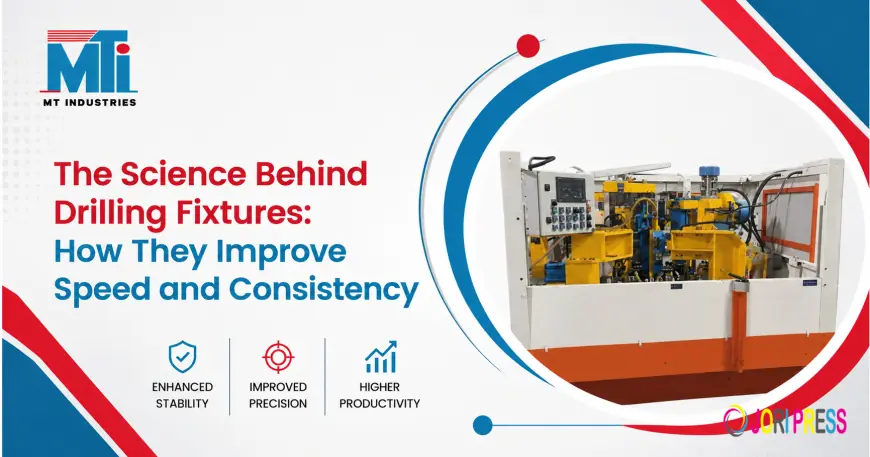
If you ask a machinist what really makes a drilling job go smoothly, most won't say drill bit. They'll say the fixture. It’s the unglamorous side of the setup no one shoots for the brochure but that quietly determines whether your hole comes out straight, your cycle time stays tight and your rejection rate stays low. A good Industrial Fixtures Manufacturer knows this more than anyone, because fixtures are not only clamps that hold a part still. They are precision tools that do half the work of accuracy before the drill bit even touches metal.
The Physics No One Talks about on the Shop Floor
And this is where people get surprised. Drilling isn’t just a push downwards. The second your bit touches, there's side force, vibration and heat all working against your part. If a part moves even a little in that process, your hole will be off-angle, too big, or misaligned. Multiply that over a thousand pieces and you have a real quality issue, not just an annoying outlier.
Drilling Fixtures are built to fight that physics. They lock a component in one precise position and soak up vibration and lateral stress that would otherwise be transferred directly into your part. With the right fixture design, the difference between a wobbly first attempt and a nice, repeatable hole pattern is almost entirely in how well the part is held, not in how skilled the operator happens to be that day.
Speed comes from no hesitation
Speed on a production line rarely comes from working faster in the literal sense. It comes from removing the small hesitations that eat up time without anyone noticing. An operator manually aligning a part, double-checking it, adjusting it again – those are seconds lost per piece that turn into hours lost per shift. A properly designed fixture removes that hesitation completely. The part goes in, it locks into the only position it can physically sit in, and the operator moves straight to drilling. No second-guessing required.
Tapping Fixtures work on the same logic but solve a slightly different headache. Tapping is far less forgiving than drilling because thread quality depends on the tap entering at exactly the right angle, every single time. A fixture built specifically for tapping operations keeps that angle locked regardless of operator fatigue, which matters a lot more on hour seven of a shift than on hour one.
Why Generic Fixtures Eventually Fail You
A lot of SMEs start out using generic clamps or makeshift jigs because they seem cheaper upfront. The problem shows up later, usually when production volume increases or a new component variant gets introduced. Generic setups simply weren't built around your part's geometry, so they compromise somewhere, whether that's clamping pressure, alignment, or repeatability.
This is where Custom Work Holding Fixtures change the equation entirely. Built around the exact dimensions and tolerances of your component, they hold a part the same way every time, which is the entire foundation of consistent drilling and tapping output. Pair that with proper Industrial Clamping Fixtures, and you've eliminated most of the variables that cause inconsistent results on a manual or semi-automatic line.
Where SPM Fixtures Fit Into The Bigger Picture
If you're running an SPM, fixture design matters even more because the machine is only as accurate as the fixture feeding it. SPM Machine Fixtures need to integrate with the machine's cycle time, locating pins, and clamping sequence without adding unnecessary seconds to each cycle. Get that integration wrong and you've basically built a fast machine that produces inconsistent parts, which defeats the entire purpose of investing in an SPM to begin with.
The Real Takeaway
Precision Machining Fixtures don't get the attention they deserve, mostly because they work quietly in the background while drills and machines get all the credit. But speed and consistency on any assembly or machining line trace back to fixture design more often than people realise. MT Industries has spent decades building fixtures around real component geometries rather than generic templates, working closely with manufacturers who needed their drilling and tapping operations to actually hold tolerance, shift after shift. Sometimes the biggest productivity gain on a line isn't a new machine at all. It's getting the fixture right.
What's Your Reaction?
 Like
0
Like
0
 Dislike
0
Dislike
0
 Love
0
Love
0
 Funny
0
Funny
0
 Angry
0
Angry
0
 Sad
0
Sad
0
 Wow
0
Wow
0