





































What Happens When a Restaurant Automates Its Shawarma Station?
Restaurant automation is changing how shawarma kitchens handle repetitive tasks. Learn how automated slicing and grill positioning can support kitchen workflow, improve portion consistency, and help restaurants manage busy service.
During a busy dinner service, a shawarma station has several jobs to handle at once. The meat needs to cook evenly, the outer layer must be sliced at the right time, and orders must keep moving. When customers arrive all at once, even an experienced kitchen team can feel the pressure.
Restaurant automation offers one way to manage these repetitive tasks. But what actually changes when a shawarma station uses automated equipment? The answer goes beyond speed. It also involves cooking consistency, staff responsibilities, food safety, and the daily demands of running a restaurant.
How Automation Changes Shawarma Preparation
Traditional shawarma preparation requires careful attention. Staff must monitor the meat, adjust its position near the heat source, and slice the cooked outer layer without cutting into the raw interior.
Automated equipment can help manage certain tasks, including grill positioning and slicing thickness. These functions can make repetitive work more consistent and reduce the need for constant manual adjustments.
However, automation does not mean the cooking process can be left unattended. Staff still need to check the meat, monitor cooking conditions, and make sure it is safe to serve.
What Happens to Kitchen Staff?
Automation can change how employees spend their time. Instead of performing every slicing task manually, staff may be able to focus more on portioning, assembling orders, preparing ingredients, and keeping service organized.
This does not automatically mean fewer employees are needed. The outcome depends on order volume, menu complexity, and how the equipment fits into the kitchen's workflow.
Training also matters. Employees must learn how to operate the machine, clean its components, recognize problems, and follow safety procedures. Technology works best when staff understand both its capabilities and its limitations.
Can Automation Improve Cooking Consistency?
Consistency is important in any restaurant. Customers expect similar portions, texture, and flavor each time they order their favorite shawarma.
Automated slicing can help produce more uniform cuts, while adjustable grill positioning allows operators to control the meat's distance from the heat source. These features can support a more repeatable cooking process.
Still, results depend on the meat, cooking settings, equipment maintenance, and operator supervision. Staff must check that the meat is thoroughly cooked rather than relying on surface color alone.
What Should Restaurants Consider Before Automating?
Before investing in automated equipment, restaurant owners should consider a few practical questions.
-
Cost: Compare the purchase price with installation, maintenance, and operating expenses.
-
Kitchen space: Check the machine's dimensions, ventilation needs, and access for cleaning.
-
Training: Make sure employees can operate the equipment safely and correctly.
-
Cleaning: Review how food-contact parts are removed, cleaned, and sanitized.
-
Order volume: Decide whether automation addresses a genuine bottleneck during busy service.
A machine that suits a high-volume restaurant may not be necessary for a smaller takeaway business. The right choice depends on the restaurant's needs, not simply the number of features an equipment offers.
A New Approach to Shawarma Preparation
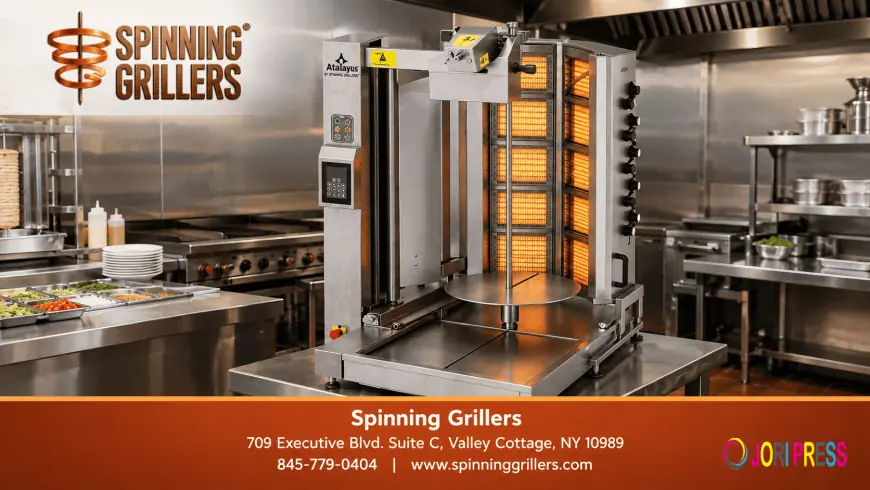
Spinning Grillers' Smart Robotic Shawarma Machine with Smart Movement, a 10-burner system, is one example of how this technology is developing. It combines automated slicing with adjustable grill positioning and touchscreen controls. The machine also includes a warming unit for cooked meat.
These features illustrate how automation can support selected tasks in a traditional shawarma station. Whether such a system makes sense depends on the restaurant's workflow, budget, available space, and training requirements.
Ultimately, automation is not about removing people from the kitchen. It is about finding practical ways to manage repetitive work while maintaining food quality, safety, and good service.
Frequently Asked Questions
1. How does a robotic shawarma machine work?
It combines a vertical roasting system with automated functions such as slicing and grill positioning. Operators still need to monitor cooking and follow safety procedures.
2. Can automation improve shawarma consistency?
It can help standardize slicing and equipment movements, but meat quality, cooking conditions, and staff supervision still affect the final result.
3. Is an automated shawarma machine suitable for every restaurant?
No. Restaurants should consider order volume, equipment costs, kitchen space, cleaning, maintenance, and staff training before deciding.
What's Your Reaction?
 Like
0
Like
0
 Dislike
0
Dislike
0
 Love
0
Love
0
 Funny
0
Funny
0
 Angry
0
Angry
0
 Sad
0
Sad
0
 Wow
0
Wow
0