








































The Questions Every Confused Student Asks Me About Choosing a College — Answered Honestly
From "course vs college" to placement percentages and backup options — here are honest answers to the questions students ask most when choosing the right college.
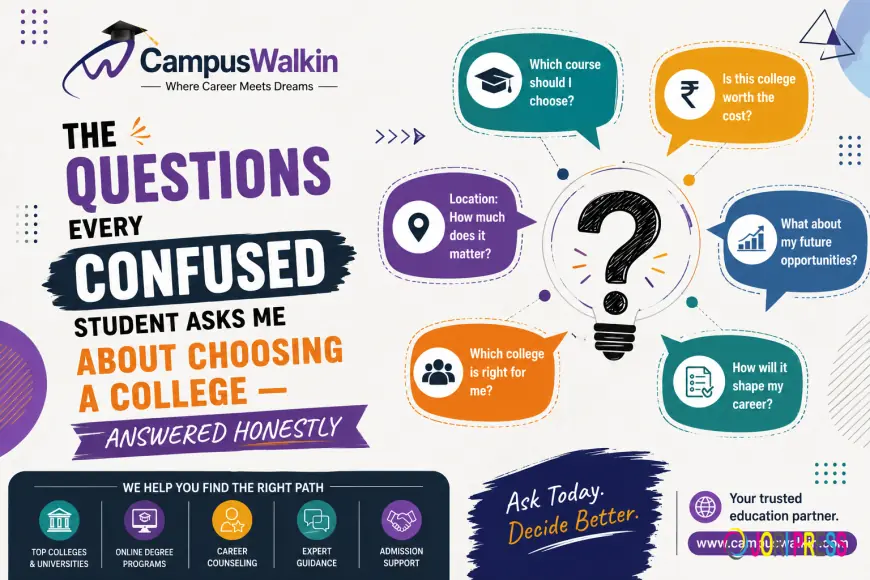
Every admission season, I hear the same handful of questions on repeat — from students, from younger cousins, from friends' kids who somehow got my number. So instead of answering them one at a time, here they are, answered honestly, in one place.
"How do I know if a college is actually good?"
Stop looking at the college as a whole. Look at the specific department you're applying to. A college can be excellent for one course and average for another. Check faculty credentials, how recently the curriculum was updated, and what current students in that exact course say — not the college's overall reputation.
"Should I choose based on the course or the college?"
Ideally, both align — but if you're forced to pick one, lean toward the course and department strength over the college's overall name. You'll spend three or four years deeply engaged with one subject area. A great course with strong faculty, even at a lesser-known college, can outperform a mediocre department at a "famous" one.
"What if I don't know what career I want yet?"
That's normal — genuinely. Most career clarity comes from exposure: internships, electives, projects, conversations with people already working in the field. Choosing a broad, flexible direction now is enough. You don't need a locked-in five-year plan at eighteen; almost nobody actually has one.
"Does the college's placement percentage really matter?"
It matters, but not the way most people think. A flashy 90%+ number often hides the details — average package, which specific branches are included, and how many students actually got placed versus how many were "eligible." Always ask for branch-wise data before trusting a headline stat.
"Is it okay to pick a 'backup' course instead of my dream one?"
Completely okay — and often smarter than people admit. Chasing one narrow "dream" course sometimes means overlooking a genuinely strong alternative. A well-chosen backup isn't settling; it's simply keeping more good options on the table.
"What's the biggest mistake you see students make?"
Comparing colleges only on brand name and campus photos, while barely looking at curriculum depth, faculty quality, or real outcomes. Four years of your life and the trajectory of your career deserve a comparison sheet, not a gut feeling based on Instagram photos.
"How much should I trust advice from relatives and family friends?"
Take it as one input, not the final word — especially if their experience is from a very different era of the job market. The most reliable advice usually comes from people just two or three years ahead of you, who are close enough to remember exactly what worked and what didn't.
"What if I choose 'wrong'? Is it really that permanent?"
It's far less permanent than it feels right now. Students switch specializations, add certifications, and pivot into entirely different fields all the time. A college choice shapes your starting point — not the rest of your life.
If there's one thing worth taking from all of this: don't look for the "perfect" answer. Look for an informed one. Every one of these questions has a version of the same underlying advice — get real information, ask specific questions, and don't let a single flashy number or brand name make the decision for you.
Still figuring out your own answers to these questions? CampusWalkin has detailed resources to help you compare courses, colleges, and career paths — a good next stop before you finalize anything.
What's Your Reaction?
 Like
0
Like
0
 Dislike
0
Dislike
0
 Love
0
Love
0
 Funny
0
Funny
0
 Angry
0
Angry
0
 Sad
0
Sad
0
 Wow
0
Wow
0