








































Quality Assurance Services Market Size, Trends & Forecast 2025–2034
Quality Assurance Services Market, driven by AI, automation, cloud testing, digital transformation, and rising demand for reliable, secure, compliant solutions.
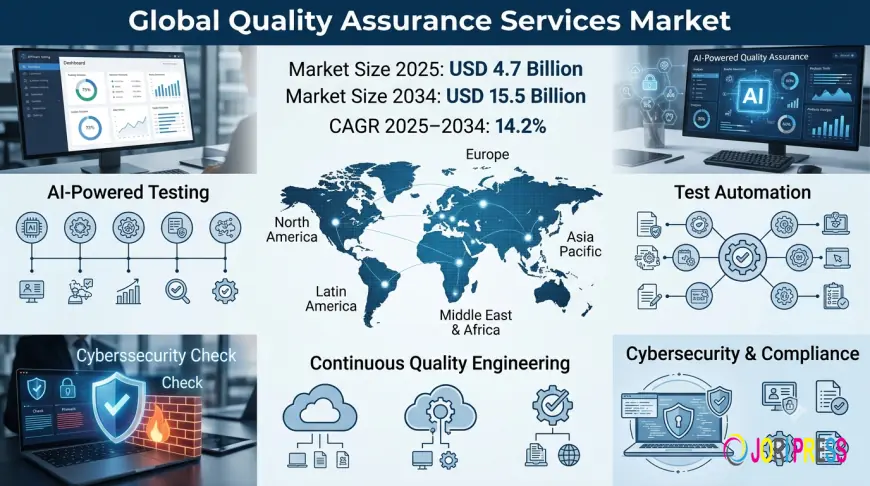
The Global Quality Assurance Services Market is expanding rapidly as organizations prioritize product reliability, software performance, regulatory compliance, and customer satisfaction across increasingly complex operating environments. The market is projected to reach USD 15.5 billion by 2034, up from USD 4.7 billion in 2025, reflecting a 14.2% CAGR from 2025 to 2034. Rising digitalization, cloud adoption, automation, and stringent quality standards are creating sustained demand for specialized assurance capabilities.
Quality assurance services encompass a broad range of activities designed to identify defects, validate performance, improve processes, and ensure products or services meet defined quality requirements. These services are increasingly being integrated into software development, manufacturing, healthcare, financial services, telecommunications, automotive, retail, and other industries. Businesses are moving beyond traditional testing toward continuous quality management supported by automation, analytics, artificial intelligence, and real-time monitoring.
The market's growth is also being shaped by the increasing cost of quality failures. Software defects, production disruptions, security vulnerabilities, regulatory violations, and inconsistent customer experiences can create substantial financial and reputational consequences. Consequently, enterprises are investing in independent testing, validation, inspection, compliance assessment, and process improvement services to strengthen operational resilience and reduce quality-related risks.
Market Overview
The Global Quality Assurance Services Market is transitioning from a predominantly compliance-oriented function into a strategic business capability. Organizations increasingly view quality assurance as an essential component of digital transformation, product innovation, and customer experience management.
The market's expansion from USD 4.7 billion in 2025 to USD 15.5 billion by 2034 represents an absolute increase of approximately USD 10.8 billion over the forecast period. A 14.2% CAGR indicates strong and sustained demand for quality assurance solutions across both established enterprises and rapidly scaling digital businesses.
Software quality assurance represents an important area of demand as organizations deploy cloud applications, mobile platforms, enterprise software, APIs, artificial intelligence applications, and connected technologies. At the same time, non-software industries are increasing their reliance on inspection, validation, certification, process auditing, and compliance services.
Key Findings
-
The market is valued at USD 4.7 billion in 2025.
-
It is expected to reach USD 15.5 billion by 2034.
-
The market is forecast to register a 14.2% CAGR between 2025 and 2034.
-
Digital transformation is increasing demand for continuous testing and quality monitoring.
-
Artificial intelligence and automation are reshaping testing and defect-detection processes.
-
Cloud computing and distributed applications are creating demand for scalable assurance services.
-
Regulatory compliance remains a major requirement across highly regulated industries.
-
North America maintains a strong position due to advanced technology adoption and enterprise IT spending, while Asia Pacific offers significant growth opportunities.
Market Dynamics
Growth Drivers
One of the strongest growth drivers is the accelerating adoption of digital technologies. Enterprises are deploying increasingly interconnected software ecosystems, cloud infrastructure, mobile applications, and automated workflows. As these environments become more complex, organizations require comprehensive testing and validation throughout the development and deployment lifecycle.
The growing adoption of DevOps and continuous integration/continuous delivery (CI/CD) is another important factor. Traditional testing performed near the end of development can delay product launches and increase remediation costs. Modern quality assurance integrates testing earlier into development workflows, allowing organizations to identify defects continuously and release products more reliably.
Artificial intelligence is further expanding the capabilities of quality assurance providers. AI-supported testing can assist with test-case generation, anomaly identification, defect prioritization, predictive analytics, and repetitive validation activities. These capabilities can improve testing coverage while reducing manual effort.
Regulatory requirements are also supporting market expansion. Financial services, healthcare, automotive, aerospace, telecommunications, and other industries operate under stringent quality, safety, privacy, and security requirements. Specialized assurance providers help organizations demonstrate compliance while maintaining consistent operational standards.
Challenges
Despite strong growth prospects, the market faces several challenges. One significant issue is the shortage of professionals with specialized expertise in advanced testing methodologies, cybersecurity, automation, AI systems, and complex enterprise environments.
The rapid evolution of technology also creates a continuous requirement for new testing capabilities. Organizations must adapt assurance frameworks to emerging technologies such as generative AI, Internet of Things platforms, edge computing, blockchain applications, and autonomous systems.
Cost pressures can present another challenge, particularly for smaller organizations. Implementing sophisticated automated testing infrastructure and maintaining specialized teams may require substantial investment. Service providers therefore need to demonstrate measurable improvements in quality, speed, risk reduction, and overall return on investment.
Data security and privacy are additional concerns. Quality assurance activities frequently involve access to application environments, databases, customer information, and sensitive business processes. Providers must maintain robust security controls to protect client information throughout the testing and validation lifecycle.
Market Trends
AI-Powered Quality Assurance
Artificial intelligence is emerging as a major trend in quality assurance. Machine learning algorithms can analyze historical defect patterns, identify unusual system behavior, and support predictive testing strategies. Generative AI is also creating opportunities for automated test documentation, test-case generation, code analysis, and conversational quality engineering.
Shift Toward Continuous Quality Engineering
The industry is moving from periodic testing toward continuous quality engineering. Rather than treating quality assurance as a separate stage, organizations are embedding quality checks across planning, development, integration, deployment, and post-release monitoring.
Greater Automation
Automation is increasingly being applied to regression testing, performance testing, API validation, security checks, and functional testing. Automated workflows can execute large testing volumes repeatedly, making them particularly valuable for organizations with frequent software releases.
Cloud-Based Testing
Cloud adoption is creating demand for flexible testing environments that can scale according to project requirements. Cloud-based quality assurance allows businesses to test applications across multiple configurations without maintaining extensive physical infrastructure.
Focus on Customer Experience
Quality assurance is increasingly linked to customer experience. Organizations are evaluating not only whether systems function correctly but also whether applications are fast, intuitive, accessible, secure, and consistent across devices and channels.
Market Segmentation Overview
The Global Quality Assurance Services Market can be assessed across several dimensions, including service type, testing type, organization size, industry vertical, and region.
By service type, the market includes software testing and quality engineering services, inspection and validation, auditing and compliance assessment, certification-related services, and other specialized assurance activities. Software-related services represent a particularly dynamic area because of increasing application complexity and accelerated release cycles.
By testing type, functional testing, performance testing, security testing, usability testing, compatibility testing, and automated testing address different stages of product and application quality. Security testing is gaining importance as organizations face increasingly sophisticated cyber threats.
By organization size, large enterprises account for substantial demand because of their extensive technology infrastructure, complex supply chains, and strict governance requirements. However, small and medium-sized businesses are increasingly adopting external quality assurance providers because outsourcing can provide access to specialized expertise without requiring large internal teams.
By industry, major applications span IT and telecommunications, healthcare, BFSI, manufacturing, automotive, retail and e-commerce, aerospace and defense, energy and utilities, and other sectors. The IT and telecommunications sector has strong demand because of continuous software development and rapidly changing digital platforms. Manufacturing and automotive organizations increasingly use assurance services to validate connected products, production processes, embedded software, and safety-critical systems.
Regional Analysis
North America
North America represents a major market for quality assurance services, supported by high enterprise technology spending, advanced software development ecosystems, cloud adoption, and stringent regulatory requirements. Organizations across financial services, healthcare, technology, and manufacturing increasingly incorporate automated and AI-assisted quality processes.
Europe
Europe is supported by strong regulatory frameworks, industrial quality requirements, and increasing digital transformation. Demand is particularly relevant to sectors where compliance, data protection, product safety, and operational reliability are critical. Automotive and manufacturing applications also contribute to regional opportunities.
Asia Pacific
Asia Pacific is expected to offer significant growth potential through rapid digitalization, expanding technology industries, manufacturing development, and increasing adoption of cloud-based platforms. Countries across the region are investing heavily in software development, digital services, connected technologies, and industrial modernization.
Latin America
Latin American markets are gradually increasing investments in digital infrastructure and enterprise software. As organizations modernize business processes and expand digital customer channels, demand for software testing, security validation, and process assurance is expected to increase.
Middle East & Africa
The Middle East & Africa region is witnessing expanding digital transformation programs across government, financial services, telecommunications, healthcare, and infrastructure. Growing technology investments and modernization initiatives are creating opportunities for quality assurance providers with specialized digital capabilities.
Competitive Landscape
The competitive landscape is characterized by a combination of global technology service providers, specialized testing companies, consulting organizations, certification providers, and regional specialists. Competition increasingly centers on automation capabilities, AI integration, industry expertise, testing coverage, scalability, security, and delivery efficiency.
Providers are strengthening their positions by expanding automated testing platforms, investing in AI-enabled quality engineering, developing sector-specific solutions, and integrating testing into DevOps environments. Strategic partnerships and service portfolio expansion are also important approaches for addressing increasingly complex client requirements.
Another competitive differentiator is the ability to provide end-to-end quality services. Enterprises increasingly prefer providers capable of supporting requirements analysis, test design, automation, validation, performance optimization, security assessment, and post-deployment quality monitoring within an integrated framework.
Future Market Outlook
The future of the Global Quality Assurance Services Market will be closely connected to the continued evolution of enterprise technology. With the market expected to grow from USD 4.7 billion in 2025 to USD 15.5 billion by 2034, quality assurance is positioned to become an increasingly important component of digital and operational strategies.
AI-driven testing will likely become more sophisticated, allowing organizations to automate larger portions of the testing lifecycle. At the same time, human expertise will remain important for strategic test planning, risk assessment, regulatory interpretation, complex troubleshooting, and quality governance.
The expansion of connected devices, cloud-native applications, APIs, cybersecurity requirements, and AI-enabled systems will further increase the number of variables that organizations need to validate. This environment favors service providers capable of delivering scalable, automated, secure, and industry-specific assurance solutions.
FAQs
1. What is the projected size of the Global Quality Assurance Services Market?
The market is projected to reach USD 15.5 billion by 2034, increasing from USD 4.7 billion in 2025.
2. What is the expected CAGR of the Quality Assurance Services Market?
The market is expected to register a 14.2% CAGR from 2025 to 2034, reflecting strong demand for specialized quality and testing capabilities.
3. What are the major factors driving market growth?
Key growth factors include digital transformation, cloud adoption, DevOps and CI/CD implementation, automation, AI integration, increasing application complexity, and stricter regulatory requirements.
4. How is artificial intelligence affecting quality assurance services?
AI can support test-case generation, defect identification, test prioritization, anomaly detection, predictive analysis, and automated documentation, helping organizations improve testing efficiency and coverage.
5. Which industries use quality assurance services?
Quality assurance services are widely used across IT and telecommunications, healthcare, BFSI, manufacturing, automotive, retail, aerospace and defense, energy and utilities, and other industries where reliability and compliance are important.
Summary of Key Insights
The Global Quality Assurance Services Market is entering a period of substantial expansion, with its value expected to increase from USD 4.7 billion in 2025 to USD 15.5 billion by 2034 at a 14.2% CAGR. Digital transformation, cloud computing, automation, AI, regulatory requirements, and growing software complexity are the primary forces shaping demand. The market is simultaneously shifting from conventional testing toward continuous quality engineering, predictive assurance, and AI-enabled validation. As enterprises place greater emphasis on reliability, security, compliance, and customer experience, quality assurance services are expected to become an increasingly strategic component of long-term technology and business operations.
What's Your Reaction?
 Like
0
Like
0
 Dislike
0
Dislike
0
 Love
0
Love
0
 Funny
0
Funny
0
 Angry
0
Angry
0
 Sad
0
Sad
0
 Wow
0
Wow
0