









































NWSC seeks UGX 650bn loan to boost water production and supply in 50 towns


KAMPALA — The National Water and Sewerage Corporation (NWSC) is seeking UGX 650 billion (about USD 176 million) to increase water production and supply in 50 towns across the country, most of it a loan the utility says it would repay over 20 years.
Under the plan, government would extend UGX 500 billion (about USD 135 million) as a concessionary loan at 2% annual interest, with a two-year grace period and a 20-year repayment window that NWSC says it would service itself on the strength of its commercial position. A further UGX 150 billion (about USD 40.5 million) would come as a revenue grant, matching the level of support government has provided over the past five years. The money would be released in five equal annual tranches of UGX 130 billion (about USD 35 million) across the 2027/28 to 2031/32 financial years.
The new Minister of Water and Environment, Gen. Kahinda Otafiire, pledged government backing for the drive on his maiden visit to the corporation. Touring NWSC's International Resource Centre in Bugolobi on his first visit since taking charge of the ministry in May, he told management and staff that supplying water to every Ugandan was a duty the corporation could not leave to technocrats alone, and urged it to plan at least 20 years ahead.
Commending the leadership as capable managers, Gen. Otafiire said institutions too often faltered on execution rather than talent. "In Africa we have intelligent people with poor management skills," he said, urging management to keep staff with special skills motivated and retained.
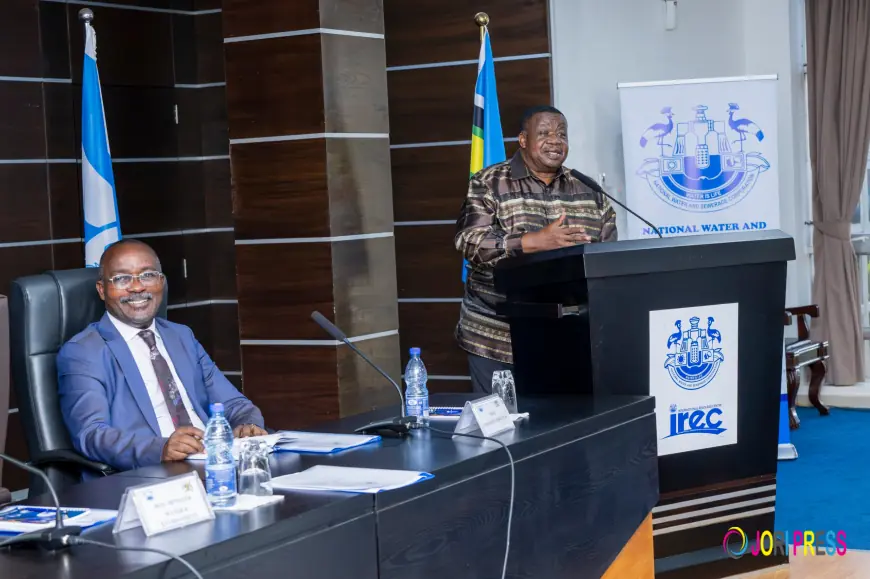
On the corporation's reliance on imported inputs, he said government was ready to support NWSC to set up in-country assembly plants for materials such as pipes and meters, telling the utility that global conflicts made self-reliance urgent. Responding to whistle-blower reports against the corporation, he said complaints were a sign that management was working — "a moving car will always raise dust" — and that legitimate grievances should be addressed. Opposition, he said, should be treated not as an enemy but as "a mirror that helps us do better." He praised NWSC as proof that state institutions can perform, recalling that it was once lined up for privatisation.
NWSC managing director Dr Silver Mugisha presented the 50 Towns Water Supply Improvement Project, which he said the minister himself had earlier asked the corporation to pursue. He told the meeting the board had reviewed and approved the concept with amendments and would forward it to the ministry before implementation. The project responds to rising strain on NWSC networks, where capacity utilisation now averages 85% — the level at which customers begin to feel shortages.
The 50 towns are drawn from all four NWSC regions: 14 in the Central region (UGX 202 billion, about USD 54.6 million), 14 in the Eastern region (UGX 178 billion, about USD 48.1 million), eight in the Northern region (UGX 90 billion, about USD 24.3 million) and 14 in the Western and South-Western region (UGX 180 billion, about USD 48.6 million). Allocations range from UGX 10 billion (about USD 2.7 million) for smaller towns to UGX 30 billion (about USD 8.1 million) for larger systems such as Gomba and Tororo.
Investment would focus on water production systems, electro-mechanical equipment, transmission mains, storage reservoirs, distribution networks and water-quality monitoring. The corporation said it intended to deliver the works using in-house design and direct supervision, package them into regional or technical lots to widen competition among domestic and regional contractors, and procure critical equipment directly from manufacturers. To safeguard the investment, it said it would maintain a dedicated project ledger, annual investment plans, internal audit, procurement controls and quarterly public reporting, alongside measures to keep non-revenue water in check.
Dr Mugisha said the corporation was carrying an investment financing gap of about UGX 1.436 trillion (about USD 388 million). He said NWSC had grown from 23 towns in 2013 to 293 as at 30 June 2026, serving more than 22 million people, with connections rising from 300,000 to over one million, turnover from UGX 120 billion to UGX 680 billion and assets from UGX 580 billion to UGX 5 trillion. He attributed the gains to cutting the cost of doing business and building systems in-house, and appealed to the minister not to compel public institutions to adopt outside systems where local expertise already existed.
In a separate overview, Johnson Amayo said the pipeline network had grown to about 24,000 kilometres and customer satisfaction stood at 82%. He pointed to a completed treatment plant at Katosi whose capacity had been raised to 240 million litres, with talks underway with the finance ministry for a further 80 million euros to expand intake and evacuation, and to a State House-directed Service Coverage Acceleration Project channelling UGX 30 billion a year toward a water point in every village.
Beyond the financing, Dr Mugisha asked the minister to back the solarisation of NWSC's power systems to cut energy costs and to support local manufacture of inputs the corporation imports, among them soda ash, polymers, meters and generators.
NWSC board chairman Prof. Henry Alinaitwe pledged strategic guidance, oversight and support to the corporation. Responding to the whistle-blower reports, he said the board had commissioned an audit whose findings so far showed that initiatives such as the corporation's insurance company were helping it save money.
Representing the permanent secretary in the Ministry of Water and Environment, John Mary Vianne Twinomujuni pledged the ministry's support for NWSC, describing it as one of its best-performing institutions, and said the ministry would guide the corporation to ensure the 50 towns project met the required processes.
What's Your Reaction?
 Like
0
Like
0
 Dislike
0
Dislike
0
 Love
0
Love
0
 Funny
0
Funny
0
 Angry
0
Angry
0
 Sad
0
Sad
0
 Wow
0
Wow
0