










































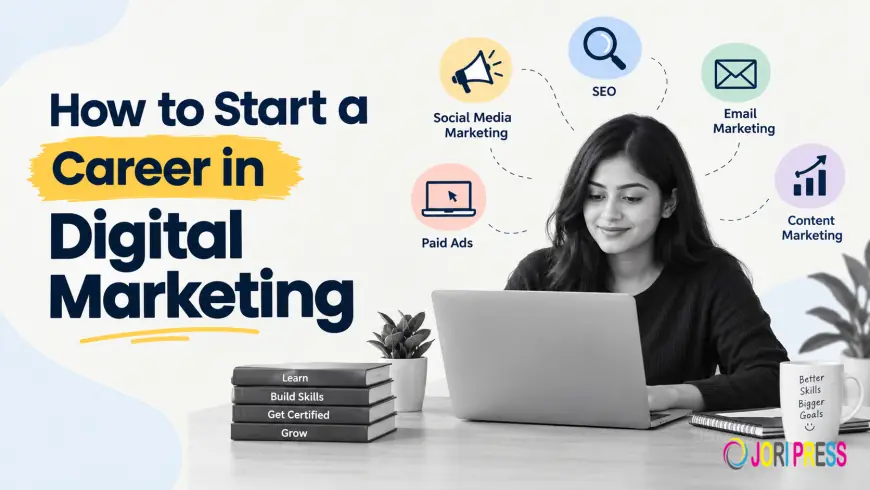
How to Start a Career in Digital Marketing
Learn how to start a career in digital marketing, including essential skills, career options, practical experience, tools, courses, and portfolio-building tips.

Digital marketing has become one of those career fields that keeps opening new doors. Almost every business today needs an online presence, whether it is a small local business, a startup, an e-commerce brand, or a large company. Someone has to manage that presence, bring people to the website, create content, run campaigns, and figure out what is actually working.
That is where digital marketers come in.
If you are thinking about starting a career in digital marketing, the good news is that you do not need to know everything before getting started. You also do not necessarily need a degree specifically in marketing. What you do need is a willingness to learn, practise, experiment, and keep up with how the industry is changing.
Here is a practical way to get started.
1. Start by Understanding What Digital Marketing Actually Is
Before jumping into courses or tools, take some time to understand what digital marketing involves.
In simple terms, digital marketing is about using online channels to reach and engage with potential customers. It includes things such as search engines, social media, websites, email, online advertising, and content.
You may have come across terms like SEO, PPC, social media marketing, content marketing, email marketing, and performance marketing. These are all different parts of the larger digital marketing ecosystem.
You don't have to become an expert in all of them. In fact, trying to learn everything at once can make things confusing. Start by understanding what each area does and how they work together.
2. Find the Area That Interests You
Once you understand the basics, think about what you actually enjoy doing.
If you like writing, research, and figuring out why some websites rank higher than others, SEO and content marketing might interest you.
If you spend a lot of time on social media and enjoy creating posts, videos, or campaigns, social media marketing could be a good direction.
On the other hand, if numbers and campaign performance are more interesting to you, you might enjoy paid advertising or performance marketing.
Some of the common roles you can explore include:
- SEO Executive or SEO Specialist
- Social Media Executive
- Content Writer or Content Marketer
- PPC Executive
- Performance Marketing Specialist
- Email Marketing Specialist
- Digital Marketing Executive
- Digital Marketing Analyst
You can start with one area and learn the others gradually.
3. Learn the Basics Before Chasing Advanced Topics
There is a lot of digital marketing content online, and it is easy to fall into the trap of jumping from one advanced topic to another.
Instead, get your fundamentals right first.
Learn how search engines work. Understand keywords and search intent. Learn how social media platforms work and why some content gets more engagement than others. Understand basic concepts such as target audiences, conversion rates, customer journeys, and marketing funnels.
These may sound like simple concepts, but they become useful in almost every digital marketing role.
Once your foundation is strong, learning advanced strategies becomes much easier.
4. Consider Taking a Digital Marketing Course
You can certainly learn digital marketing on your own. There are countless videos, blogs, tutorials, and free resources available online.
The problem is usually not finding information. It is figuring out what to learn, in what order, and how to put it into practice.
That is where a structured course can help, especially if you are starting from scratch.
For example, LPT Skills offers a Digital Marketing Course for learners who want a more structured way to learn the different aspects of digital marketing.
If you decide to take a course, don't choose one simply because it promises a certificate. Look at what you will actually learn. Check whether the course includes practical work, projects, tools, assignments, and examples based on real marketing situations.
A certificate can add something to your resume, but your actual skills are what will help you in the long run.
5. Get Comfortable With Digital Marketing Tools
Tools are a big part of a digital marketer's everyday work.
You don't need to learn dozens of platforms immediately. Start with a few commonly used ones and understand what they do.
For example, Google Search Console can help you understand how a website performs in search. Google Analytics can provide insights into website traffic and user behaviour. Google Ads and Meta Ads are useful for understanding paid advertising.
SEO professionals also work with keyword research and competitor analysis tools, while social media marketers may use scheduling, analytics, and content creation platforms.
The goal shouldn't be to memorise every feature of every tool. Try to understand the problem each tool helps you solve.
6. Don't Just Learn- Start Practising
This is probably the most important step.
You can watch 50 videos about SEO, but you will understand it much better after actually optimising a website or writing an article around a keyword.
You don't need a client to start practising.
Create a small website or blog. Pick a topic you know something about and start creating content. Try researching keywords, writing an SEO-friendly article, creating a social media calendar, or planning a sample advertising campaign.
You can even create a fictional business and build a marketing strategy for it.
The point is to move from "I know what SEO is" to "I have actually done SEO work."
That difference matters when you eventually start applying for jobs.
7. Build a Portfolio Before You Need One
A portfolio gives employers something concrete to look at.
And no, you don't need five big clients to build one.
Your portfolio can include personal projects, practice campaigns, sample content, website audits, keyword research, social media plans, or SEO projects.
For each project, explain what you were trying to achieve, what you did, and what you learned.
For example, instead of simply writing:
"Keyword research project"
you could explain that you researched keywords for a particular topic, grouped them according to search intent, and used the findings to create a content plan.
That tells a potential employer much more about your ability.
8. Keep an Eye on AI and New Trends
Digital marketing is not the same field it was a few years ago.
AI has become a major part of marketing workflows. Marketers are using AI tools for brainstorming, research, content ideation, data analysis, automation, and many other tasks.
But that doesn't mean AI has made digital marketing skills unnecessary.
If anything, marketers need to become better at understanding audiences, evaluating information, creating useful content, analysing results, and making strategic decisions.
Use AI as a tool, but don't depend on it for everything. Understanding the fundamentals will help you use new technology much more effectively.
9. Work on Your Communication Skills Too
There is a common misconception that digital marketing is only about tools and technical skills.
It isn't.
A digital marketer may have to explain campaign results to a client, write a social media caption, present a content strategy, discuss SEO recommendations with a developer, or work with a sales team.
So, work on your communication, writing, presentation, and analytical skills alongside your technical knowledge.
These skills can make a noticeable difference once you start working professionally.
10. Start Applying for Internships and Entry-Level Jobs
You don't have to wait until you feel completely ready.
Once you understand the basics and have a few projects to show, start looking for internships and entry-level opportunities.
Search for roles such as Digital Marketing Intern, SEO Intern, Content Executive, Social Media Executive, PPC Executive, or Digital Marketing Executive.
Your first role may not involve everything you have learned. That's completely normal.
The first job is often where you learn how campaigns are actually planned, how teams work together, how deadlines are handled, and how marketing decisions are made based on real data.
11. Keep Learning as You Work
Digital marketing doesn't really have a final stage where you can say, "I've learned everything."
Search engines change. Social platforms introduce new features. Advertising platforms evolve. Consumer behaviour changes. New AI tools appear.
So, even after getting your first job, keep learning.
Follow industry news, read case studies, experiment with new tools, and pay attention to what successful brands are doing.
At the same time, don't chase every new trend. Strong fundamentals will continue to matter even when specific tools or platforms change.
What's Your Reaction?
 Like
0
Like
0
 Dislike
0
Dislike
0
 Love
0
Love
0
 Funny
0
Funny
0
 Angry
0
Angry
0
 Sad
0
Sad
0
 Wow
0
Wow
0