








































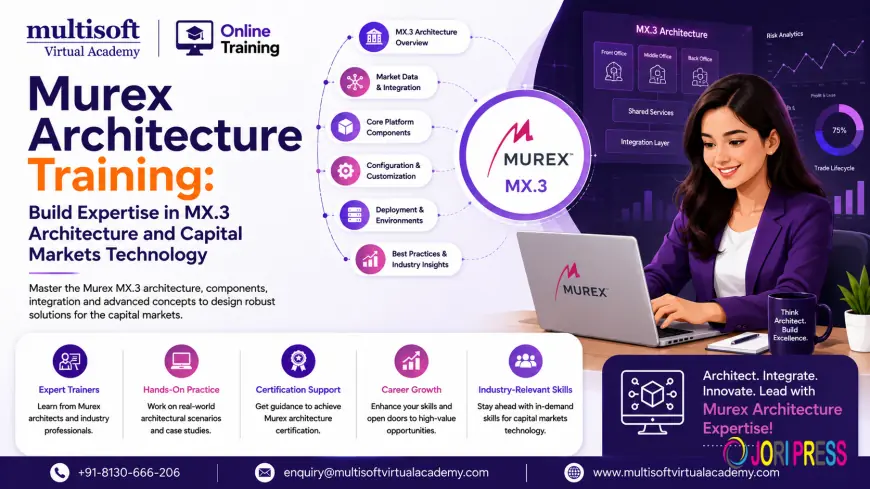
Murex Architecture Training: Build Expertise in MX.3 Architecture and Capital Markets Technology
Master Murex Architecture Training to build expertise in system design, integration, configuration, and architecture concepts for successful Murex careers.

Financial institutions today depend on sophisticated technology platforms to manage trading, treasury, risk, operations, collateral and regulatory requirements. As transaction volumes increase and financial products become more complex, organizations need professionals who understand not only financial processes but also the architecture that connects them.
Murex Architecture Training is designed for professionals who want to develop a strong understanding of the Murex MX.3 platform, its architectural layers, system components, data flows, integrations and deployment models. Murex MX.3 uses a tiered, service-oriented architecture with presentation, business, orchestration and technical layers supported by scalable infrastructure and multiple data technologies.
For professionals working in banking, capital markets, financial technology, enterprise architecture or application support, learning Murex architecture can provide valuable technical knowledge for designing, implementing, integrating and maintaining financial technology environments.
What Is Murex MX.3 Architecture?
Murex MX.3 is an integrated capital markets platform supporting front-office, risk, finance and operations across a wide range of financial activities. Its architecture is designed to support high transaction volumes, complex calculations, integration with external systems and flexible deployment across on-premises infrastructure, cloud and SaaS environments.
The architecture brings together several technical and functional capabilities. These include presentation services, business engines, workflow and orchestration services, technical services, data storage and scalable computing infrastructure.
Understanding this architecture is essential for professionals who need to troubleshoot application issues, design integrations, optimize performance or participate in Murex implementation projects.
Why Is Murex Architecture Training Important?
Murex implementations involve multiple business and technology teams. A developer may work on integrations while an application support engineer monitors environments and a business analyst focuses on functional workflows. Without an understanding of the underlying architecture, it can be difficult to understand how these components interact.
A structured Murex Architecture Training program helps learners develop a complete architectural perspective.
Key benefits include:
- Understanding MX.3 architectural components
- Learning how different application layers interact
- Understanding trade and data flows
- Exploring system integration concepts
- Developing knowledge of APIs and connectivity
- Understanding database and data management concepts
- Learning scalability and high-availability principles
- Improving troubleshooting and application support skills
- Understanding cloud and SaaS deployment models
- Building knowledge relevant to Murex implementation projects
This architectural knowledge can help professionals communicate more effectively with developers, infrastructure teams, business users and project stakeholders.
Core Layers of Murex Architecture
A major part of Murex architecture learning involves understanding how the platform separates responsibilities across different layers.
1. Presentation Layer
The presentation layer provides the user-facing experience through which users interact with business functions. Depending on the implementation and use case, users can access MX.3 capabilities through desktop applications or web-based interfaces.
Professionals studying Murex architecture learn how presentation components connect users with business processes, workflows and underlying services.
2. Business Layer
The business layer contains important engines responsible for financial and operational processing. These can include pricing, workflow, calculation, accounting, risk, collateral and other business capabilities.
Understanding this layer helps learners see how business requirements are translated into system processing.
3. Orchestration Layer
The orchestration layer coordinates services and distributes processing between different business engines. Murex describes orchestration services that distribute calculations across business-layer engines.
For architects and technical professionals, understanding orchestration is particularly important when analyzing performance, processing flows and workload distribution.
4. Technical Services Layer
The technical layer provides foundational capabilities such as authentication, authorization, messaging, caching, service registry, logging, monitoring and cluster management.
This layer is critical for building secure, observable and reliable enterprise environments.
5. Data Layer
Data is central to every financial technology platform. Murex architecture training introduces learners to database concepts, market data, reference data, financial data and downstream data requirements.
MX.3 supports multiple relational database technologies, including Oracle, SAP ASE and Microsoft SQL Server, depending on deployment requirements.
Murex Architecture and Trade Life Cycle
A strong understanding of the trade life cycle is essential for anyone working with Murex.
A typical financial transaction moves through several stages, from trade capture and validation to pricing, risk analysis, confirmation, settlement, accounting and reporting.
Murex architecture connects these processes so that information can move across front-office, risk, operations and finance.
This integrated approach reduces unnecessary reconciliation and supports straight-through processing. MX.3 provides connectivity with existing enterprise systems and the wider capital markets ecosystem through interfaces, APIs and batch data extraction capabilities.
Training therefore should not focus exclusively on technical components. Learners should also understand how those components support real financial workflows.
Murex Architecture and System Integration
Modern financial institutions rarely operate a single application. Murex environments must often communicate with market data providers, trading systems, clearing platforms, settlement systems, data warehouses, general ledgers and regulatory reporting solutions.
Integration is therefore one of the most important topics in Murex Architecture Training.
MX.3 provides connectivity capabilities and APIs that enable organizations to integrate the platform with surrounding technology environments. Its newer API framework provides REST-based access to MX.3 functionality and supports integration across front-office trading, risk and post-trade processes.
Professionals can benefit from learning:
- API-based integration
- REST APIs
- JSON-based data exchange
- Authentication and authorization
- Enterprise integration patterns
- Batch processing
- Real-time processing
- External system connectivity
- Data transformation
- Error handling and monitoring
These skills are increasingly relevant as financial institutions modernize legacy integration landscapes.
Murex APIs and Digital Transformation
API-driven architecture is becoming increasingly important in enterprise technology. Organizations want applications that can connect with cloud services, analytics platforms, automation solutions and internal applications without creating isolated technology silos.
Murex's current API capabilities emphasize RESTful services, JSON payloads, OpenAPI specifications and language-agnostic integration. The platform also supports security mechanisms such as TLS encryption and OAuth2 authentication.
For learners, this creates an important opportunity to connect traditional financial technology knowledge with modern integration practices.
Understanding Murex API integration, MX.3 APIs, Murex integration architecture and Murex system integration can be particularly valuable for technical professionals working on modernization initiatives.
Murex Architecture, Cloud and Scalability
Cloud adoption has changed how financial institutions approach enterprise application deployment. Scalability, elasticity, availability and operational efficiency have become major architecture considerations.
MX.3 can be deployed across on-premises infrastructure, cloud and SaaS environments. Murex also describes the use of Kubernetes and containers for computationally intensive workloads such as market risk and reporting, allowing organizations to benefit from scalable cloud infrastructure.
A comprehensive training program should therefore cover concepts such as:
- Cloud deployment architecture
- Hybrid environments
- Containerized workloads
- Kubernetes concepts
- High availability
- Horizontal scalability
- Performance optimization
- Infrastructure monitoring
- Disaster recovery considerations
- Capacity planning
These concepts help professionals understand how Murex environments can be designed to support demanding financial workloads.
Murex Architecture for Risk Management
Risk management is one of the most computationally demanding areas of capital markets technology. Financial institutions need to calculate exposures, sensitivities, stress scenarios, value at risk and other risk measures efficiently.
MX.3 provides enterprise risk capabilities covering market, counterparty credit and liquidity risk among other areas. Its architecture is designed to support large-scale calculations and real-time or batch processing requirements.
Learning how risk engines interact with other Murex components can help technical professionals understand performance requirements and data dependencies.
This knowledge is especially relevant for Murex risk management, Murex market risk, Murex technology, Murex implementation and Murex support roles.
Murex Architecture for Treasury and Capital Markets
Treasury departments require accurate information about funding, liquidity, market exposure, collateral and financial transactions.
MX.3 supports treasury activities including trade management, liquidity risk, collateral management, market risk, credit risk, finance and operational processes.
For professionals working with banks and financial institutions, understanding how treasury requirements map onto Murex architecture can improve both functional and technical decision-making.
It also helps learners understand why architecture design must consider performance, data consistency, security and integration simultaneously.
Who Should Learn Murex Architecture?
Murex Architecture Training can be useful for a broad range of professionals, including:
- Murex developers
- Murex technical consultants
- System architects
- Solution architects
- Business analysts
- Application support engineers
- Integration specialists
- Middleware professionals
- Financial technology professionals
- Risk technology professionals
- Treasury technology professionals
- Banking IT consultants
- Project and implementation teams
Professionals with knowledge of databases, financial markets, software development, enterprise applications or IT infrastructure may find the learning process particularly relevant.
Skills to Develop Through Murex Architecture Training
A well-structured learning program should combine architectural theory with practical understanding.
Important skills include:
Architectural Analysis
Learn to identify different components, services and layers and understand their relationships.
Integration Design
Understand how MX.3 communicates with external systems and how APIs, interfaces and data exchanges support enterprise workflows.
Performance Optimization
Learn how processing requirements, workload distribution, caching, infrastructure and scalable computing affect application performance.
Security Awareness
Understand authentication, authorization, permissions and secure communication within an enterprise financial technology environment.
Troubleshooting
Develop the ability to trace application flows, identify dependencies and analyze technical problems systematically.
Deployment Knowledge
Understand different infrastructure approaches, including on-premises, cloud, hybrid and SaaS environments.
Career Opportunities After Murex Architecture Training
As financial institutions continue investing in digital transformation, professionals who combine financial domain knowledge with technology expertise can contribute to complex implementation and modernization projects.
Murex-related roles may include Murex Technical Consultant, Murex Developer, Murex Application Support Engineer, Murex Business Analyst, Murex Integration Specialist and Solution Architect.
However, career progression depends on experience, technical skills, financial domain knowledge and the ability to work on real-world implementation environments.
Training should therefore be viewed as a foundation for developing practical expertise rather than simply as a certification exercise.
How to Choose the Right Murex Architecture Training
Before selecting a course, professionals should evaluate whether the program provides meaningful architectural coverage rather than only introductory product information.
Look for training that includes:
- MX.3 architecture fundamentals
- Application layers
- Data architecture
- Trade life cycle
- Integration and APIs
- Workflow and orchestration
- Database concepts
- Cloud deployment
- Performance and scalability
- Security and authentication
- Practical scenarios
- Implementation-oriented exercises
Hands-on learning can be particularly valuable because architecture concepts become easier to understand when learners can connect them with realistic financial workflows.
Murex Architecture Training: A Future-Ready Learning Path
The financial technology landscape is moving toward greater automation, cloud adoption, API-based integration, real-time analytics and scalable computing.
This means Murex professionals increasingly need knowledge that extends beyond traditional application configuration.
Learning Murex MX.3 architecture, Murex integration, Murex API, Murex cloud architecture, Murex risk management, Murex treasury, Murex technical training and Murex implementation can help professionals build a broader understanding of modern capital markets technology.
The objective should be to understand how technology components work together to support business outcomes. When learners can connect architecture with trading, risk, treasury, operations and regulatory processes, they become better equipped to participate in enterprise-level Murex projects.
Final Thought
Murex architecture is an important area for professionals seeking to understand how modern capital markets technology supports complex financial operations. A structured Murex Architecture Training program can help learners understand MX.3 architecture, application layers, integration, APIs, data flows, scalability, cloud deployment and risk-focused processing. For professionals looking to develop these skills through structured learning, practical exercises and industry-oriented guidance, Multisoft Virtual Academy acts as a trusted service provider for professional training and skill development in Murex architecture and related financial technology domains.
What's Your Reaction?
 Like
0
Like
0
 Dislike
0
Dislike
0
 Love
0
Love
0
 Funny
0
Funny
0
 Angry
0
Angry
0
 Sad
0
Sad
0
 Wow
0
Wow
0