


































Miniaturization and High-Throughput NMR Testing Labs: The Next Big Thing

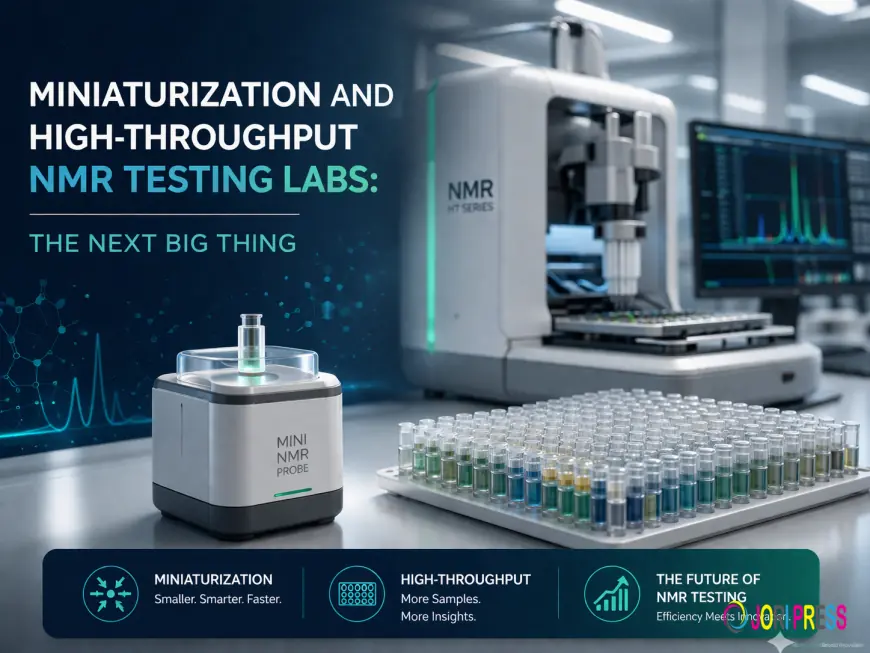
Nuclear Magnetic Resonance (NMR) spectroscopy has long been a cornerstone of chemical analysis, enabling scientists to determine molecular structures with exceptional precision. However, traditional NMR systems are often associated with large instrument footprints, high operational costs, and time-intensive workflows.
Today, a powerful shift is underway—miniaturization and high-throughput NMR testing labs are redefining how this technology is used across industries. These advancements are making NMR faster, more accessible, and more scalable than ever before.
What is Miniaturization in NMR Testing?
Miniaturization in NMR refers to the development of compact, benchtop, and portable NMR instruments that reduce the size and complexity of conventional systems without significantly compromising performance.
Key Features:
-
Smaller magnet systems (often permanent magnets instead of superconducting ones)
-
Reduced need for cryogens like liquid helium
-
User-friendly interfaces and automation
-
Lower installation and maintenance costs
These compact systems are increasingly being adopted by NMR testing labs that want flexibility without sacrificing analytical capability.
Understanding High-Throughput NMR Testing Labs
High-throughput NMR focuses on analyzing large numbers of samples quickly and efficiently. It combines automation, robotics, and advanced data processing to streamline workflows.
Core Components:
-
Automated sample changers
-
Robotic liquid handling systems
-
Parallel data acquisition
-
AI-driven spectral analysis
With these capabilities, modern NMR testing labs can process hundreds to thousands of samples per day, a major leap from traditional methods.
Why Miniaturization is Transforming NMR Testing Labs
1. Accessibility Beyond Specialized Facilities
Earlier, NMR instruments were limited to large research institutions. Miniaturized systems now allow:
-
Small labs
-
Startups
-
Educational institutions
to integrate NMR capabilities without heavy infrastructure investments.
2. Cost Efficiency
Compact systems reduce:
-
Capital expenditure
-
Maintenance costs
-
Energy consumption
This makes NMR testing labs more economically viable for routine analysis.
3. On-Site and Field Analysis
Portable NMR devices enable real-time, on-site testing, which is especially useful in:
-
Oil and gas exploration
-
Food quality testing
-
Environmental monitoring
The Rise of High-Throughput Capabilities
1. Faster Decision-Making
Industries such as pharmaceuticals rely on rapid data. High-throughput NMR allows:
-
Quick screening of compounds
-
Faster R&D cycles
-
Reduced time-to-market
2. Automation Reduces Human Error
Automation ensures:
-
Consistent sample handling
-
Reproducible results
-
Minimal manual intervention
3. Data-Driven Insights
Integration with AI and machine learning enables:
-
Automated peak identification
-
Pattern recognition
-
Predictive analysis
Key Applications of Miniaturized and High-Throughput NMR Testing Labs
Pharmaceuticals and Drug Discovery
-
Rapid screening of drug candidates
-
Structural validation of molecules
-
Quality control of formulations
Chemical and Petrochemical Industry
-
Composition analysis
-
Reaction monitoring
-
Process optimization
Food and Beverage Industry
-
Authenticity testing
-
Detection of adulterants
-
Nutritional profiling
Academic and Research Institutions
-
Affordable access to advanced analytical tools
-
Faster experimentation cycles
Challenges to Consider
While the future looks promising, there are still some limitations:
1. Lower Sensitivity Compared to High-Field Systems
Miniaturized NMR instruments may not match the sensitivity of large superconducting systems.
2. Limited Advanced Capabilities
Some complex experiments still require high-end NMR setups.
3. Initial Integration Costs for Automation
High-throughput systems may require investment in robotics and software infrastructure.
Future Trends in NMR Testing Labs
1. Integration with AI and Cloud Computing
Remote data access and AI-powered analysis will further enhance efficiency.
2. Lab-on-a-Chip NMR Systems
Microfluidic-based NMR devices could revolutionize sample handling and reduce volumes drastically.
3. Hybrid Analytical Platforms
Combining NMR with other techniques (like mass spectrometry) for deeper insights.
4. Wider Industrial Adoption
From agriculture to healthcare, more sectors will rely on compact and high-throughput NMR testing labs.
Conclusion
Miniaturization and high-throughput capabilities are not just incremental improvements—they represent a paradigm shift in how NMR testing labs operate. By making NMR more accessible, faster, and cost-effective, these innovations are opening new possibilities across industries.
As technology continues to evolve, NMR testing labs will become more integrated, automated, and indispensable—truly making them the next big thing in analytical science.
What's Your Reaction?
 Like
0
Like
0
 Dislike
0
Dislike
0
 Love
0
Love
0
 Funny
0
Funny
0
 Angry
0
Angry
0
 Sad
0
Sad
0
 Wow
0
Wow
0