










































Kosher Food Market: Innovation in Food Certification and Distribution
Growing awareness of food quality, increasing demand for ingredient transparency, and expanding availability of certified products across mainstream retail channels are creating new opportunities for kosher food manufacturers worldwide.

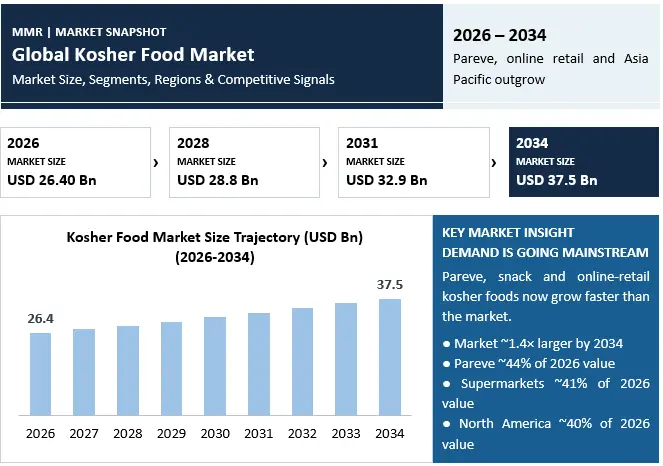
Global Kosher Food Market
The Global Kosher Food Market is experiencing steady growth as consumers increasingly seek certified, traceable, and quality-assured food products. Kosher foods are prepared, processed, and certified in accordance with Jewish dietary laws, known as Kashrut. These products include meat and poultry, dairy products, bakery items, packaged foods, snacks, confectionery, beverages, and specialty food products. Growing awareness of food quality, increasing demand for ingredient transparency, and expanding availability of certified products across mainstream retail channels are creating new opportunities for kosher food manufacturers worldwide.
Kosher certification plays an important role in building consumer confidence by verifying ingredients, production processes, and compliance with established dietary requirements. Although traditionally associated with Jewish dietary practices, kosher-certified products are increasingly attracting vegetarian consumers, health-conscious shoppers, and individuals seeking additional assurance regarding ingredient sourcing and manufacturing standards. Food manufacturers are expanding their certified product portfolios to reach broader consumer groups, while supermarkets, specialty retailers, and online platforms are improving product accessibility. The growing popularity of packaged foods, plant-based alternatives, and clean-label products is further supporting market expansion.
Market Growth Drivers
- Increasing demand for certified food products: Growing consumer interest in ingredient transparency, traceability, and supervised production is encouraging food manufacturers to obtain kosher certification.
- Expansion of mainstream food manufacturing: Multinational food companies are extending kosher certification across packaged foods, dairy products, bakery items, beverages, and processed food portfolios.
- Growing preference for clean-label products: Consumers are increasingly examining ingredient declarations and production standards, creating opportunities for kosher-certified food brands.
- Rising demand for packaged and processed foods: Increasing consumption of convenient food products is supporting demand for kosher-certified snacks, ready-to-eat meals, confectionery, and packaged grocery products.
- Growth of plant-based and pareve foods: Vegan and vegetarian food products that meet pareve classification requirements are attracting consumers seeking dairy-free and meat-free alternatives.
- Expansion of online food retail: E-commerce platforms and specialty kosher food websites are improving access to certified products across different geographic markets.
- Increasing international trade: Growing demand for certified food products across export markets is encouraging manufacturers to strengthen certification partnerships and expand international distribution.
Key Market Segments
The Kosher Food Market can be segmented based on product category, kosher classification, end user, distribution channel, and region. Major product categories include kosher meat and poultry, dairy products, bakery and cereal products, packaged and processed foods, snacks, confectionery and desserts, beverages, and other specialty food products.
By kosher classification, the market is divided into meat (Fleishig), dairy (Milchig), and pareve products. Pareve represents the largest classification segment, accounting for approximately 44% of the global market value in 2026. These products contain neither meat nor dairy ingredients and offer flexibility across different dietary applications. Kosher meat accounts for approximately 31%, while dairy products represent around 25% of the market.
Based on product category, meat and poultry represent the largest segment, accounting for approximately 27% of the global market value in 2026. Packaged and processed foods contribute around 22%, followed by dairy products at 17%, snacks, confectionery and desserts at 12%, bakery and cereals at 10%, beverages at 8%, and other products at 4%.
By distribution channel, supermarkets and hypermarkets dominate the market, accounting for approximately 41% of total market value in 2026. Specialty kosher food stores, independent grocery retailers, wholesale distributors, foodservice suppliers, and online retail platforms also contribute to market demand. Household and individual consumers represent the leading end-user segment, accounting for approximately 62% of the market.
Emerging Trends
- Expansion of mainstream kosher certification: Food manufacturers are increasingly obtaining kosher certification for conventional food products to improve market accessibility and attract a wider consumer base.
- Growing demand for pareve products: Plant-based, dairy-free, and meat-free food products are gaining popularity because of their flexibility across different dietary preferences.
- Increasing availability of organic and clean-label kosher foods: Manufacturers are focusing on transparent ingredient sourcing, organic certification, and minimally processed food formulations.
- Growth of online kosher food retail: E-commerce platforms are making certified food products more accessible through specialized product listings, subscription services, and home delivery.
- Rising demand for kosher packaged foods: Snacks, confectionery, ready-to-eat meals, and shelf-stable products are expanding the range of everyday kosher food options.
- Focus on supply-chain traceability: Manufacturers are strengthening ingredient verification, production monitoring, and certification documentation to improve consumer confidence.
- Increasing international certification partnerships: Collaboration between certification agencies and food manufacturers is helping companies enter new international markets and simplify compliance requirements.
Recent Developments
- January 2026 – Updated beverage certification policy: The Orthodox Union (OU) introduced an updated beer certification policy requiring reliable kosher certification for beers served at OU-certified establishments and events, strengthening compliance across beverage-related foodservice operations.
- July 2026 – Combined kosher and halal certification: EarthKosher partnered with Etimad Halal to introduce a combined kosher and halal certification program, helping manufacturers streamline certification procedures and improve access to international markets.
- August 2026 – Financial performance of Willi-Food: G. Willi-Food International reported second-quarter 2026 sales of approximately USD 53.7 million, with gross profit increasing 21.5% year over year, highlighting developments in international kosher food distribution.
- September–November 2026 – Expansion of certified product portfolios: The Sephardi Kashrut Authority (SKA) approved additional products, including Gosh! plant-based burgers, Kingsmill protein pancakes, and products from The Coconut Collab, reflecting diversification across plant-based foods, bakery products, and dairy alternatives.
- November 2026 – Expansion of Asian food certification: The Orthodox Union strengthened its outreach to South Korean food manufacturers, encouraging K-food companies to obtain OU kosher certification to improve access to North American and European markets.
Regional Outlook
North America dominates the Global Kosher Food Market, accounting for approximately 40% of the global market share in 2026. The United States represents the largest contributor, supported by established kosher food manufacturing, widespread certification infrastructure, and strong retail availability. Recognized certification organizations such as the Orthodox Union, OK Kosher, Star-K, and Kof-K play an important role in supporting industry compliance. Canada and Mexico also contribute through expanding certified food distribution and international trade. Growing demand for packaged foods, specialty products, and kosher-certified mainstream brands continues to strengthen regional market opportunities.
Europe accounts for approximately 22% of the global market share in 2026, supported by established food manufacturing industries and demand for certified products. The United Kingdom, France, Germany, Belgium, and the Netherlands represent important markets. Increasing availability of kosher-certified packaged foods, specialty bakery products, dairy products, and confectionery is supporting regional demand. Cross-border food trade and established certification networks are also contributing to market development.
The Middle East & Africa accounts for approximately 18% of the global market share in 2026. Israel represents the major contributor, supported by widespread kosher certification across food manufacturing, retail, and foodservice industries. Growing demand for certified packaged foods, meat products, dairy products, and specialty food categories is supporting regional development. The United Arab Emirates, Saudi Arabia, South Africa, and other emerging markets are creating additional opportunities through expanding hospitality, foodservice, and international food distribution.
Asia-Pacific accounts for approximately 15% of the global market share in 2026 and represents the fastest-growing regional market, with a projected CAGR of 6.1%. Australia, India, China, Japan, Singapore, and South Korea are creating opportunities through expanding food manufacturing, international exports, and increasing availability of certified products. Growing interest in kosher certification among Asian food manufacturers is also supporting export opportunities, particularly in North American and European markets.
South America contributes approximately 5% of the global market share in 2026. Argentina, Brazil, Chile, and Uruguay are important markets, particularly for kosher-certified beef, poultry, dairy products, and food ingredients. Established meat-processing industries and export-oriented food production are supporting the region's participation in the global kosher food supply chain.
Conclusion
The Global Kosher Food Market is evolving as manufacturers increasingly recognize certification as both a dietary compliance requirement and a commercial advantage. Traditional kosher meat and dairy products continue to generate significant demand, while pareve foods, packaged products, plant-based alternatives, snacks, and confectionery are creating additional growth opportunities. Expanding international certification partnerships, improved supply-chain traceability, and growing online retail availability are transforming the competitive landscape. Continued investment in certified manufacturing facilities, product innovation, and international distribution is expected to support opportunities for kosher food manufacturers across established and emerging markets.
What's Your Reaction?
 Like
0
 Dislike
0
 Love
0
 Funny
0
 Angry
0
 Sad
0
 Wow
0