








































Keeping Professional Certifications Current Without Last-Minute Renewal Problems
Learn how to manage professional certification renewals, track expiration dates, plan continuing education, and avoid last-minute renewal problems.

Keeping Professional Certifications Current Without Last-Minute Renewal Problems
A professional certification may remain valid for several years, making its expiration date easy to overlook during ordinary working routines.
When renewal becomes necessary, the holder might discover that additional training, supporting documents, fees, or an application review must be completed before the credential expires.
Simply remembering the expiration date may not provide enough preparation time.
A better approach involves understanding the complete renewal process and identifying when each requirement needs attention. This is particularly useful for professionals who maintain several credentials with different validity periods and renewal conditions.
Understand What the Expiration Date Actually Represents
Certification providers establish their own rules for validity and renewal.
Some credentials require periodic examinations. Others may involve continuing education activities, professional experience records, or payment of renewal fees.
The expiration date generally indicates when the current credential's validity ends, subject to the provider's specific terms.
It should not automatically be treated as the final date for beginning the renewal process.
Suppose a certification expires on November 30. The provider requires a completed application and supporting documents, followed by a review period.
If the review takes approximately fifteen working days, submitting the application on November 29 could create problems even though the credential has not yet expired.
Check whether renewal must be submitted, approved, or fully processed before the expiration date.
These are different requirements and may lead to different preparation schedules.
Also establish whether the provider offers a grace period and what restrictions apply during that period. Never assume that an expired credential remains acceptable for professional activities.
Create a Renewal Timeline From the Provider's Requirements
Imagine a professional whose certification expires on December 31, 2027.
The provider recommends submitting renewal applications at least thirty calendar days before expiration.
This places the recommended submission date on December 1.
The professional still needs to complete a training course and collect supporting documents. Allowing fourteen additional calendar days for those activities establishes November 17 as a practical preparation milestone.
If the course itself requires four weeks, the professional may need to begin by October 20.
Professionals can Calculate days between these milestones to understand how much preparation time remains.
The dates in this example are illustrative. Actual renewal schedules must follow the relevant certification provider's published requirements.
A personal reminder set for the expiration date alone would overlook several important stages of preparation.
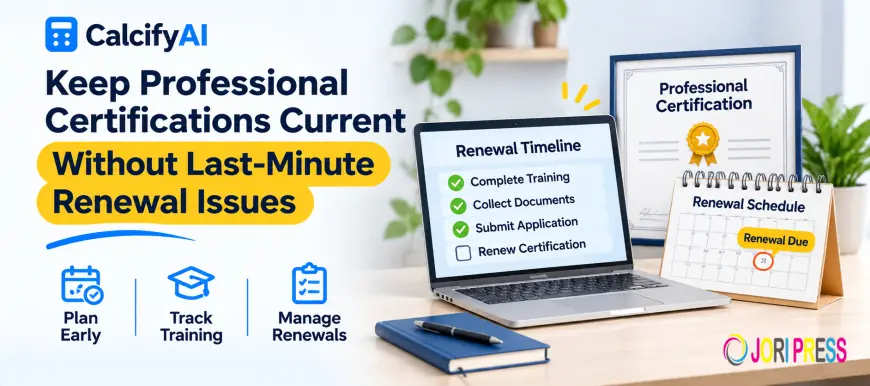
Instead, establish reminders for training completion, document collection, application submission, and confirmation of renewal.
This creates a more useful schedule than relying on a single annual notification.
Manage Continuing Education Throughout the Validity Period
Some professional credentials require holders to complete a specified amount of continuing education before renewal.
Leaving all training until the final months can make it difficult to balance professional responsibilities with course availability.
Consider a certification requiring sixty eligible education hours over a three-year period.
A professional who completes twenty hours each year would reach the required total by the end of the third year.
However, an equal annual distribution is not always practical.
The holder might complete twenty-five hours during the first year, fifteen during the second, and twenty during the third.
Both arrangements produce sixty hours.
Using an online calculator can help track completed training hours and identify the remaining requirement.
Keep evidence of each completed activity, including course certificates, attendance records, or other documentation accepted by the certification provider.
Not every training activity necessarily qualifies. Some providers restrict eligible subjects, learning formats, or the number of hours accepted from particular activities.
Review those conditions before registering for a course specifically intended to support renewal.
Where possible, choose educational activities that contribute to actual professional development rather than completing courses solely to satisfy an administrative requirement.
Organize Several Credentials in One Renewal Register
Professionals working across different areas may hold multiple certifications.
An information technology specialist, for example, could maintain separate credentials relating to software platforms, security practices, and project management.
Each certification may have a different renewal cycle.
A simple renewal register can contain the following information for every credential:
-
Certification name and issuing organization.
-
Current expiration date.
-
Required training or professional activities.
-
Recommended application submission date.
-
Expected processing period.
-
Renewal fee and current application status.
Review the register periodically, particularly when completing training or receiving updated information from a certification provider.
Keep copies of important renewal confirmations and check that the new expiration date has been recorded correctly.
If a provider changes its renewal requirements, update the preparation schedule rather than continuing to rely on information from an earlier renewal cycle.
Professionals should also consider whether every existing credential remains relevant to their current work. Maintaining unnecessary certifications may involve fees and preparation time that could be directed toward more suitable professional development.
A certification renewal schedule is ultimately a way of protecting continuity. By identifying requirements early, recording accurate dates, and distributing preparation across the available period, professionals can reduce avoidable administrative problems. The objective is not simply to remember when a credential expires, but to complete the necessary steps while sufficient time remains to address unexpected changes.
What's Your Reaction?
 Like
0
 Dislike
0
 Love
0
 Funny
0
 Angry
0
 Sad
0
 Wow
0