




































Karnataka Minimum Wages FY 2026–27: Complete Employer Compliance Guide Before April
Check Karnataka minimum wages for FY 2026–27. Know DA increase, salary rules, zones, and compliance steps to avoid penalties and payroll errors.
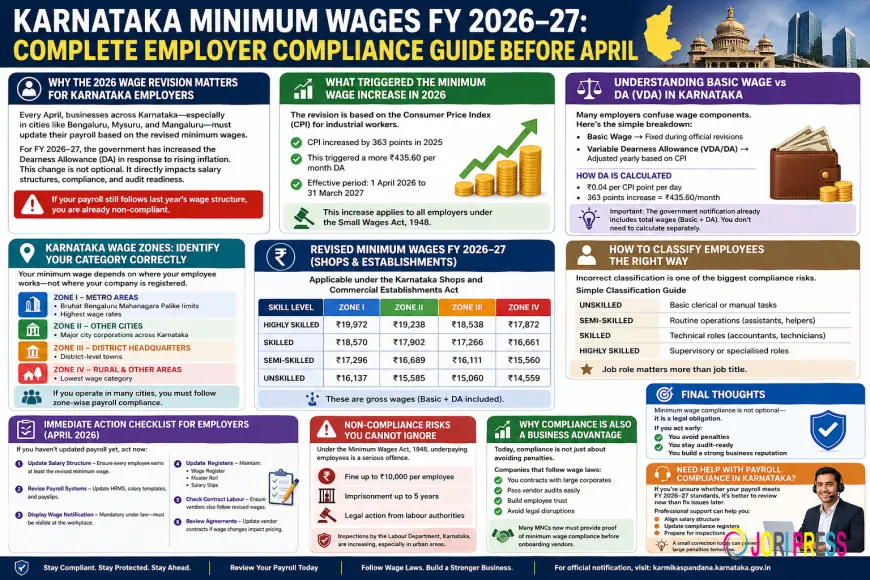
Why the 2026 Wage Revision Matters for Karnataka Employers
Every April, businesses across Karnataka —especially in cities like Bengaluru, Mysuru, and Mangaluru—must update their payroll based on the revised minimum wages.
For FY 2026–27, the government has increased the Dearness Allowance (DA) in response to rising inflation. This change is not optional. It directly impacts salary structures, compliance, and audit readiness.
If your payroll still follows last year’s wage structure, you are already non-compliant.
What Triggered the Karnataka Minimum Wage Increase in 2026
The revision is based on the Consumer Price Index (CPI) for industrial workers.
- CPI increased by 363 points in 2025
- This triggered a more ₹435.60 per month DA
- Effective period: 1 April 2026 to 31 March 2027
This increase applies to all employers under the Small Wages Act, 1948.
Understanding Basic Wage vs DA (VDA) in Karnataka
Many employers confuse wage components. Here’s the simple breakdown:
- Basic Wage → Fixed during official revisions
- Variable Dearness Allowance (VDA/DA) → Adjusted yearly based on CPI
How DA is Calculated
- ₹0.04 per CPI point per day
- 363 points increase = ₹435.60/month
? Important: The government notification already includes total wages (Basic + DA). You don’t need to calculate separately.
Karnataka Wage Zones: Identify Your Category Correctly
Your minimum wage depends on where your employee works—not where your company is registered.
Zone I – Metro Areas
- Bruhat Bengaluru Mahanagara Palike limits
- Highest wage rates
Zone II – Other Cities
- Major city corporations across Karnataka
Zone III – District Headquarters
- District-level towns
Zone IV – Rural & Other Areas
- Lowest wage category
? If you operate in many cities, you must follow zone-wise payroll compliance.
Revised Minimum Wages FY 2026–27 (Shops & Establishments)
Applicable under the Karnataka Shops and Commercial Establishments Act
|
Skill Level |
Zone I |
Zone II |
Zone III |
Zone IV |
|
Highly Skilled |
₹19,972 |
₹19,238 |
₹18,538 |
₹17,872 |
|
Skilled |
₹18,570 |
₹17,902 |
₹17,266 |
₹16,661 |
|
Semi-Skilled |
₹17,296 |
₹16,689 |
₹16,111 |
₹15,560 |
|
Unskilled |
₹16,137 |
₹15,585 |
₹15,060 |
₹14,559 |
? These are gross wages (Basic + DA included).
How to Classify Employees the Right Way
Incorrect classification is one of the biggest compliance risks.
Simple Classification Guide
- Unskilled → Basic clerical or manual tasks
- Semi-Skilled → Routine operations (assistants, helpers)
- Skilled → Technical roles (accountants, technicians)
- Highly Skilled → Supervisory or specialised roles
? Job role matters more than job title.
Immediate Action Checklist for Employers (April 2026)
If you haven’t updated payroll yet, act now:
1. Update Salary Structure
Ensure every employee earns at least the revised minimum Wage.
2. Revise Payroll Systems
Update HRMS, salary templates, and payslips.
3. Display Wage Notification
Mandatory under law—must be visible at the workplace.
4. Update Registers
Maintain:
- Wage Register
- Muster Roll
- Salary Slips
5. Check Contract Labour
Ensure vendors also follow revised wages.
6. Review Agreements
Update vendor contracts if wage changes impact pricing.
Non-Compliance Risks You Cannot Ignore
Under the Minimum Wages Act, 1948, underpaying employees is a serious offense.
Penalties Include
- Fine up to ₹10,000 per employee
- Imprisonment up to 5 years
- Legal action from labour authorities
? Inspections by the labour department, Karnataka, are increasing, especially in urban areas.
Why Compliance is Also a Business Advantage
Today, compliance is not just about avoiding penalties.
Companies that follow wage laws:
- Win contracts with large corporates
- Pass vendor audits easily
- Build employee trust
- Avoid legal disruptions
? Many MNCs now must provide proof of minimum wage compliance before onboarding vendors.
Final Thoughts: Fix Your Payroll Before It Becomes a Problem
Minimum wage compliance is not optional—it is a legal obligation.
If you act early:
- You avoid penalties
- You stay audit-ready
- You build a strong business reputation
Delays only increase cost and risk.
Need Help with Payroll Compliance in Karnataka?
If you’re unsure whether your payroll meets FY 2026–27 standards, it’s better to review now than fix issues later.
Professional support can help you:
- Align salary structure
- Update compliance registers
- Prepare for inspections
? A small correction today can prevent large penalties tomorrow.
FAQ
1. What is the minimum wage in Karnataka for 2026–27?
Minimum wages range from ₹14,559 to ₹19,972 per month depending on skill level and zone. These include Basic + DA.
2. What is the DA increase for Karnataka in 2026?
The Dearness Allowance increased by ₹435.60 per month due to a rise of 363 CPI points.
3. Is DA included in minimum wages?
Yes. Minimum wages include both basic salary and variable dearness allowance (VDA).
4. Who must follow minimum wage rules in Karnataka?
All employers under the Minimum Wages Act, 1948 including startups, MSMEs, IT firms, shops, and service businesses.
5. What happens if a company pays less than minimum wage?
It is a legal offence. Employers may face fines, penalties, or even imprisonment.
6. How often are minimum wages revised in Karnataka?
Basic wages are revised periodically, but DA is updated every year based on CPI changes.
7. Which zone does Bengaluru fall under?
Bengaluru falls under Zone I, which has the highest wage rates.
What's Your Reaction?
 Like
0
Like
0
 Dislike
0
Dislike
0
 Love
0
Love
0
 Funny
0
Funny
0
 Angry
0
Angry
0
 Sad
0
Sad
0
 Wow
0
Wow
0