






































Industrial RS232/RS485 to LoRa Converter: Wireless Communication for Remote Devices
RS232 RS485 to LoRa Converter enables reliable wireless communication for remote industrial devices, offering long-range connectivity and flexibility.

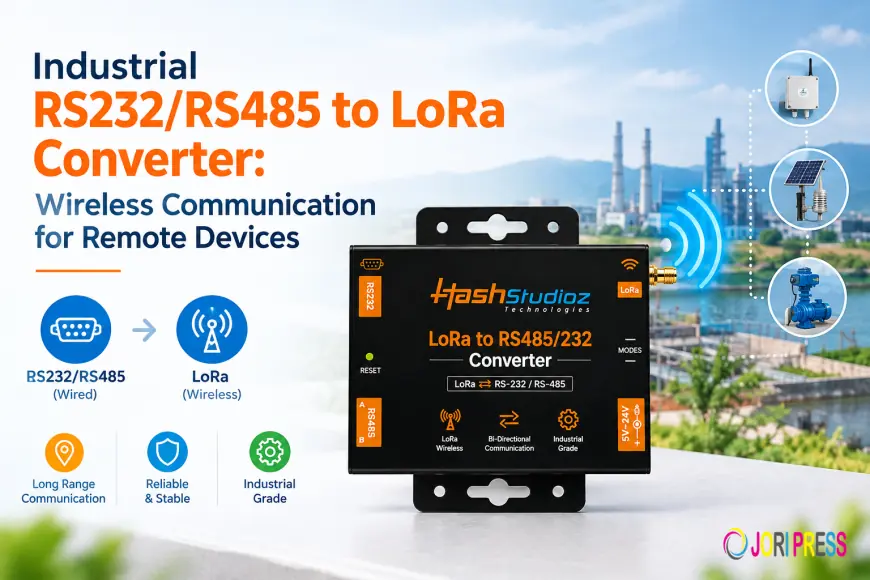
Industrial environments often rely on RS232 and RS485 interfaces to connect sensors, meters, PLCs, controllers, and other field devices. While these wired communication standards are reliable, connecting devices across large or difficult-to-wire areas can be challenging.
An Industrial RS232/RS485 to LoRa Converter provides a practical solution by transforming serial communication into long-range wireless communication. Using LoRa technology, industrial devices can exchange data over long distances without requiring extensive cabling.
What Is an Industrial RS232/RS485 to LoRa Converter?
An Industrial RS232/RS485 to LoRa Converter is a communication device that connects traditional serial equipment to a LoRa wireless network.
It typically supports RS232, RS485, or both interfaces on the serial side and uses LoRa radio communication to transmit and receive data wirelessly.
The basic communication flow is:
Industrial Device → RS232/RS485 → LoRa Converter → LoRa Wireless Network → Remote LoRa Converter → Industrial System
This allows existing serial devices to communicate wirelessly without replacing the equipment or redesigning the entire communication infrastructure.
Why Use LoRa for Industrial Communication?
LoRa is designed for long-range, low-power wireless communication. Compared with conventional short-range wireless technologies, it can be useful when industrial devices are distributed across large facilities or remote locations.
Key advantages include:
-
Long-range wireless communication
-
Reduced dependence on physical communication cables
-
Low power consumption
-
Reliable communication for remote monitoring
-
Flexible deployment across large industrial areas
-
Easy integration with existing serial devices
-
Suitable for challenging or remote installation locations
For industrial applications where installing communication cables is expensive or impractical, LoRa can provide a flexible alternative.
RS232 vs. RS485: Why Support Both?
RS232 and RS485 are widely used serial communication standards, but they serve different purposes.
RS232
RS232 is commonly used for point-to-point communication between devices. It can be found in older industrial equipment, controllers, instruments, and computers.
However, RS232 is generally intended for shorter communication distances and typically connects two devices directly.
RS485
RS485 is widely used in industrial automation because it supports longer cable distances and multi-device networks. It is commonly used with industrial sensors, energy meters, PLCs, and Modbus RTU devices.
An RS232/RS485 to LoRa converter can therefore help modernize both types of serial equipment by adding wireless connectivity.
How Does an RS232/RS485 to LoRa Converter Work?
The converter acts as a bridge between wired serial communication and wireless LoRa communication.
For example, consider a remote industrial sensor connected through RS485.
-
The sensor sends serial data through RS485.
-
The converter receives the RS485 data.
-
The converter processes the serial data for wireless transmission.
-
The data is transmitted through LoRa.
-
A remote LoRa converter receives the wireless data.
-
The receiving converter outputs the data through RS232 or RS485.
-
The connected controller or monitoring system receives the original data.
This approach allows existing serial equipment to communicate over a wireless link while minimizing changes to the field devices.
Key Features to Look For
When selecting an industrial RS232/RS485 to LoRa converter, several technical factors should be considered.
1. RS232 and RS485 Interface Support
Choose a converter based on the interfaces used by your existing industrial equipment. Dual-interface support can provide greater flexibility for mixed serial environments.
2. Long-Range Wireless Communication
The effective LoRa communication range depends on factors such as antenna selection, transmission power, environmental conditions, installation height, and obstacles.
For industrial deployments, the converter should be selected based on the actual site requirements rather than relying only on maximum theoretical range.
3. Industrial Protection
Industrial communication equipment may be exposed to electrical noise, voltage fluctuations, dust, temperature variations, and other harsh conditions.
Features such as ESD protection, surge protection, isolation, and a robust enclosure can improve reliability depending on the application.
4. Serial Communication Compatibility
The converter should support the required serial parameters, such as:
-
Baud rate
-
Data bits
-
Stop bits
-
Parity
-
RS485 communication mode
Compatibility with commonly used protocols such as Modbus RTU can also be important for industrial automation applications.
5. Easy Configuration
A good converter should provide a straightforward method for configuring serial and wireless parameters. This reduces installation time and makes troubleshooting easier.
Industrial Applications
Industrial RS232/RS485 to LoRa converters can be used across a wide range of applications.
Remote Meter Monitoring
Energy meters, water meters, and other measurement devices can transmit readings wirelessly to a central monitoring system.
Industrial Automation
RS485-based PLCs, sensors, controllers, and automation equipment can communicate wirelessly when conventional cabling is difficult to install.
Smart Agriculture
Remote agricultural sensors can use RS485 interfaces to collect information such as soil conditions, environmental parameters, and equipment status and transmit the data wirelessly.
Water and Wastewater Monitoring
Remote pumping stations, flow meters, level sensors, and other equipment can communicate with a central monitoring system without requiring long communication cables.
Factory Monitoring
Factories with distributed machines can use wireless serial communication to collect equipment data and improve centralized monitoring.
Remote Infrastructure
The technology can also be useful for infrastructure located across large areas, including utility systems, storage facilities, and remote monitoring stations.
Benefits of Wireless Serial Communication
Deploying an RS232/RS485 to LoRa converter can provide several practical benefits.
Reduced Cabling:
Wireless communication can reduce the need for long communication cables, particularly in remote or difficult-to-access locations.
Simpler Deployment:
LoRa connectivity can make it easier to connect devices located across large areas.
Integration with Existing Equipment:
Organizations can add wireless connectivity to existing serial devices without replacing them.
Lower Infrastructure Requirements:
Reducing communication cabling can simplify installation in some industrial environments.
Scalable Communication:
Additional remote devices can potentially be integrated as the industrial network expands, depending on the LoRa network architecture.
RS485 and LoRa for Modbus Applications
Many industrial devices use Modbus RTU over RS485. An RS485-to-LoRa converter can help transmit Modbus data wirelessly between remote field devices and a central controller or gateway.
For example:
Modbus Sensor → RS485 → LoRa Converter → Wireless Link → LoRa Converter → RS485 → PLC/Gateway
This architecture can be useful for applications where sensors are distributed across a large facility and centralized monitoring is required.
However, the converter and network architecture should be selected carefully to meet the timing, addressing, packet size, and communication requirements of the specific Modbus application.
Wired vs. Wireless Serial Communication
|
Feature |
Traditional RS232/RS485 |
RS232/RS485 + LoRa |
|
Communication |
Wired |
Wireless |
|
Cabling |
Required |
Reduced |
|
Deployment |
Suitable for fixed installations |
Suitable for remote/distributed devices |
|
Mobility/Flexibility |
Limited |
Higher |
|
Long-distance deployment |
Requires suitable cabling |
Wireless range depends on environment |
|
Existing device integration |
Direct |
Via converter |
The right approach depends on the application. Wired RS485 remains an excellent choice for many industrial networks, while LoRa can be valuable when wireless connectivity provides installation or operational advantages.
How to Choose the Right Converter
Before selecting an industrial RS232/RS485 to LoRa converter, consider:
-
Which serial interface is required: RS232, RS485, or both?
-
What baud rates and serial settings are required?
-
Is Modbus RTU required?
-
What communication distance is needed?
-
Are there significant obstacles between devices?
-
What environmental conditions will the converter experience?
-
Is electrical isolation required?
-
What power supply is available?
-
What antenna and enclosure options are required?
-
How many remote devices need to communicate?
-
Will the system need future expansion?
Answering these questions can help ensure that the selected converter matches the actual industrial environment.
Conclusion
An Industrial RS232/RS485 to LoRa Converter provides a practical way to extend traditional serial communication into wireless industrial networks. It can connect existing RS232 and RS485 equipment across remote or distributed locations while reducing dependence on physical communication cabling.
For applications involving industrial automation, remote monitoring, smart agriculture, utilities, energy management, and distributed sensors, LoRa-based serial communication can offer flexibility and simplified deployment.
By combining established serial interfaces with long-range wireless technology, businesses can modernize existing industrial communication systems without necessarily replacing their field equipment.
What's Your Reaction?
 Like
0
Like
0
 Dislike
0
Dislike
0
 Love
0
Love
0
 Funny
0
Funny
0
 Angry
0
Angry
0
 Sad
0
Sad
0
 Wow
0
Wow
0