





































Indian e-Visa vs Tourist Visa: Key Differences, Eligibility & How to Choose (2026)
Are you a tourist and planning to visit India? If so, then before you start packing your luggage, you must understand one crucial thing: obtaining the correct Visa. There are two options, namely the regular Paper Visa and the Indian e-Visa. Understanding how these two work can help you save time and avoid any unwanted problems.
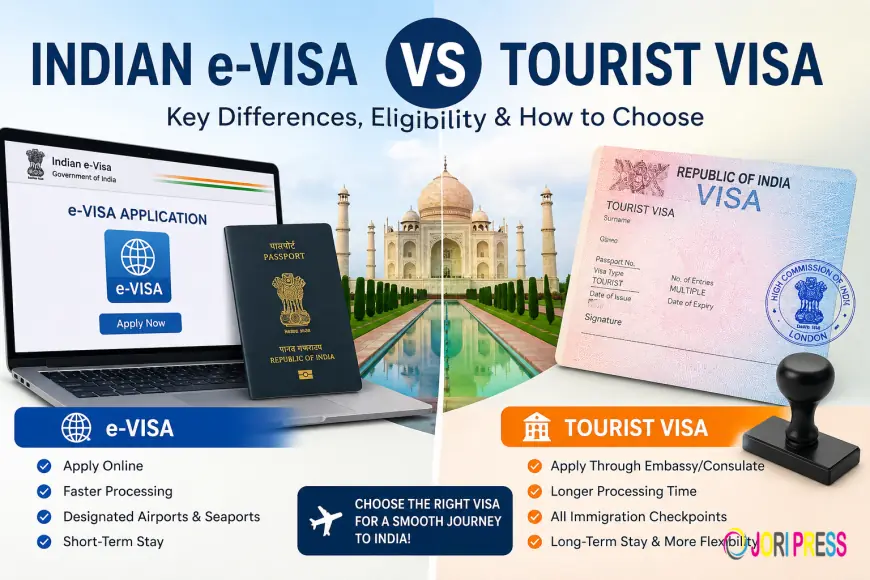
Are you a tourist and planning to visit India? If so, then before you start packing your luggage, you must understand one crucial thing: obtaining the correct Visa. There are two options, namely the regular Paper Visa and the Indian e-Visa. Understanding how these two work can help you save time and avoid any unwanted problems.
This guide will help you learn more about the Indian e-Visa and Tourist Visa, and which among them best suits your travel needs.
What are the types of Indian Visa?
There are several categories for an Indian Visa, but if you are a first-time traveller, the most common options include:
- Indian e-Visa
This includes e-Tourist Visa, e-Business Visa and e-Medical Visa. These can be easily applied online and are approved electronically. You can present them at designated ports of entry.
- Regular Paper Visa
This is issued by the Indian consulate for longer stays and multiple re-entries.
After you have completed the online application and paid the applicable fees, you will receive an Electronic Travel Authorisation (ETA). Print it and present it upon arrival in India.
The validity and stay limits for a US citizen are listed below:
- The maximum stay limit for a tourist visa (e-Visa or Regular Visa) is 180 days in a single year.
- Multiple entries are allowed using an e-Visa, but the stay per visit is limited.
- e-Visas are only valid for travel through designated airports and seaports.
Who all can apply for an e-Visa?
Since it is fast and online, most travellers prefer an e-Visa. But certain eligibility criteria are present. These are:
For US Citizens
- The US passports are eligible for the Indian e-Tourist Visa.
- The Indian e-Visa is digitally available for US citizens.
General Eligibility Criteria
- Your passport must be valid for at least 6 months from the date of arrival in India.
- Your passport must have at least 2 blank pages for immigration stamping.
- If you are a diplomatic/official passport holder or have a travel document, then you are not eligible for an e-Visa.
- Applicants must apply on the same passport they intend to travel with. If you obtain a new passport after approval, you should carry both the old and new passports.
Stay Limits and Restrictions
- For US nationals, long-term visas are valid for up to 10 years. However, the stay per entry is limited.
- Multiple-entry tourist visas can be granted for 10 years to US nationals.
What documents are required for an Indian visa?
The following documents are required to obtain an Indian Visa.
- Your valid passport with a minimum of 6 months' validity from the arrival date.
- Your passport-sized photo that meets the website requirements.
- A scan of your passport bio page for the e-Visa.
- Proof of return or onward ticket (accommodation details may be requested)
- For a business/medical visa, you must have an invitation letter, a business card and medical documents
How to apply for an Indian e-Visa?
To apply for an Indian e-Visa, follow the steps below.
1. Visit the Official Website
- Access the official online portal to apply for an e-Visa.
2. Fill out the Application Form
- Every applicant must complete a different form.
- Double-check all your details (names, passport number, nationality, purpose, etc) before submitting.
- Once submitted, you will be unable to modify anything.
3. Upload the Required Documents
- Your recent passport-sized photograph, with a white background
- A scan of your passport bio page
- Depending on the visa type, any kind of travel details or invitation
4. Fee Payment
- Pay the fees online based on your visa type and nationality.
- Make sure your card/transaction works internationally.
5. Receive ETA
- After approval, you will receive an Electronic Travel Authorisation (ETA) via email.
- You must print this and carry it with your passport when you travel.
6. Travel to India
- On arrival, present your passport and ETA at immigration.
- Your biometric capture will be done, and your passport will be stamped with a permitted stay.
Special Tips
- You must apply at least 4 days before your travel date.
- Make sure you enter via an authorised airport or seaport.
- Take a printout of your ETA and backup copies of your passport.
What are the Fees and Processing Time for an Indian Visa?
The fee for an Indian Visa mostly depends on nationality, visa category and duration. They also change periodically.
- The standard processing time for e-Visas is 4-5 working days, when all the documents are in order.
- The application should be submitted early to avoid last-minute stress.
Note: After you have submitted the application and paid the fee, it is usually non-refundable even if the application is rejected. (Standard practice)
What to do after arriving in India?
After arriving in India, you must keep the following points in mind.
- Show your passport and printed ETA (regular visa) at the immigration counter.
- Your biometric details, such as fingerprints and a photo, might be captured.
- Make sure you stay only for the permitted duration.
- If you are a US national, you must not stay for more than 180 days in a single year under a tourist visa.
- Always keep your visa and a copy of the ETA with you during your stay.
- If your visa is only for airport/seaport entry, then you must avoid entering anywhere via land border.
How to extend your stay and change your visa?
If you plan to stay for a longer duration, then you must keep these things in mind.
- In most cases, the e-Tourist Visa or e-Business Visa is non-extendable and non-convertible.
- If you have a regular Paper Visa and are planning to stay longer for any reason, you must apply for an extension with the FRRO (Foreign Regional Registration Office) or the local Foreigners Registration Office (FRO) in India.
- Overstaying your Visa may lead to legal issues and complications for future travels.
What are the common mistakes to avoid when applying for an Indian Visa?
The list below outlines the common errors that applicants make when applying for a visa.
- Always use the official government portal when applying. You can be misled or charged extra if you apply through non-official websites or agents.
- Avoid any mistakes in the online application (wrong passport number, spelling and date of birth) since you will not be able to edit them after submission.
- Beware of using the wrong visa category when applying.
- Avoid applying late. e-Visas must be applied for at least 4 days before arrival.
- You must not arrive through any unauthorised ports or land border when only airport or seaport entry is allowed.
- Avoid overstaying. This can lead to fines, deportation and difficulty getting future visas.
Important Tips and Tricks for a Smooth Experience
Take note of the following tips and tricks to have a smooth journey without any problems.
- Apply well in advance, such as 2-3 weeks before your trip. You must do this if you have planned for a long stay.
- Double-check all the data in your application before submitting.
- Always use the official government website when applying and avoid non-official services.
- Always carry copies of your accommodation booking, proof of funds and return ticket.
- Check for additional permit requirements if you plan to visit restricted or protected areas.
- Save the contact information of your country's embassy or consulate for emergencies.
- Understand the currency rules of the country you are visiting.
Conclusion
Travelling to India for the first time as a tourist may feel confusing with all the different types of visas. However, it is crucial to understand the type of visa you need for your travel. Having the correct visa not only helps you to have a smooth journey but also proves that you comply with the Visa authorities and their rules and regulations. Keeping in mind all the correct documents, submitting the application in time and choosing the correct visa category will help you avoid any unnecessary issues while visiting India.
What's Your Reaction?
 Like
0
Like
0
 Dislike
0
Dislike
0
 Love
0
Love
0
 Funny
0
Funny
0
 Angry
0
Angry
0
 Sad
0
Sad
0
 Wow
0
Wow
0