









































How to Write a Strong Introduction for an Essay
Learn how to write a strong essay introduction with practical tips for creating an engaging opening, providing relevant background, and developing a clear thesis statement.Discover how to write a strong introduction for an essay. Learn effective techniques for creating an engaging opening, adding relevant context, writing a focused thesis statement, and improving your academic writing.

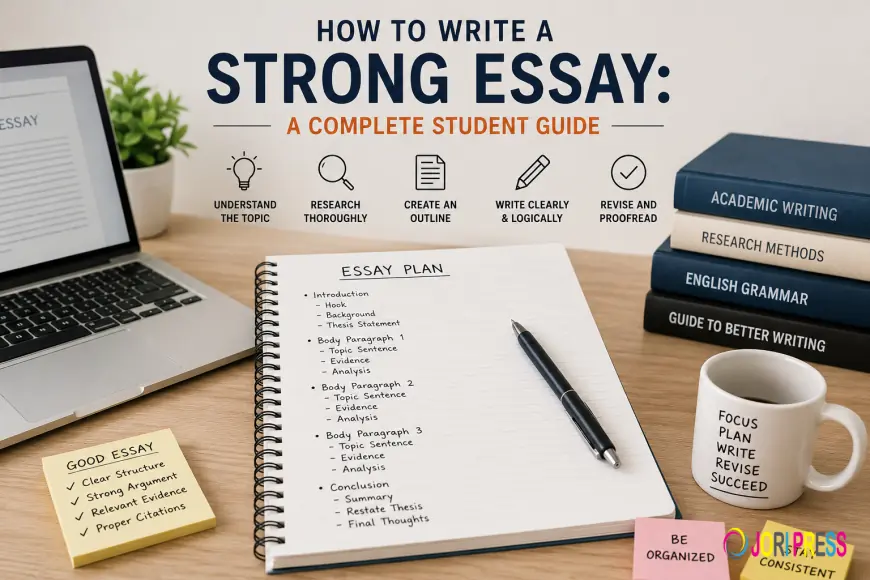
A strong essay introduction gives readers a clear idea of what the paper is about and why the topic matters. Learning how to write an essay introduction involves presenting the topic, providing relevant context, and ending with a focused thesis statement. A well-structured opening creates a positive first impression and prepares readers for the main arguments that follow.
Why Is an Essay Introduction Important?
The introduction is one of the most important parts of an academic essay because it establishes the direction of the entire paper. Before reading your arguments, evidence, and analysis, your reader encounters the introduction.
A well-written introduction should:
- Introduce the main topic clearly
- Provide enough background information
- Establish the purpose of the essay
- Capture the reader’s attention
- Present a clear thesis statement
- Prepare the reader for the discussion ahead
An introduction does not need to explain every point you will discuss. Instead, it should provide a concise roadmap that helps readers understand what to expect.
Start With an Engaging Opening
The first few sentences should encourage the reader to continue. This does not mean using exaggerated statements or unnecessary information. Instead, begin with something directly relevant to your topic.
Depending on the subject, you can start with:
- An interesting fact
- A relevant question
- A brief observation
- A surprising statistic
- A meaningful statement
- A short explanation of the issue
For example, if you are writing about social media and education, you could begin by discussing how digital platforms have changed the way students communicate and access information.
The opening should feel natural and should connect directly to the subject of your essay.
Provide Relevant Background Information
After getting the reader’s attention, provide some context about your topic. Background information helps readers understand the issue before you present your main argument.
However, avoid including information that does not contribute to your discussion. Too much background can make an introduction unnecessarily long and may distract readers from the main purpose of the essay.
Ask yourself:
What does my reader need to know before understanding my argument?
The answer can help you decide which information belongs in the introduction.
Clearly Introduce Your Main Topic
Once you have provided some context, narrow the discussion toward your specific subject.
For example, instead of beginning with a broad discussion about technology, gradually move toward a specific issue such as the impact of artificial intelligence on university education.
This narrowing approach creates a logical progression:
General idea → Background → Specific issue → Main argument
This structure makes the introduction easier to follow and gives your essay a clear direction.
Write a Focused Thesis Statement
The thesis statement is usually the most important sentence in an academic essay introduction. It communicates the central argument or position that your essay will develop.
A strong thesis should be:
- Clear
- Specific
- Relevant to the topic
- Debatable when appropriate
- Supported by the body of the essay
For example, instead of writing:
Technology is important in education.
A more focused thesis might be:
Artificial intelligence can improve university education by providing personalized learning opportunities, supporting research, and helping students develop more efficient study strategies.
The second statement gives the reader a clearer understanding of the essay's argument and the areas that will be discussed.
Create a Logical Flow Between Ideas
A professional introduction should not feel like a collection of unrelated sentences. Each idea should naturally lead to the next.
One effective structure is:
- Introduce the broader topic.
- Provide necessary background.
- Narrow the discussion.
- Identify the central issue.
- Present the thesis statement.
Using this progression can make your essay writing more organized and easier for readers to understand.
Transitions can also help connect ideas. Words such as however, therefore, in addition, consequently, and in contrast can improve the flow when they are used appropriately.
Keep the Introduction Focused
One common mistake students make is trying to include too much information in the introduction.
Remember that the introduction is not the place to explain every argument, example, or source. Those details belong in the body paragraphs.
A focused introduction should answer three basic questions:
- What is the essay about?
- Why is the topic important?
- What is the main argument?
If your introduction answers these questions clearly, readers will have a better understanding of your essay.
Avoid Unnecessary General Statements
Broad statements can make an introduction sound weak or predictable.
For example:
Since the beginning of time, education has been important to society.
This type of opening does not provide meaningful information about the specific essay topic.
Instead, begin with a statement that immediately connects to your subject.
A precise opening demonstrates that you understand the topic and have a clear purpose for writing.
Match the Introduction to the Essay Type
Different types of essays may require slightly different approaches.
An argumentative essay should introduce the issue and establish the position you intend to defend.
A compare and contrast essay should introduce the subjects being compared and establish the basis for comparison.
A critical analysis essay should introduce the work or subject being analyzed and establish the central analytical perspective.
A research paper may require additional background information before presenting the research problem or thesis.
Understanding the purpose of your assignment can help you determine what information your introduction should contain.
Use Academic Language Without Making It Complicated
Professional academic writing should be clear rather than unnecessarily complicated.
Avoid excessive jargon, informal expressions, slang, and overly long sentences. Choose precise words that communicate your ideas effectively.
For example:
Less effective:
This topic is really, really important and has a huge impact on basically everyone.
More academic:
This issue has significant implications for students, educators, and educational institutions.
The second version communicates the idea more precisely and professionally.
Connect the Introduction to the Body Paragraphs
A strong introduction should prepare readers for what comes next.
If your thesis identifies three main areas of discussion, the body paragraphs should develop those areas with evidence and analysis.
For example, if your thesis states that online learning improves accessibility, flexibility, and personalized education, your body paragraphs should explore these points rather than introduce completely unrelated arguments.
This connection creates essay structure and helps maintain consistency throughout the paper.
How Long Should an Essay Introduction Be?
There is no universal word count for an essay introduction because the appropriate length depends on the overall assignment.
For a short college essay, the introduction may only require one well-developed paragraph. A longer research paper may need several paragraphs to establish the necessary context.
As a general principle, the introduction should be long enough to establish the topic and thesis but short enough to leave room for the main discussion.
Quality is more important than reaching a specific word count.
Common Introduction Mistakes to Avoid
Students often weaken their essays by making avoidable mistakes in the opening paragraph.
Starting Too Broadly
Avoid beginning with extremely general statements that have little connection to your specific topic.
Including Irrelevant Information
Every sentence should contribute to the purpose of the introduction.
Writing a Weak Thesis
A vague thesis makes it difficult for readers to understand the central argument.
Using Unsupported Claims
If you make a factual claim that requires evidence, make sure it can be supported by a reliable source.
Repeating the Assignment Question
Simply rewriting the essay prompt does not create a strong introduction. Instead, develop the topic and establish your own argument.
Giving Away the Entire Essay
The introduction should provide direction without unnecessarily explaining every detail of your argument.
A Simple Formula for Writing Better Introductions
If you struggle with where to begin, use this simple structure:
Hook → Background → Specific Topic → Problem or Focus → Thesis Statement
For example:
Hook: Introduce an interesting aspect of the subject.
Background: Give the reader essential context.
Specific Topic: Narrow the discussion.
Focus: Explain the particular issue being examined.
Thesis: State your central argument.
This formula can be adapted to different academic assignments and subjects.
How to Improve Your Introduction During Editing
Do not assume your first draft is your final version. Reviewing your introduction after completing the essay can help you identify areas that need improvement.
Ask yourself:
- Is the topic immediately clear?
- Does the opening sentence relate to the subject?
- Have I provided enough context?
- Is my thesis specific?
- Does the thesis match my body paragraphs?
- Have I removed unnecessary information?
- Does the introduction transition naturally into the main discussion?
Reading the introduction after completing the body can be particularly useful because you now have a clearer understanding of the essay's overall argument.
Final Thoughts
Learning how to write a strong introduction for an essay is an essential academic writing skill. A successful introduction does more than introduce a topic—it establishes context, communicates purpose, and gives readers a clear understanding of the argument.
By starting with a relevant opening, providing focused background information, narrowing the topic, and ending with a strong thesis statement, students can create introductions that are clear, professional, and engaging.
Strong introductions are built through practice. The more you analyze effective academic writing and revise your own work, the easier it becomes to develop an opening that gives your essay a confident and organized beginning.
If you need additional guidance with academic writing, Write Essay Today can also be used as a resource for students looking to improve their essay-writing process.
What's Your Reaction?
 Like
0
Like
0
 Dislike
0
Dislike
0
 Love
0
Love
0
 Funny
0
Funny
0
 Angry
0
Angry
0
 Sad
0
Sad
0
 Wow
0
Wow
0