








































How to Scale a Business Without Scaling Your Problems
Ashish Somvanshi explains why most businesses scale their problems along with their growth and how building the right systems before hiring can change everything.
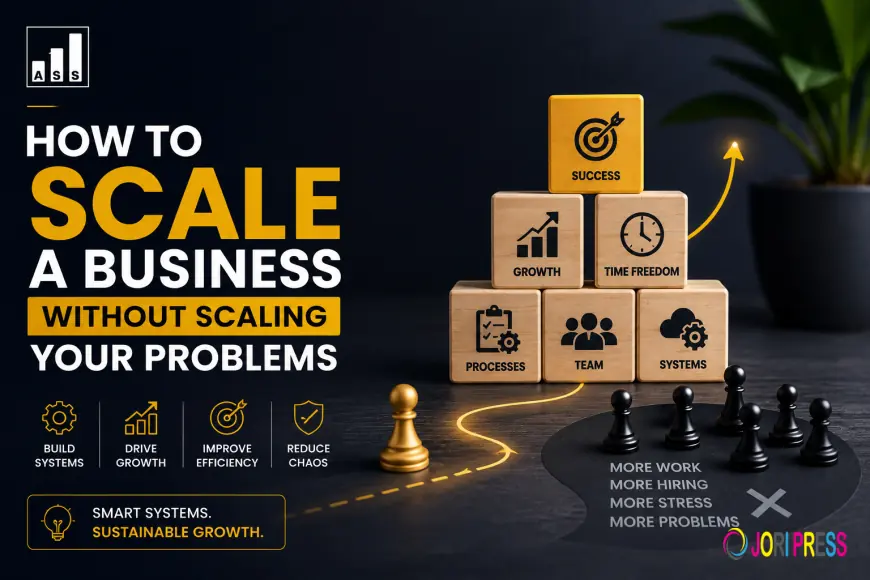
There's a version of growth that feels exciting from the outside and exhausting from the inside.
More clients. More team members. More revenue. More of everything — including more chaos, more fires to put out, more things falling through the cracks. The business is technically bigger, but nobody feels like they're winning. The founder is more stressed than they were when they started. The team is stretched. The customers are getting a slightly worse version of the product or service that made the business successful in the first place.
This is what scaling your problems looks like. And it happens to more businesses than most founders want to admit.
I've built three ventures. I've worked with hundreds of brands and education institutions across India. And the single most common mistake I see growing businesses make isn't a marketing mistake or a hiring mistake or a product mistake. It's a systems mistake. They try to grow before they've figured out how to run what they already have.
Growth Exposes Everything
Here's the thing about scale — it's a magnifier.
Whatever is working in your business gets amplified when you grow. But whatever isn't working gets amplified too. The communication gap that was manageable when your team was five people becomes a serious problem when your team is twenty-five. The manual process that worked fine when you had ten clients starts breaking down when you have fifty. The founder who could keep everything in their head when the business was small becomes a bottleneck when every decision still needs to go through them.
Scale doesn't create new problems. It reveals the ones that were already there.
This is why businesses that grow too fast often implode — not because the market wasn't there, not because the product wasn't good enough, but because the infrastructure underneath couldn't hold the weight of the growth sitting on top of it.
The businesses that scale well are the ones that solve the infrastructure problem before it becomes a crisis. Not after.
The Difference Between Busy and Productive
One of the most uncomfortable conversations I have with founders is about the difference between being busy and being productive.
Most growing businesses are full of busy people. Everyone is working hard. Everyone has a full calendar. Everyone is responding to things, attending things, managing things. And yet somehow the business isn't moving forward as fast as it should.
The reason is almost always the same — activity without systems is just noise.
When every task depends on someone remembering to do it, when every process lives in someone's head rather than in a documented workflow, when every decision escalates to the founder because there's no framework for making it at a lower level — the business creates its own drag. It consumes energy without converting that energy into outcomes.
Building systems isn't glamorous work. It doesn't generate the same excitement as closing a big client or launching a new product. But it is the work that determines whether your growth compounds or collapses.
What I Mean by Systems
I use the word systems a lot, and I want to be specific about what I mean because it gets thrown around loosely.
A system is any process that can run without you making a decision every time it runs. It's the documented workflow that tells your team exactly what to do when a new client comes in, so you don't have to explain it again. It's the automated follow-up sequence that keeps your leads warm without someone manually sending emails. It's the reporting structure that tells you what's working and what isn't without you having to dig through spreadsheets every week.
Systems are how you buy back your time as a founder. They're how you make sure the quality of what your business delivers doesn't depend entirely on which team member is handling it on a given day. They're how you make growth feel manageable rather than overwhelming.
The most scalable businesses I've worked with all have one thing in common — they've systematized everything that can be systematized, so the human energy in the business goes toward the things that actually require human judgment.
Hiring Before You're Ready Is a Trap
One of the most common mistakes I see founders make when they start growing is hiring people to solve problems that systems should solve.
The client onboarding process is chaotic, so they hire an account manager. The lead follow-up is inconsistent, so they hire a salesperson. The social media presence is weak, so they hire a content creator. Each hire makes sense in isolation. But without the underlying systems to support those people, you've just added headcount without adding capacity.
The account manager is now managing chaos manually. The salesperson is following up inconsistently because there's no CRM process to follow. The content creator is creating content without a strategy.
The right order is systems first, then people. Build the process, then hire someone to run it. That hire will onboard faster, perform better, and stay longer — because they have something to work within, not just a problem to figure out alone.
The Founder Bottleneck
I want to talk about something that most business growth content glosses over — the founder as the primary obstacle to scaling.
I've been this person. I know what it feels like to believe that the business runs on your judgment and that if you step back something will go wrong. And in the early days, that belief is often true. Your judgment is the product. Your relationships are the business. Your energy is the engine.
But there comes a point where that dynamic has to change. Where your job shifts from doing to enabling. From being the best person in the room to building a room full of people who don't need you to be in it.
That transition is hard. It requires letting go of things you're good at. It requires trusting people to make decisions you might have made differently. It requires being willing to accept that the business will sometimes do things in a way that isn't exactly how you would have done them — and that's okay, because the alternative is staying small forever.
The founders who scale successfully are the ones who make this transition deliberately and early. The ones who wait until they're completely overwhelmed usually make it reactively and badly.
What Scaling Well Actually Looks Like
The businesses I've seen scale well don't feel frantic. They feel calm, even when they're moving fast. The team knows what they're supposed to be doing. The founder is working on the business more than in it. Problems get caught early because there are systems to catch them. New clients or customers get a consistent experience because the process doesn't depend on which person shows up that day.
That kind of business is built deliberately, not accidentally. It requires saying no to growth opportunities that come before you're ready for them. It requires investing in infrastructure before you feel the pain of not having it. It requires treating the way you run your business with the same seriousness you treat the product or service you're selling.
Growth without that foundation isn't really growth. It's just more — more clients, more stress, more problems, more of everything except the thing you actually wanted when you started, which was a business that works.
What's Your Reaction?
 Like
0
Like
0
 Dislike
0
Dislike
0
 Love
0
Love
0
 Funny
0
Funny
0
 Angry
0
Angry
0
 Sad
0
Sad
0
 Wow
0
Wow
0