






































Specialised Elderly Care at Home in Joka: What Families Actually Need to Know
As Joka continues to grow with new residential communities and an ageing population, more families are seeking reliable elderly care that allows loved ones to remain safely at home. This article explains why specialised home care is becoming increasingly important in Joka and how it differs from basic attendant services. It explores the different levels of home care—from companionship and daily assistance to skilled nursing and condition-specific support for dementia, stroke recovery, respiratory illnesses, and post-hospitalisation care. The article also discusses the unique healthcare challenges faced by families in Joka, including the need for coordinated care between hospitals and home. Readers will learn what to look for when choosing a home healthcare provider, common warning signs to avoid, and why proper clinical supervision matters for long-term patient safety and quality of life. Whether caring for an elderly parent recovering from surgery or managing a chronic medical condition, this guide helps families make informed decisions about specialised elderly care at home.
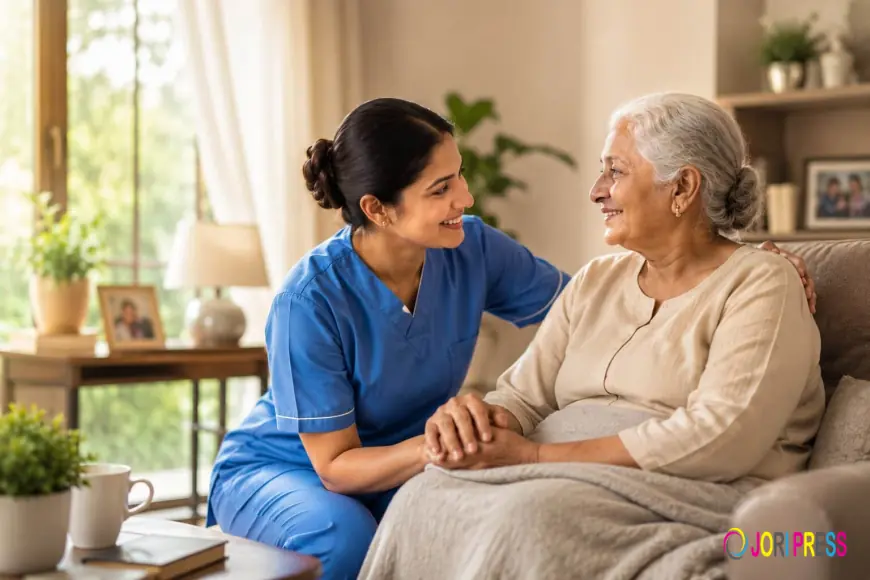
Joka has changed faster than most people notice. A decade ago it was a quiet edge of South Kolkata, known mainly for IIM Calcutta and open land. Today it is a locality of new residential towers, young working professionals, and an ageing population that increasingly lives alone for large parts of the day. Adult children move for work, commute long hours, or relocate outright, while parents stay back in the home they have always known. This shift has created a steady, quiet demand for elderly care that happens inside the home rather than in an institution.
Search for the topic online and the picture that comes back is oddly narrow. Most questions and answers about elder care in Kolkata point toward old age homes, assisted living campuses, or city-wide attendant agencies that treat Joka as just one more pin on a service map. Very little of it addresses what specialised home care in Joka specifically involves: the medical conditions it needs to cover, how the locality's geography affects response time, and what separates a trained caregiver from a companion who simply sits with an elderly person. This article tries to close that gap.
Why Joka's Situation Is Different From the Rest of Kolkata
Joka sits at the southern edge of the Kolkata Municipal Corporation area, bordered by Thakurpukur, Pailan, and Maheshtala. It is well connected by the metro and by Diamond Harbour Road, but it is still a meaningful distance from the major multi-speciality hospitals clustered around central and south-central Kolkata. For an elderly resident managing a chronic condition, that distance matters. A missed dose, a fall, or a sudden drop in oxygen saturation cannot always wait for a trip across the city.
At the same time, Joka is not without medical infrastructure. The ESIC Medical College and Hospital gives the area a genuine tertiary care anchor, and a growing number of diagnostic centres and clinics have opened along with the residential boom. The opportunity in Joka is not the absence of healthcare, but the absence of a bridge between hospital-based treatment and what happens to a patient between appointments, inside their own home.
What "Specialised" Home Care Actually Means
The word specialised gets used loosely. In practice, home care in Kolkata spans a wide range, and families searching for help often cannot tell one tier from another until they have already hired someone.
General companionship and daily support
This covers help with bathing, dressing, meals, mobility around the house, and simply having someone present. It requires patience and reliability, but not clinical training. Most of the attendants advertised through classifieds and local agencies sit in this category.
Skilled nursing care
This is care delivered or supervised by a qualified nurse: wound dressing, catheter and feeding tube management, injections, vital monitoring, and coordination with the treating doctor. It is used for patients recovering from surgery, managing diabetes with complications, or living with a condition that needs regular clinical observation.
Condition-specific specialised care
This is the tier most home care conversations skip entirely. It includes dementia and Alzheimer's care that requires behavioural training, not just supervision; post-stroke rehabilitation involving physiotherapy and speech therapy at home; oxygen and ventilator support for respiratory patients; and palliative care for those in advanced illness, where comfort and dignity matter as much as medical procedure. Each of these needs a different skill set, and conflating them under one "elderly care" label is where families run into trouble.
Conditions That Commonly Bring Families to Home Care in Joka
● Post-hospitalisation recovery, especially after cardiac events, fractures, or major surgery, where the patient is discharged but not yet independent
● Dementia and memory-related conditions, where routine, familiar surroundings, and a trained caregiver reduce agitation better than a facility can
● Diabetes and other chronic illnesses that need daily monitoring, medication timing, and diet supervision
● Mobility loss following stroke or age-related decline, requiring physiotherapy and fall-prevention support
● Respiratory conditions that require home oxygen concentrators or equipment monitoring
● End-of-life and palliative situations, where the family wants the patient to remain at home with clinical support available
What to Check Before Hiring a Home Care Provider in Joka
Because the market includes everyone from informal attendants to trained clinical teams, the burden of verification usually falls on the family. A few questions tend to separate a genuine specialised provider from a general staffing agency.
● Are the nurses and attendants formally trained and background-verified, and can the provider show this rather than just claim it?
● Is there a doctor or clinical supervisor who reviews the case periodically, not just an attendant working in isolation?
● What happens in a genuine emergency? Is there a documented protocol for stabilising the patient and reaching a hospital quickly given Joka's distance from major medical centres?
● Is care documented, with notes on vitals, medication, and any changes, so a family member or doctor can review progress?
● Does the provider understand the local area well enough to coordinate with nearby diagnostic centres and hospitals, rather than treating Joka as a remote drop-off point?
Red Flags Families Often Miss
A provider who cannot clearly explain the difference between an attendant and a nurse is usually offering the former while charging for the latter. Vague answers about staff training, an unwillingness to share credentials, and no fixed point of contact for emergencies are all signs the arrangement is informal rather than specialised. Price alone is not a reliable indicator either; both overpriced and underpriced services can be poorly supervised.
The Caregiver Behind the Caregiver
Home care conversations tend to focus entirely on the elderly patient, but the adult children coordinating this care, often from a distance, carry a real burden too. Choosing home-based specialised care is frequently as much about giving the family a dependable system to check in on as it is about the patient's medical needs. A good provider keeps the family informed without requiring them to manage every detail themselves.
Frequently Asked Questions
Is home care in Joka as reliable as hospital-based care for serious conditions?
For stable, ongoing needs such as post-surgical recovery, dementia support, or chronic disease management, well-supervised home care can match hospital-level attention while keeping the patient in familiar surroundings. It is not a substitute for emergency or intensive hospital treatment, but it works well as the bridge before and after it.
How is specialised care different from hiring a local attendant?
An attendant provides supervision and daily assistance. Specialised care adds clinical oversight, a trained nurse or therapist, and a doctor who reviews the case, which matters for conditions like dementia, stroke recovery, or respiratory support.
What should a family in Joka do first if they are unsure what level of care is needed?
A short conversation with the patient's treating doctor, followed by an assessment from a home care provider, usually clarifies whether the need is companionship, skilled nursing, or condition-specific specialised care. Starting with an assessment avoids paying for the wrong tier of service.
The Way Forward
Joka's residential growth is not slowing down, and neither is the number of elderly residents who will need support that a busy household cannot always provide on its own. The families who navigate this well are usually the ones who understand what "specialised" should actually mean before they hire anyone, rather than after something goes wrong. Providers such as Medilink Healthcare Services have grown alongside this need in South Kolkata, but regardless of who a family eventually chooses, asking the right questions upfront remains the most reliable way to get care that genuinely fits the situation at home.
What's Your Reaction?
 Like
0
Like
0
 Dislike
0
Dislike
0
 Love
0
Love
0
 Funny
0
Funny
0
 Angry
0
Angry
0
 Sad
0
Sad
0
 Wow
0
Wow
0