









































How to Choose the Right Washing Machine for Your Home

Washing Machines on Sale can make upgrading your laundry routine much more affordable, but finding the right model involves more than simply choosing the lowest price. A washing machine is a long-term household appliance that can affect your daily routine, water consumption, electricity bills, and the condition of your clothes. With so many sizes, designs, features, and wash programs available, it is worth understanding what to look for before making a purchase.
Whether you are replacing an old machine, moving into a new home, or buying your first washer, a little research can help you choose an appliance that suits your household and laundry habits. From capacity and efficiency to installation requirements and useful features, several factors deserve consideration.
Start With the Right Washing Machine Capacity
One of the first things to consider is the machine's capacity. Washing machines are generally measured by the kilograms of laundry they can handle in a single cycle. Choosing an appropriate capacity can help prevent overloading while avoiding the unnecessary use of a large machine for small loads.
For individuals or couples, a smaller-capacity washing machine may be sufficient for everyday laundry. Families with several members, children, or larger amounts of bedding and towels may benefit from a larger capacity.
However, bigger is not always better. A washing machine with more capacity may take up additional space and could use more water and energy depending on the model and selected cycle. Think about how frequently you wash clothes and the typical size of your loads before choosing.
Consider the Available Space
Before purchasing a washing machine, measure the area where you intend to install it. This sounds simple, but it is an important step that is sometimes overlooked.
Measure the available width, height, and depth, and remember to allow enough room for hoses, electrical connections, ventilation where applicable, and opening the door or lid. If the machine will be installed in a confined laundry area, a few centimetres can make a significant difference.
You should also consider the route the appliance will take when it is delivered. Doorways, hallways, stairs, and tight corners can affect whether a particular model can be brought into position safely.
For front-loading machines, check that there is sufficient space to open the door fully. If the machine is going beneath a bench or in a particularly compact area, its dimensions should be compared carefully with the available space.
Front Load or Top Load?
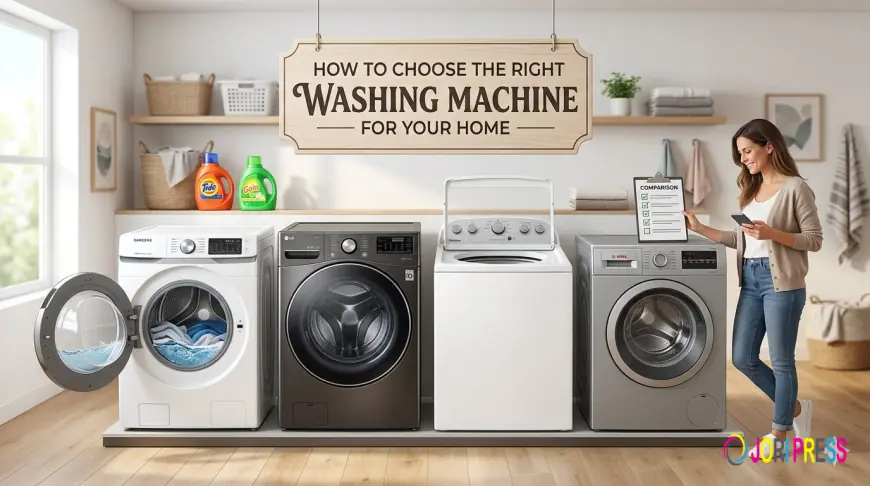
Another important decision is whether to choose a front-loading or top-loading washing machine. Both designs have advantages, so the better option depends on your preferences and laundry setup.
Front-loaders typically have a door at the front and use a horizontal drum. They can be convenient for households looking to maximise floor space because some models can be paired with a compatible dryer in a stacked configuration. They are also often designed with a variety of specialised wash programs.
Top-loaders have a lid on the top and allow users to place clothes into the machine without bending as far down. Some households prefer this design because it can be easier to add or remove laundry during certain stages of a wash.
When comparing the two designs, consider accessibility, available space, typical laundry loads, and the features that matter most to you.
Look at Energy and Water Efficiency
Running a washing machine regularly can contribute to household utility costs, so efficiency is another factor worth considering.
Modern washing machines can offer different approaches to managing water and electricity consumption. Energy ratings can help shoppers compare models, while water-efficiency information provides insight into how much water a machine may use under specified conditions.
However, efficiency is influenced by more than the appliance itself. The selected wash cycle, load size, water temperature, and frequency of washing can all affect overall consumption.
Using cold-water cycles when appropriate, washing full loads rather than repeatedly running small loads, and selecting an appropriate program can help make everyday laundry more efficient.
Choose Features That You Will Actually Use
Modern washing machines can include a long list of features. Some can be genuinely useful, while others may not matter to your household.
Common features include delayed start, quick wash programs, temperature selection, adjustable spin speeds, child locks, automatic load sensing, and specialised cycles for different types of fabric.
Some appliances also offer smart connectivity, allowing users to monitor or control certain functions through a smartphone application. This can be useful for people who want additional control over their laundry schedule.
The key is to distinguish between useful functionality and features that simply increase the purchase price. If you primarily wash everyday clothing, towels, and bedding, you may not need an appliance packed with specialised settings.
Think About Your Laundry Habits
Your personal laundry routine should influence your choice just as much as technical specifications.
Someone who washes several loads every week may benefit from a machine designed for frequent use and a capacity that accommodates larger loads. A smaller household that washes less frequently may have different priorities.
Consider the types of clothing you regularly wash as well. If your wardrobe includes delicate fabrics, sportswear, work clothes, children's clothing, or heavily soiled items, look for a machine with programs suited to those needs.
Families may also appreciate practical features such as shorter cycles, easy-to-use controls, and programs designed to handle everyday stains.
Pay Attention to Spin Speed
Spin speed determines how quickly the drum rotates during the spin portion of a wash cycle. A higher spin speed can remove more water from clothing before the laundry is transferred to a clothesline or dryer.
This can be particularly useful if you frequently use a dryer because clothing may enter the drying process with less moisture.
However, maximum spin speed is not necessarily the most important specification for everyone. Different fabrics may require different treatment, and some delicate garments should be washed and spun more gently.
A machine with adjustable spin speeds can provide additional flexibility for different types of laundry.
Consider Noise Levels
If your laundry area is close to bedrooms, living spaces, or a home office, noise can be an important consideration.
Washing machines can produce different levels of sound during washing and spinning. A machine that operates relatively quietly may be more comfortable for households where laundry needs to be done while people are sleeping, working, or relaxing.
Remember that installation also matters. An uneven floor or improperly levelled machine can cause excessive vibration and noise during high-speed spinning. Proper installation can therefore be just as important as the machine's advertised noise characteristics.
Check Installation and Maintenance Requirements
Before buying, find out what is required to install and maintain the machine. Most washing machines need appropriate water connections, drainage, electrical power, and a stable level surface.
Regular maintenance can also help keep an appliance working properly. Cleaning the detergent drawer, checking seals, removing debris from filters where applicable, and following the manufacturer's cleaning recommendations can help maintain performance.
Front-loading machines may require particular attention to the door seal because moisture can remain around the rubber gasket after a cycle. Leaving the door slightly open when appropriate can help the interior dry between washes.
Always follow the manufacturer's instructions for cleaning and maintenance.
Compare the Overall Value
Price is naturally an important part of the purchasing decision, but it should not be the only consideration.
A cheaper appliance may appear attractive initially, but a model with better efficiency, useful programs, appropriate capacity, and suitable build quality may provide better value over its useful life.
Compare the purchase price alongside running costs, capacity, features, warranty coverage, installation requirements, and expected usage. Also consider whether you genuinely need premium features or whether a simpler model will comfortably meet your requirements.
When comparing several appliances, making a short list of your essential requirements can make the process much easier.
Make Laundry Easier With the Right Choice
A washing machine is an appliance you may use several times a week for many years, so choosing one that matches your household is worthwhile. Start by measuring your available space, determining the capacity you need, and deciding whether a front-loader or top-loader suits your routine.
From there, compare efficiency ratings, wash programs, spin speeds, noise levels, maintenance requirements, and additional features. Instead of focusing solely on the most advanced or cheapest option, look for a machine that provides the combination of performance, convenience, efficiency, and capacity that makes sense for your home.
Taking time to compare different models before purchasing can help you avoid common mistakes and make laundry more convenient in the long run. A well-chosen washing machine can simplify one of the most repetitive household tasks while helping you manage water, energy, and time more effectively.
For shoppers comparing household appliances, exploring available washing machine options can be a useful starting point before deciding which model best fits their laundry needs.
What's Your Reaction?
 Like
0
Like
0
 Dislike
0
Dislike
0
 Love
0
Love
0
 Funny
0
Funny
0
 Angry
0
Angry
0
 Sad
0
Sad
0
 Wow
0
Wow
0