




































How to Choose a Wood Burning Stove Installer in Lincolnshire: Nine Checks Before You Pay a Deposit
Learn how to choose a wood-burning stove installer in Lincolnshire with nine essential checks to make before paying a deposit, from credentials to installation costs.
Most people spend weeks choosing a stove and about ten minutes choosing the person who fits it. That is the wrong way round.
The appliance sitting in a showroom is a tested, certified product. Every model on sale in the UK today has been through Ecodesign testing. The variable is not the stove. The variable is the flue it is connected to, the hearth it stands on, the air supply feeding it, and the competence of the person who signed the whole thing off.
Get that wrong, and the consequences are not abstract. A badly lined flue can leak combustion gases into a bedroom above. An undersized liner tars up and becomes a chimney fire risk. An install with no certification can invalidate a home insurance claim and will show up as a defect when you come to sell.
Here are the nine things worth checking before money changes hands.
1. Competent person scheme registration, confirmed at source
Installing a solid fuel appliance is notifiable work under the Building Regulations. There are only two legitimate routes to compliance. Either you notify your local authority building control department before work starts and pay for an inspection, or you use an installer registered with a competent person scheme who self certifies the work and notifies the council on your behalf.
HETAS is the scheme that specialises in solid fuel, wood and biomass. NAPIT and OFTEC also cover solid fuel work. Any of these is acceptable.
What matters is verifying it rather than believing it. A registration number on a van is not evidence. Ask for the number and check it against the scheme's own installer directory. Registration is held by a named engineer, not by a company, so also confirm that the person actually turning up is the registered one and not a subcontractor working under somebody else's number.
If an installer tells you certification is optional, or offers to do the job cheaper without paperwork, walk away. You are not saving money. You are buying an uninsurable appliance.
2. Ask who carries out the chimney work
This is the question that separates a fitter from a specialist, and it is the one most homeowners never think to ask.
Plenty of installers are competent at connecting an appliance and dropping a liner down an existing flue. Far fewer can touch the structure itself. If your survey turns up a cracked crown, a leaning stack, perished pointing, an unlined Victorian flue that has been parged and patched over the decades, or a chimney that was capped and rendered over during a previous renovation, that becomes masonry work.
At that point the job either stalls while a second trade is found, or the installer takes a shortcut and fits the appliance to a chimney that was never fit for purpose.
Ask directly: do you do repointing, recrowning, repotting and rebuilds in house, or do you bring someone else in? Firms with a construction background behind them, such as the team at TSR Fires & Flues Ltd, handle both sides under one contract, which matters enormously on older Lincolnshire properties where the stack is frequently the real project.
3. A survey before a quote, not after
A price given over the phone, or from photographs, is a guess. It is also the single most common source of the mid job price increase that turns a £2,000 project into a £3,500 one.
A proper survey should cover room dimensions and heat loss so the appliance output is correctly sized, the internal condition of the flue, usually with a camera, the hearth and the floor structure beneath it, the air permeability of the room, clearance distances to combustible materials, and access for scaffolding if any work at roof level is needed.
You should come out of that survey knowing the appliance output being recommended, the liner size and specification, whether a vent is required, what hearth work is needed and what the total figure includes. Get it in writing.
4. Flue liner specification, in writing
A flue pipe must never be smaller in internal diameter than the appliance outlet. In practice, a 150mm flexible liner is the default for a wood burner. A 125mm liner is permissible where the appliance is DEFRA exempt, and the manufacturer's instructions allow it.
Ask which grade of liner is being quoted. There is a real cost and lifespan difference between grades, and a cheap quote often hides a thinner liner with a shorter guarantee. Ask what the liner warranty is and what it is conditional on, because most are void without annual sweeping.
Ask whether the liner is being backfilled with insulation, which keeps flue gas temperatures up and reduces tar formation, or simply dropped in and left in the void.
5. Ventilation calculated, not assumed
The rule of thumb that stoves under 5kW never need a vent is out of date and was always an oversimplification.
Approved Document J sizes permanent ventilation using both the appliance output and the dwelling's design air permeability, not the age of the house alone. For a typical closed stove in a leakier property, you need 550 mm² of permanent vent area for each kilowatt of rated output above 5kW. In a more airtight property, at or below 5 m³/(h·m²), you need 550 mm² for every kilowatt of output including the first 5kW. Different figures apply again where a flue draught stabiliser is fitted.
The practical test of a competent installer is whether they ask about your property's airtightness at all, or whether they simply repeat the 5kW rule. Newer and heavily retrofitted homes very often need a vent regardless of output, and an appliance starved of air will smoke, burn dirty and, at worst, spill carbon monoxide into the room.
An alternative worth asking about is a direct external air supply ducted into the appliance, which avoids a permanent draught in the room.
6. Hearth requirements, before the stove is ordered
Hearth rules catch people out because the answer depends on the appliance test data.
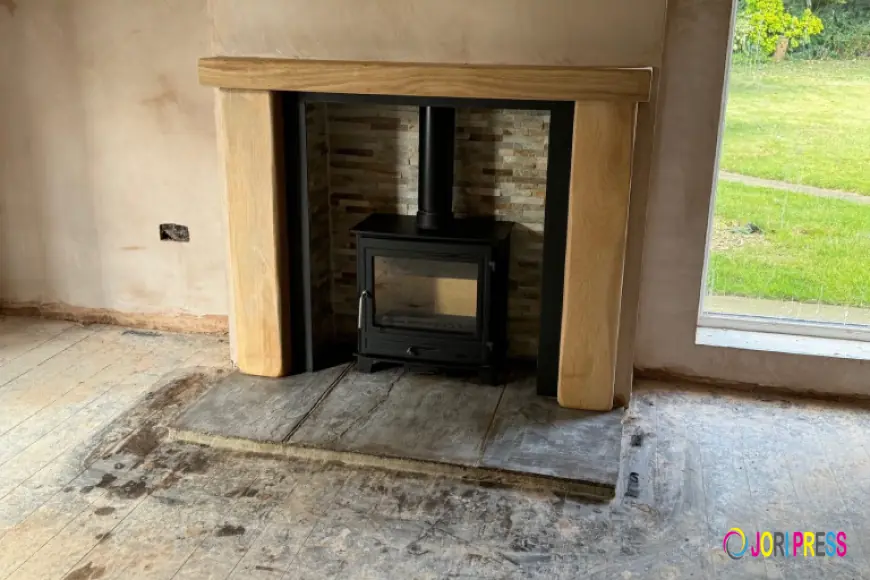
A superimposed hearth of 12mm is only acceptable where the appliance has been tested to prove it will not raise the hearth temperature above 100°C. Where it has not, a constructional hearth of 125mm, or a total hearth and floor thickness of 250mm, is required. Free-standing stoves in rooms without an existing fireplace need a minimum hearth area of 840mm by 840mm.
The hearth must be non-combustible and must extend at least 150mm to each side of the appliance and at least 225mm in front for a closed appliance, with 300mm in front commonly specified for an opening door.
If your installer has not asked to see the appliance datasheet, they cannot yet know what hearth you need.
7. Carbon monoxide alarm and notice plate
Both are legal requirements, not optional extras.
A carbon monoxide alarm must be fitted in any room containing a solid fuel appliance. It belongs on the ceiling or high on a wall, typically between one and three metres horizontally from the stove, and not directly above it.
A notice plate must be permanently fixed in the property recording the flue type and diameter, hearth details and the essential information needed to use the installation correctly. In a lot of substandard installs it is simply never fitted. Check for it on handover.
8. The paperwork you should be handed
Before the installer leaves, you should have a certificate of compliance from the competent person scheme, confirmation that the local authority has been notified, the appliance manufacturer's instructions and warranty registration, the liner warranty, a smoke evacuation or spillage test result, and a demonstration of how to run the appliance and what fuel to burn.
Keep all of it. Your insurer and your conveyancing solicitor will both want it eventually.
9. Reviews that mention the unglamorous parts
Anyone can collect reviews saying the stove looks lovely. The useful reviews are the ones that mention arriving when they said they would, sheeting the room, clearing soot and rubble, explaining decisions rather than presenting them, and coming back when something needed adjusting.
Look for those on Google and on independent trade platforms rather than only on the installer's own website, and look for volume over time rather than a cluster posted in one week.
What it actually costs in Lincolnshire
Budget around £2,000 for a straightforward installation including the appliance, with wide variation either side.
The appliance itself typically runs from £950 to £2,500 and above. A flexible liner is usually £300 to £450 depending on grade and flue length. Hearth construction commonly adds around £250. Then add cowls, the carbon monoxide alarm and certification.
Structural chimney work sits outside that range entirely. A rebuild, recrown or restabilisation is a separate scope of work and should be quoted separately and clearly.
Treat any quote significantly below these figures as a prompt for questions rather than a bargain.
If you have already bought the stove
Plenty of people buy an appliance online and then look for someone to fit it. That is fine, and most reputable installers offer an install only service. Two points are worth knowing.
First, the installer still needs the manufacturer's instructions and test data to specify the hearth and clearances correctly, so keep the documentation.
Second, if the survey reveals the appliance is the wrong output for the room, a good installer will tell you before fitting rather than after. Oversizing is the most common mistake made by buyers choosing alone, and an oversized stove run permanently on low is both unpleasant to live with and bad for the flue.
Frequently asked questions
Do I need building regulations approval for a wood burning stove? Yes. Installing a solid fuel appliance is notifiable work. You either notify local authority building control before starting, or use an installer registered with a competent person scheme such as HETAS, who self certifies the work and notifies the council for you.
Can a stove be installed if my house has no chimney? Yes. A twin wall insulated flue system can be run internally through the building or externally up an outside wall, subject to the height and clearance provisions in Approved Document J.
How often does a wood burner flue need sweeping? At least once a year for seasonal wood burning use, and more frequently with heavy use. Most liner warranties are conditional on documented annual sweeping.
How long does a typical installation take? A straightforward install into a sound existing chimney is usually one to two days. Where chimney restoration, a rebuild or a new twin wall system is involved, allow considerably longer and expect scaffolding.
Is a HETAS certificate the same as building control sign off? It serves the same purpose. Registered installers self certify compliance and notify the local authority, which is why you receive a certificate rather than a building control inspection.
What's Your Reaction?
 Like
0
Like
0
 Dislike
0
Dislike
0
 Love
0
Love
0
 Funny
0
Funny
0
 Angry
0
Angry
0
 Sad
0
Sad
0
 Wow
0
Wow
0