







































How Text Categorization Powers Intelligent Document Processing
Learn how text categorization powers Intelligent Document Processing (IDP), improving document classification, automation, and AI accuracy with expert text annotation.
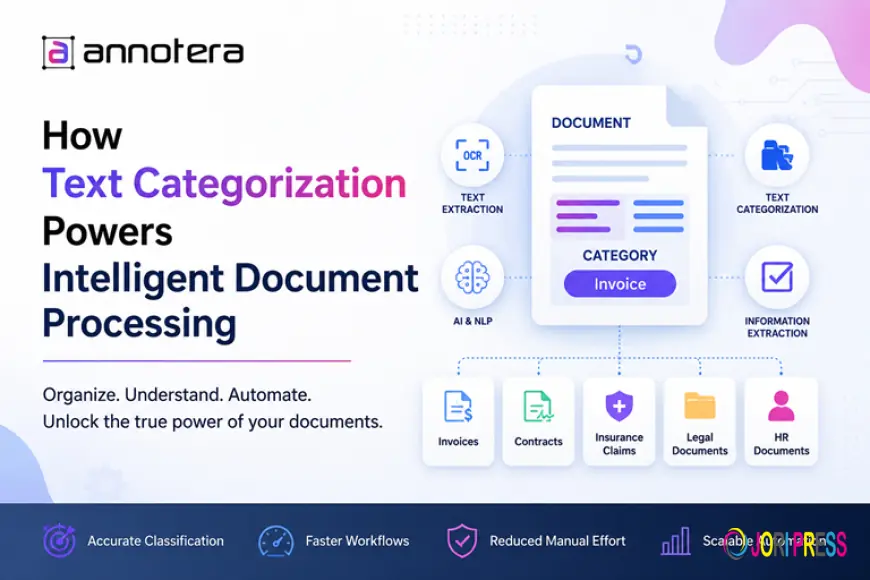
How Text Categorization Powers Intelligent Document Processing
Organizations today manage enormous volumes of unstructured documents, including invoices, contracts, emails, insurance claims, medical records, legal filings, and customer correspondence. Manually reviewing and organizing these documents is time-consuming, expensive, and prone to human error. This is where Intelligent Document Processing (IDP) is transforming business operations by combining Artificial Intelligence (AI), Machine Learning (ML), Natural Language Processing (NLP), and Optical Character Recognition (OCR) to automate document understanding.
However, the success of any Intelligent Document Processing system depends on one critical capability—text categorization. Before AI can extract relevant information or trigger automated workflows, it must first understand what kind of document it is processing. Accurate text categorization enables IDP systems to organize documents intelligently, improving speed, accuracy, and decision-making.
In this blog, we'll explore how text categorization powers Intelligent Document Processing and why partnering with an experienced data annotation company is essential for building high-performing document AI solutions.
What Is Text Categorization?
Text categorization, also known as document classification, is the process of assigning predefined categories or labels to textual content. AI models analyze the document's content, structure, metadata, and language patterns to determine its appropriate category.
For example, an AI-powered document processing system can automatically classify documents as:
-
Invoices
-
Purchase Orders
-
Contracts
-
Medical Records
-
Insurance Claims
-
Bank Statements
-
Customer Emails
-
Legal Documents
-
Tax Forms
-
Resumes
Once categorized, the system can apply specialized extraction rules and business workflows tailored to each document type.
Understanding Intelligent Document Processing (IDP)
Intelligent Document Processing goes beyond traditional OCR by interpreting document meaning rather than simply converting images into text.
A typical IDP workflow includes:
-
Document ingestion
-
OCR text extraction
-
Text categorization
-
Named Entity Recognition (NER)
-
Information extraction
-
Validation
-
Business workflow automation
Among these stages, text categorization acts as the decision-making layer that determines how the remaining pipeline operates.
For example, if an incoming document is identified as an invoice, the AI knows to extract invoice numbers, payment dates, vendor names, and total amounts. If it's a medical report, the extraction targets diagnoses, medications, and patient information instead.
Without accurate categorization, downstream AI models may extract incorrect information, reducing overall system performance.
Why Text Categorization Is Critical for IDP
1. Automates Document Routing
Businesses receive thousands of different document types every day.
Instead of manually sorting files, text categorization automatically routes documents to the appropriate processing pipelines.
Examples include:
-
HR receives resumes.
-
Finance processes invoices.
-
Legal reviews contracts.
-
Customer support handles service requests.
This dramatically reduces manual effort and improves operational efficiency.
2. Improves Information Extraction Accuracy
Different document types contain different data fields.
Categorizing documents first allows extraction models to focus only on relevant information.
For example:
Invoice
-
Vendor Name
-
Invoice Number
-
Due Date
-
Amount
Contract
-
Effective Date
-
Expiration Date
-
Parties Involved
-
Legal Clauses
Medical Record
-
Patient ID
-
Diagnosis
-
Prescription
-
Lab Results
Proper classification significantly improves extraction precision.
3. Accelerates Business Workflows
Organizations often rely on automated workflows after documents are processed.
Examples include:
-
Invoice approvals
-
Loan processing
-
Insurance claim verification
-
Customer onboarding
-
Compliance reporting
Text categorization ensures each document reaches the correct workflow immediately, minimizing delays and reducing operational bottlenecks.
4. Reduces Human Intervention
Manual document sorting is repetitive and susceptible to errors.
AI-powered categorization minimizes human involvement by automatically organizing incoming documents with high accuracy.
Employees can instead focus on reviewing exceptions and handling complex business decisions.
5. Enables Scalable Document Automation
As organizations grow, document volumes increase rapidly.
AI-based categorization allows businesses to process:
-
Thousands of documents daily
-
Multiple languages
-
Various document formats
-
Complex enterprise workflows
Scalability becomes possible without proportionally increasing staffing costs.
Industries Benefiting from Text Categorization in IDP
Healthcare
Hospitals process vast amounts of documentation daily.
Examples include:
-
Patient records
-
Lab reports
-
Insurance claims
-
Prescriptions
-
Referral letters
Categorization enables faster patient data retrieval while supporting compliance requirements.
Financial Services
Banks and financial institutions rely heavily on document automation.
Common document types include:
-
Loan applications
-
KYC documents
-
Credit reports
-
Tax forms
-
Account statements
Accurate categorization accelerates loan approvals and fraud detection while reducing manual processing.
Insurance
Insurance companies manage:
-
Claim forms
-
Accident reports
-
Medical documentation
-
Repair estimates
-
Policy documents
Automated categorization speeds up claims processing and improves customer satisfaction.
Legal
Law firms deal with extensive document collections.
Examples include:
-
Contracts
-
Court filings
-
Case records
-
Evidence documentation
-
Legal correspondence
AI categorization simplifies legal document management and improves searchability.
Retail and E-commerce
Retail organizations receive:
-
Purchase orders
-
Supplier invoices
-
Customer emails
-
Return requests
-
Shipping documentation
Text categorization enables automated customer service and supply chain operations.
The Importance of High-Quality Text Annotation
Machine learning models only perform as well as the data used to train them.
Building reliable text categorization systems requires carefully labeled training datasets.
These datasets often include:
-
Document labels
-
Content categories
-
Hierarchical classifications
-
Metadata tagging
-
Multi-label annotations
An experienced text annotation company develops detailed annotation guidelines and ensures consistent labeling across millions of documents.
This consistency directly impacts model accuracy.
Why Businesses Choose Data Annotation Outsourcing
Creating high-quality training datasets internally can be resource-intensive.
Many organizations therefore prefer data annotation outsourcing to access specialized expertise, scalable workforces, and rigorous quality assurance processes.
Benefits include:
-
Faster project delivery
-
Lower operational costs
-
Access to trained annotation specialists
-
Consistent quality control
-
Scalability for enterprise AI initiatives
Professional annotation partners also support domain-specific projects across healthcare, finance, legal, retail, manufacturing, and customer service applications.
How Annotera Supports Intelligent Document Processing
At Annotera, we help organizations build AI-ready datasets that improve document understanding and automation.
As a trusted data annotation company, our teams provide high-quality text annotation services designed for enterprise NLP and Intelligent Document Processing initiatives.
Our capabilities include:
-
Document classification
-
Text categorization
-
Named Entity Recognition (NER)
-
Sentiment annotation
-
Intent labeling
-
Metadata tagging
-
OCR validation
-
Relationship annotation
-
Quality assurance and consensus review
-
Human-in-the-loop validation
Our text annotation company follows rigorous quality assurance processes, customizable annotation guidelines, and secure workflows to deliver datasets tailored to your AI models.
Whether you're developing enterprise search, document automation, contract intelligence, or Intelligent Document Processing systems, our text annotation outsourcing services help improve model performance while reducing development time.
Conclusion
Intelligent Document Processing is rapidly transforming how organizations manage unstructured information. Yet the foundation of every successful IDP system lies in accurate text categorization. By automatically identifying document types before information extraction begins, businesses can streamline workflows, reduce manual effort, improve data accuracy, and scale document automation with confidence.
Achieving this level of performance requires high-quality annotated training data. Partnering with an experienced data annotation company like Annotera ensures your AI models are trained on consistently labeled datasets that deliver reliable results in real-world environments.
As enterprises continue investing in AI-driven automation, data annotation outsourcing and expert text annotation outsourcing will remain critical for building robust Intelligent Document Processing solutions that drive efficiency, compliance, and smarter business decisions.
What's Your Reaction?
 Like
0
Like
0
 Dislike
0
Dislike
0
 Love
0
Love
0
 Funny
0
Funny
0
 Angry
0
Angry
0
 Sad
0
Sad
0
 Wow
0
Wow
0