







































Guillotine Machine Safety: Guarding, PUWER and Safe Operation
Learn how to use a guillotine machine safely, from guarding and PUWER duties to risk assessment, pre-use checks and the safety features to look for when buying.

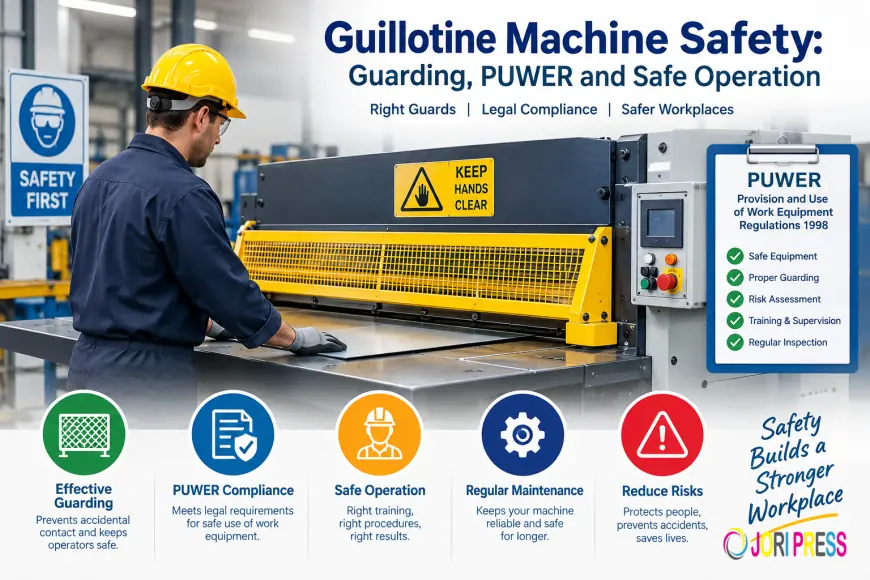
A guillotine machine is one of the most useful pieces of equipment in a sheet metal workshop, and one of the most dangerous if it is not properly guarded and operated. The forces involved are enough to cause serious injury in a fraction of a second.
This guide explains the main hazards, the guarding and safety devices used on guillotines, how PUWER applies, and the checks and procedures that help keep operators safe. It is general guidance, not legal advice, so always check current HSE guidance and take competent advice for your own workplace.
What Is a Guillotine Machine?
A guillotine machine, or guillotine shear, cuts sheet metal in a straight line. Hold-downs clamp the sheet, then an upper blade descends past a fixed lower blade to shear it.
The two main types are:
- Hydraulic guillotines, where hydraulic cylinders drive the blade beam. These are common on modern machines and offer controlled cutting force.
- Mechanical guillotines, where a motor, flywheel and clutch drive the blade. These are often faster, but rely on the clutch and brake working correctly to stop the blade.
Why Is Guillotine Machine Safety Important?
A guillotine is designed to cut steel, so it will cut through fingers and hands just as easily. Injuries are usually caused by reaching into the blade or hold-down area, unexpected machine movement or incorrect operation, and they are often severe and permanent.
Common Guillotine Machine Hazards
The main hazards are:
- Blade contact at the front, sides and rear of the cutting line
- Crushing and trapping under the hold-downs, which close before the blade cuts
- Material movement, such as sheets springing, sliding or falling after the cut
- Sharp edges on sheets and cut parts during handling
- Unexpected activation, for example from an unguarded foot pedal
- Poor visibility of the cutting line or the area behind the machine
- Inadequate guarding, including missing, damaged or poorly adjusted guards
- Unsafe maintenance, such as working on a machine that has not been isolated, or under a blade beam held up only by hydraulic pressure
What Is Guillotine Machine Guarding?
Guarding prevents people reaching dangerous moving parts while the machine is working. On a guillotine, that mainly means stopping fingers reaching the blades and hold-downs from the front, and preventing access to the cutting area from the sides and rear.
Types of Guards and Safety Devices
Not every device suits every machine, but common options include:
- Fixed front guards, which allow the sheet to be fed in but are set so fingers cannot reach the hold-downs or blade
- Adjustable guards, which can be set for different material thicknesses and must be reset correctly after adjustment
- Interlocked guards on the sides and rear, which stop the machine when opened
- Light guards (light curtains), often used at the rear to stop the machine if someone enters the area behind the blade
- Shrouded foot pedals, which reduce the risk of accidental activation
- Two-hand controls, used on some machines so both hands must be on the controls during the cut
- Emergency stops, positioned within easy reach of the operator
What Is PUWER?
PUWER is the Provision and Use of Work Equipment Regulations 1998. It requires employers to make sure that equipment used at work is suitable, safe, properly maintained and used only by people who have received adequate information, instruction and training.
PUWER applies across Great Britain and covers almost all work equipment, from hand tools to industrial machinery. Northern Ireland has equivalent regulations.
How Does PUWER Apply to a Guillotine Machine?
PUWER applies to any
used at work. In practice, it means employers should consider:
- Suitability: the machine should be suitable for the materials, thicknesses and work it is used for.
- Risk assessment: hazards should be identified and controlled, as required under health and safety law.
- Safe installation: the machine should be stable, well lit and positioned with safe access and space around it.
- Guarding: dangerous parts must be protected, with fixed guards preferred where practicable, followed by other guards and protection devices.
- Controls: start, stop and emergency stop controls must be clear and work reliably.
- Isolation: there must be a way to isolate the machine from its power sources for maintenance.
- Maintenance and inspection: the machine and its safety devices should be kept in good working order, with inspection where deterioration could lead to danger.
- Training and information: operators, supervisors and maintenance staff need adequate training and clear instructions.
Whether a particular machine meets PUWER depends on the equipment, the workplace and how it is used. A machine cannot be described as compliant on its own, so check the latest HSE guidance and take competent advice if you are unsure.
Safe Guillotine Machine Operation: Step by Step
- Complete pre-use checks before the first cut of the shift.
- Check guards and safety devices are in place, correctly adjusted and working, including light guards and interlocks.
- Inspect the blade and machine for damage, chips, leaks or anything unusual.
- Confirm the material and settings, making sure the material and thickness are within the machine’s rated capacity and the blade gap and rake are set correctly.
- Keep hands clear of danger zones, feeding the sheet from the front and never reaching past the guard or behind the machine.
- Operate the controls correctly, keeping your foot off the pedal until you are ready to cut.
- Monitor the cut, watching how the sheet behaves and stopping if anything looks wrong.
- Stop the machine safely, switching it off, leaving the blade in a safe position and clearing the work area.
Guillotine Machine Safety Checklist
Use a checklist like this before use, adapted to your machine and risk assessment:
- Guards: fitted, undamaged and correctly adjusted
- Emergency stop: tested and working
- Controls: foot pedal shrouded, controls clearly marked and responding correctly
- Blade condition: sharp, undamaged and securely fixed
- Electrical and hydraulic systems: no damaged cables, leaks or warning lights
- Machine condition: hold-downs, backgauge and squaring arm in good order
- Work area: clear, well lit and free of trip hazards and offcuts
- Operator competence: trained and authorised for this machine
- PPE: cut-resistant gloves for handling sheets, safety footwear and eye protection where your risk assessment requires them
- Maintenance records: up to date, with any defects reported and resolved
What to Look for When Buying a Guillotine Machine for Sale
Safety should be part of the decision whenever you compare a guillotine machine for sale, whether new or used. Check:
- Guarding at the front, sides and rear, including light guards where the design calls for them
- Safety controls, such as shrouded foot pedals and clearly marked controls
- Emergency stop systems that are easy to reach and tested
- Machine condition, particularly blades, hold-downs, hydraulics, clutch and brake
- Manufacturer documentation, including the instruction manual and, for new machines, a Declaration of Conformity and UKCA or CE marking
- Maintenance history and any records of safety-related repairs
- Capacity, cutting length and material thickness to suit your work, as overloading a machine creates risk
- Operator requirements, including the training needed for its controls
- Servicing and spare parts availability, so safety devices can be maintained
- Suitability for your workplace, including space, access and power supply
With a used machine, ask whether guarding has been modified or removed, and arrange a competent inspection before it goes into use.
Common Guillotine Machine Safety Mistakes to Avoid
- Bypassing guards or defeating interlocks to speed up work
- Ignoring faults in light guards, emergency stops or other safety devices
- Operating without training, or using unfamiliar settings without supervision
- Using damaged equipment, such as chipped blades or leaking hydraulics
- Reaching into danger zones, including behind the machine to retrieve parts
- Maintaining without isolation, or working under the blade beam without mechanical support
- Skipping inspections and leaving defects unreported
- Allowing unauthorised use by people who have not been trained on the machine
Final Thoughts on Guillotine Machine Safety
Guillotine machine safety depends on more than good guarding. It combines suitable equipment, a thorough risk assessment, working safety devices, trained operators, clear procedures and regular maintenance and inspection.
If you are reviewing your current machine or buying a new one, involve your operators, follow current HSE guidance and get competent advice where needed. Our team can help you compare guillotine machinery and the safety features that suit your workshop.
What's Your Reaction?
 Like
0
 Dislike
0
 Love
0
 Funny
0
 Angry
0
 Sad
0
 Wow
0