









































From Data to Decisions: How AI Is Reshaping the Future of eCommerce
Discover how AI is transforming eCommerce with smarter personalization, intelligent search, predictive analytics, automated support, fraud detection, and better business decisions.
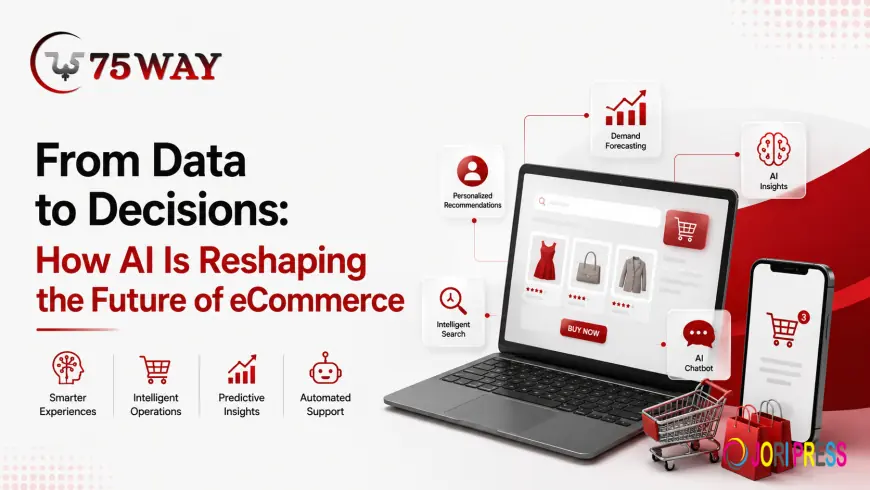
Online shopping is becoming increasingly intelligent, with businesses using technology to understand customers, automate repetitive processes, and make faster decisions. AI for ecommerce is helping retailers move beyond traditional recommendation engines by enabling smarter search, personalized experiences, predictive analytics, automated customer support, and more efficient operations. As competition increases and shoppers expect faster, more relevant experiences, artificial intelligence is becoming an important strategic tool for brands looking to improve both customer satisfaction and business performance.
Artificial intelligence is no longer limited to experimental projects or large technology companies. Retailers of different sizes can now use machine learning, natural language processing, computer vision, predictive analytics, and generative AI to solve practical business challenges.
The real opportunity lies in identifying where intelligent technology can create measurable value rather than adding AI features simply because they are trending.
Why Artificial Intelligence Matters for Modern eCommerce
Traditional online stores depend heavily on predefined rules. Product categories, search filters, promotional campaigns, and customer communication often require significant manual management.
Artificial intelligence introduces a more adaptive approach. Systems can analyze large volumes of information, recognize patterns, and make predictions based on customer behavior and business data.
This can help retailers understand what shoppers are looking for, identify products that may interest them, anticipate demand, and automate routine interactions.
The result is a more responsive digital shopping environment where technology can continuously learn from new information.
Personalized Shopping Experiences
Customers increasingly expect online stores to understand their preferences. Showing identical products and offers to every visitor can make discovery less relevant, particularly when a business has a large catalog.
Intelligent personalization systems can examine information such as browsing behavior, previous purchases, searches, product interactions, and preferences to generate more relevant experiences.
For example, two shoppers visiting the same store may see different recommendations based on their previous interactions.
Personalization can extend beyond product recommendations. Businesses can also adapt promotional content, search results, category suggestions, and communication according to individual behavior.
The objective is not simply to show more products but to help customers discover appropriate products with less effort.
Smarter Product Recommendations
Recommendation engines have become one of the most recognizable applications of artificial intelligence in retail.
Instead of relying entirely on manually selected “related products,” intelligent systems can analyze relationships between products and customer behavior.
A recommendation engine may identify patterns such as customers who purchase one product frequently purchasing another. It can also consider individual browsing history and similar customer behavior.
More advanced systems can combine multiple signals to generate recommendations dynamically.
When implemented correctly, these systems can improve product discovery while creating additional opportunities for cross-selling and upselling.
Intelligent Search Improves Product Discovery
Search is one of the most important interactions within an online store. If customers cannot quickly find what they want, they may leave without making a purchase.
Traditional keyword-based search can struggle with spelling errors, vague queries, natural language, and different ways of describing the same product.
AI-powered search can interpret the meaning behind a query rather than relying exclusively on exact keyword matches.
A customer might search for “comfortable shoes for long walks” instead of entering a specific product name. An intelligent search system can interpret the intent and return products based on relevant attributes.
Natural-language understanding can therefore make product discovery more conversational and intuitive.
Generative AI for Product Content
Maintaining product catalogs can require considerable effort. Retailers may have thousands of products requiring descriptions, specifications, summaries, metadata, and other content.
Generative AI can assist content teams by creating initial drafts based on structured product information.
It can also help transform technical specifications into easier-to-understand descriptions or create variations of content for different marketing channels.
Human review remains important, particularly for product accuracy, brand voice, regulatory requirements, and factual claims.
Used appropriately, generative technology can reduce repetitive content production while allowing teams to focus more heavily on strategy and quality control.
AI-Powered Customer Support
Customer service is another area where intelligent automation can provide significant value.
Shoppers frequently ask repetitive questions about shipping, returns, order status, product availability, payment methods, and account management.
An AI assistant can handle many routine questions instantly and remain available outside traditional business hours.
More advanced systems can use customer and order information to provide context-aware assistance.
For example, instead of simply explaining a return policy, an assistant could potentially guide an authenticated customer through the appropriate return process.
Complex or sensitive issues should still be transferred to human support teams when appropriate.
Predictive Demand Forecasting
Inventory management is a major challenge for retailers. Overstocking can increase storage costs, while insufficient inventory can result in missed sales and disappointed customers.
Predictive analytics can examine historical sales, seasonal patterns, promotions, customer behavior, and other relevant variables to estimate future demand.
These forecasts can help businesses make more informed purchasing and inventory decisions.
The technology does not eliminate uncertainty. Unexpected events can still influence demand. However, data-driven forecasting can provide businesses with a stronger foundation for planning than relying solely on intuition.
Intelligent Inventory Management
Artificial intelligence can also support inventory operations beyond demand forecasting.
Systems can identify products with unusual sales patterns, highlight potentially slow-moving inventory, and help businesses recognize emerging demand.
Automated alerts can notify teams when stock levels reach important thresholds.
When inventory information is connected across warehouses, suppliers, and sales channels, businesses can gain a more comprehensive view of product availability.
This can help reduce manual monitoring and support faster operational decisions.
Visual Search and Product Recognition
Not every shopping journey starts with words. Customers may see a product in an image and want to find something similar.
Computer vision can analyze images to identify visual characteristics such as shape, color, patterns, and product categories.
A shopper could upload an image and receive visually similar products from the retailer's catalog.
This capability can be particularly useful for fashion, furniture, accessories, home décor, and other visually driven categories.
As computer vision continues to improve, image-based discovery could become a more natural part of digital shopping experiences.
Voice-Based Shopping Assistance
Voice technology can make product discovery and customer interactions more accessible.
Customers may use natural language to ask questions, search for products, compare options, or obtain information about orders.
Voice interfaces can be particularly useful when customers are multitasking or when typing is inconvenient.
The technology can also be combined with conversational AI to create shopping assistants capable of understanding follow-up questions and maintaining context during an interaction.
However, voice functionality should complement existing interfaces rather than replace them entirely.
Fraud Detection and Transaction Security
Retail businesses face risks from fraudulent transactions, account takeovers, suspicious activity, and payment abuse.
AI-driven security systems can analyze transaction patterns and identify behavior that differs from normal activity.
Signals may include unusual purchasing frequency, unexpected locations, device information, transaction values, or account behavior.
A risk-scoring system can help determine when additional verification may be appropriate.
The goal is to detect suspicious activity without creating unnecessary friction for legitimate customers.
Effective fraud prevention requires continuous refinement because fraudulent behavior evolves.
Dynamic Pricing and Promotional Intelligence
Pricing decisions can become complicated when businesses manage large product catalogs and rapidly changing market conditions.
Predictive models can analyze historical demand, inventory levels, customer behavior, competitor information where legally and appropriately available, and promotional performance.
These insights can help businesses understand how different pricing strategies may influence demand.
However, automated pricing requires careful governance. Businesses need clear rules to prevent inappropriate price changes, misleading promotions, or decisions that could negatively affect customer trust.
AI should support pricing strategy rather than operate without meaningful oversight.
Improving Customer Retention
Acquiring new customers can be expensive, making retention an important business objective.
Intelligent systems can help identify patterns associated with customer churn and engagement.
For example, businesses may discover that customers who stop interacting with the brand for a certain period are less likely to purchase again.
These insights can support targeted retention strategies such as personalized recommendations, relevant offers, loyalty benefits, or timely communication.
The emphasis should remain on relevance. Excessive promotional messaging can damage the customer relationship instead of strengthening it.
Understanding Customer Sentiment
Customer reviews and feedback contain valuable information, but manually analyzing thousands of comments can be difficult.
Natural-language processing can categorize feedback and identify recurring themes.
Businesses can use sentiment analysis to understand how customers feel about products, delivery experiences, customer support, pricing, or specific features.
For example, if a large number of reviews repeatedly mention packaging problems, the business can investigate its fulfillment process.
This transforms unstructured customer feedback into information that teams can use for operational improvements.
AI Can Help Marketing Teams Work Smarter
Marketing teams often spend significant time analyzing audiences, preparing campaigns, segmenting customers, and evaluating performance.
Intelligent tools can assist with audience segmentation, content ideation, campaign analysis, personalization, and predictive customer modeling.
Instead of treating every customer as part of one broad audience, businesses can identify smaller groups with different behaviors and preferences.
This can help marketers create more relevant campaigns and allocate resources more effectively.
AI-generated insights should still be reviewed by experienced marketing professionals to ensure that campaigns remain aligned with business objectives and brand guidelines.
Building an AI-Ready eCommerce Architecture
Implementing intelligent functionality requires more than connecting an AI model to an existing store.
Businesses need reliable data pipelines, secure APIs, scalable infrastructure, appropriate databases, analytics systems, and integration capabilities.
Data quality is particularly important. If product information is incomplete or customer records contain inconsistencies, AI systems may produce unreliable results.
Organizations should therefore establish strong data governance before expanding intelligent capabilities.
A modular architecture can also make it easier to introduce new AI functionality over time without disrupting the core shopping experience.
The Importance of Responsible AI
Artificial intelligence can create significant benefits, but businesses also need to consider privacy, transparency, security, bias, and accountability.
Retailers should understand what information their AI systems use and why it is being processed.
Sensitive customer information should be protected through appropriate access controls and security measures.
Businesses should also establish human oversight for decisions that could significantly affect customers.
Responsible implementation can help organizations benefit from AI while maintaining customer trust.
How AI Solutions Can Be Implemented Strategically
Businesses exploring ecommerce AI solutions should begin with clearly defined problems rather than attempting to introduce artificial intelligence across every part of the organization.
A practical implementation strategy may involve:
- Identifying a specific business challenge.
- Establishing measurable objectives.
- Auditing available data.
- Selecting an appropriate AI use case.
- Building a small proof of concept.
- Testing results with real users or business teams.
- Measuring performance.
- Improving the system based on feedback.
- Expanding successful capabilities.
This approach can reduce unnecessary investment and provide evidence of value before a broader rollout.
How 75way Technologies Can Support AI Adoption
Organizations often need technical expertise to transform AI concepts into reliable business applications. 75way Technologies can support businesses in exploring intelligent digital solutions, integrating AI capabilities, and developing technology around specific operational requirements.
The development process should focus on measurable outcomes, data quality, security, scalability, and usability. AI should be treated as a component of a broader digital strategy rather than an isolated feature.
A well-planned implementation can allow businesses to introduce intelligent functionality gradually while maintaining control over costs and technical complexity.
Measuring the Business Impact of AI
AI adoption should be evaluated using meaningful performance indicators.
Depending on the use case, businesses may measure:
- Conversion rates
- Average order value
- Customer retention
- Search success rates
- Support resolution time
- Inventory turnover
- Forecast accuracy
- Fraud detection rates
- Customer satisfaction
- Operational costs
For example, an AI-powered support assistant should not be judged solely by the number of conversations it handles. Businesses should also evaluate resolution quality, customer satisfaction, escalation rates, and cost savings.
Measurement allows organizations to identify which applications of AI are producing real business value.
Common Challenges When Adopting AI
AI implementation can involve several challenges.
Poor-quality data is one of the most common. Intelligent systems depend on accurate and relevant information.
Integration can also become difficult when businesses operate legacy platforms that were not designed to support modern AI workflows.
Another challenge is employee adoption. Teams may hesitate to use automated systems if they do not understand how the technology works or how it affects their responsibilities.
Cost management is also important. Businesses should evaluate infrastructure, model usage, integration, maintenance, and ongoing optimization rather than focusing only on initial development expenses.
What the Future May Look Like
The next generation of online shopping experiences is likely to become increasingly conversational, predictive, and personalized.
Customers may interact with digital shopping assistants that understand preferences, compare products, answer questions, and help complete purchases.
Retailers may use predictive systems to anticipate demand before customers place orders. Computer vision could make product discovery more intuitive, while automated analytics could help business teams respond to changing market conditions faster.
At the same time, privacy and transparency will become increasingly important as AI systems process more customer information.
The businesses most likely to benefit will be those that combine technological innovation with responsible implementation and a clear understanding of customer needs.
Final Thoughts
Artificial intelligence is changing the way ecommerce businesses approach customer experience, operations, marketing, inventory, security, and decision-making. From intelligent search and personalized recommendations to predictive analytics and automated support, AI can address practical challenges throughout the digital shopping journey.
However, successful implementation is not about adding the maximum number of AI features. It is about identifying where intelligent technology can produce meaningful improvements.
Businesses should begin with clear objectives, reliable data, appropriate technology, strong security practices, and measurable KPIs. Starting with focused use cases can help organizations demonstrate value before expanding into more advanced applications.
As AI technology continues to evolve, ecommerce businesses that adopt it thoughtfully can create more relevant customer experiences, streamline operations, and make faster, data-informed decisions while building a stronger foundation for long-term digital growth.
What's Your Reaction?
 Like
0
Like
0
 Dislike
0
Dislike
0
 Love
0
Love
0
 Funny
0
Funny
0
 Angry
0
Angry
0
 Sad
0
Sad
0
 Wow
0
Wow
0