


































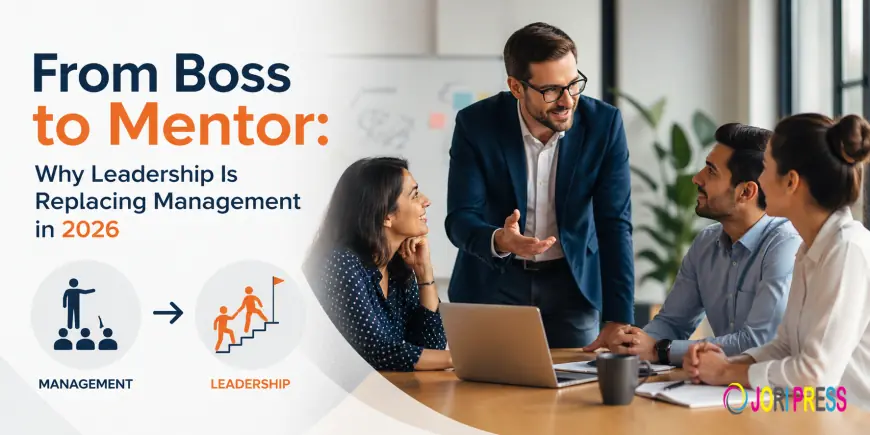
From Boss to Mentor: Why Leadership Is Replacing Management in 2026
Discover why leadership is replacing management in 2026 and how modern leaders inspire teams, drive growth, and adapt to changing workplaces effectively

Introduction
The workplace is undergoing a fundamental shift. Traditional management, defined by control, hierarchy, and authority, is giving way to a more human-centered model called mentorship-driven leadership. In 2026, executives are no longer expected to simply manage outcomes. They are expected to develop people, inspire growth, and unlock potential.
This transition is not just a trend. It is a response to changing workforce expectations, rapid technological disruption, and the need for continuous learning. Organizations that embrace this shift are seeing higher engagement, stronger innovation, and better retention.
The Decline of Traditional Management
For decades, management was built on structure:
-
Top-down decision-making
-
Performance monitoring
-
Task delegation
While effective in stable environments, this model struggles in today’s fast-changing world. Employees now seek:
-
Purpose over process
-
Growth over control
-
Collaboration over hierarchy
Rigid management styles often lead to disengagement, especially among younger professionals who value autonomy and meaningful work.
The Rise of Mentorship-Based Leadership
Modern leadership is increasingly defined by mentorship. Instead of asking, “Did you complete the task?”, leaders now ask, “How can I help you grow?”
Mentorship-based leadership focuses on:
-
Guidance instead of control
-
Development instead of supervision
-
Coaching instead of commanding
Executives are becoming facilitators of success rather than enforcers of rules.
Why This Shift Is Happening
1. The Knowledge Economy Demands Continuous Learning
In a world driven by innovation, skills become outdated quickly. Leaders must actively mentor employees to keep them relevant.
2. Employee Expectations Have Changed
Today’s workforce values:
-
Career development
-
Meaningful feedback
-
Personal connection
Employees are more likely to stay in organizations where leaders invest in their growth.
3. Hybrid Work Requires Trust-Based Leadership
With remote and hybrid teams, micromanagement becomes ineffective. Mentorship fosters trust, accountability, and independence.
Key Traits of Mentor-Leaders
1. Active Listening
Mentor-leaders prioritize understanding before responding. They listen to challenges, ambitions, and ideas.
2. Empathy
They recognize that employees are not just resources but individuals with unique needs and motivations.
3. Growth Mindset
They encourage experimentation, learning from failure, and continuous improvement.
4. Personalized Guidance
Rather than applying generic solutions, they tailor their approach to each team member.
Benefits of Mentorship-Driven Leadership
Higher Employee Engagement
Employees feel valued when leaders invest time in their development.
Improved Retention
Mentorship builds loyalty and reduces turnover.
Stronger Leadership Pipeline
Future leaders are developed internally through guidance and coaching.
Increased Innovation
When employees feel supported, they are more willing to share ideas and take risks.
Practical Ways to Transition from Boss to Mentor
1. Shift Your Mindset
Move from managing tasks to developing people.
2. Schedule Regular Development Conversations
Go beyond performance reviews. Focus on career aspirations and growth.
3. Ask More Questions
Encourage employees to think critically instead of giving direct answers.
4. Provide Constructive Feedback
Focus on improvement, not just evaluation.
5. Lead by Example
Demonstrate continuous learning and openness to feedback.
Challenges Leaders May Face
Letting go of control can be difficult. Leaders who are used to authority may struggle with a more collaborative approach.
Time constraints can also be a barrier. Mentorship requires time and effort, which can be challenging in high-pressure roles.
Measuring impact is another concern. Unlike traditional metrics, mentorship outcomes can be harder to quantify.
Despite these challenges, the long-term benefits make the effort worthwhile.
The Future of Leadership
The future belongs to leaders who can:
-
Inspire rather than instruct
-
Develop rather than direct
-
Empower rather than control
Mentorship is no longer optional. It is a core leadership competency. Organizations that fail to adapt risk losing talent, innovation, and competitiveness.
Q and A Section
Q1: What is the main difference between a manager and a mentor?
A manager focuses on tasks and performance, while a mentor focuses on growth, development, and long-term success.
Q2: Can every leader become a mentor?
Yes, but it requires a mindset shift, emotional intelligence, and a willingness to invest in people.
Q3: Does mentorship reduce authority?
No. It enhances leadership effectiveness by building trust and respect rather than relying solely on authority.
Q4: How can organizations encourage mentorship?
By integrating mentoring into leadership development programs, rewarding coaching behaviors, and fostering a learning culture.
Q5: Is mentorship suitable for all industries?
Yes. Whether in technology, healthcare, finance, or manufacturing, mentorship improves performance and engagement.
Q6: How do you measure mentorship success?
Through indicators such as employee engagement, retention rates, internal promotions, and feedback quality.
What's Your Reaction?
 Like
0
Like
0
 Dislike
0
Dislike
0
 Love
0
Love
0
 Funny
0
Funny
0
 Angry
0
Angry
0
 Sad
0
Sad
0
 Wow
0
Wow
0