


































FDA’s New Charcoal BE Expectation for Inhalation Generics: Is Your Development Strategy Ready?
In generic drug development, delays rarely occur because sponsors lack knowledge. More often, they happen because certain risks or regulatory expectations are underestimated early in the program.
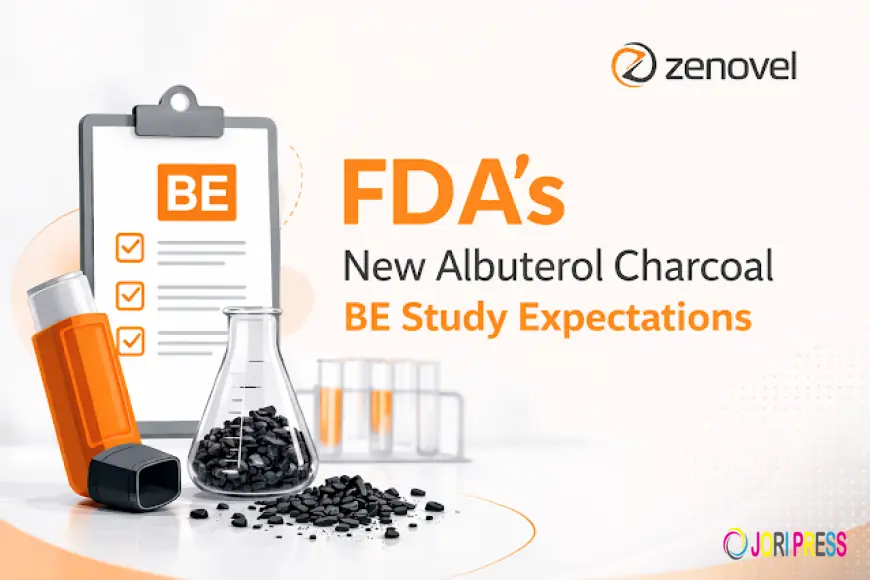
A clear example of this shift is the October 2025 draft product-specific guidance (PSG) from the U.S. Food and Drug Administration for Albuterol Sulfate inhalation powder. The guidance introduces a more explicit expectation for a fasting, single-dose, two-way crossover pharmacokinetic (PK) study with a charcoal block as part of a recommended bioequivalence (BE) pathway.
While this may appear to be a technical refinement, it actually signals something larger. For sponsors developing generic inhalation products, charcoal block studies are no longer simply an additional protocol component. They reshape how teams approach dose selection, analytical sensitivity, regulatory interaction, and BE strategy design.
Organizations that adapt early can streamline their regulatory journey. Those that treat the change as a late-stage requirement may face avoidable complications.
This is where Zenovel helps sponsors move from reactive execution to strategic study design.
Why the New Guidance Matters More Than It Appears
The updated PSG for Albuterol Sulfate inhalation powder outlines two potential pathways for demonstrating bioequivalence.
Under one recommended pathway, sponsors are expected to complete:
-
Three in vitro bioequivalence studies
-
One comparative characterization study
-
Two in vivo pharmacokinetic BE studies
The first PK study follows a conventional design:
-
Fasting
-
Single dose
-
Two-way crossover
The second PK study introduces the additional complexity:
-
Fasting
-
Single dose
-
Two-way crossover with charcoal block
The charcoal block component significantly increases the strategic considerations behind the study.
The guidance specifies that:
-
The minimum number of inhalations should be used to characterize the PK profile.
-
Sensitive analytical methods must support exposure detection.
-
A Bio-IND may be required if the study dose exceeds the maximum labeled single dose.
-
Sponsors must justify the charcoal dose within the ANDA submission.
-
The FDA encourages discussion of study design through a pre-ANDA meeting before conducting the charcoal study.
These expectations mean sponsors must make critical scientific and regulatory decisions much earlier in development.
What a Charcoal Block Study Really Evaluates
Charcoal block PK studies are designed to distinguish pulmonary drug absorption from gastrointestinal absorption.
Activated charcoal reduces drug absorption in the gastrointestinal tract, allowing investigators to isolate the systemic exposure that originates from lung deposition.
While scientifically valuable, this approach creates a less forgiving study design environment.
Typical expectations for the charcoal block PK study include:
-
Healthy adult subjects
-
Fasting conditions
-
Single-dose administration
-
Two-way crossover design
-
Proper inhalation technique training
-
Administration consistent with reference listed drug labeling
Bioequivalence is evaluated using PK parameters such as AUC and Cmax, where the 90% confidence interval of the geometric mean test/reference ratio must fall within 80%–125%.
Even small design miscalculations—such as insufficient analytical sensitivity or inconsistent inhalation technique—can weaken the interpretability of the results.
This is why complex inhalation BE programs increasingly require strategic expertise before protocol development begins.
Zenovel’s Strategic Approach to Charcoal BE Study Design
Many development programs treat protocol writing as the start of study strategy.
In reality, strategy begins earlier—with a structured assessment of regulatory expectations, device performance, clinical pharmacology constraints, and analytical feasibility.
Zenovel supports sponsors in building a submission-ready BE strategy before the first study design decision is finalized.
1. Endpoint-Driven Strategy Architecture
Because bioequivalence conclusions depend on AUC and Cmax, study planning must ensure that dose selection, sampling schedules, and analytical methods can reliably generate those endpoints.
Zenovel works backward from these regulatory endpoints to build a scientifically aligned PK study design.
2. Dose Optimization with Regulatory Foresight
The requirement to use the minimum number of inhalations necessary to characterize the PK profile introduces a delicate balance.
-
Too few inhalations may produce inadequate exposure data.
-
Too many inhalations may exceed the maximum labeled dose, potentially triggering a Bio-IND requirement.
Zenovel evaluates these variables early so that dose selection becomes a data-driven scientific decision, not a last-minute compromise.
3. Submission-Ready Charcoal Justification
The guidance requires sponsors to justify the charcoal dose within the ANDA submission.
This means the rationale must satisfy regulatory reviewers, not just protocol reviewers.
Zenovel approaches charcoal strategy as part of the regulatory narrative, ensuring that the justification is:
-
Scientifically sound
-
Operationally feasible
-
Consistent with the broader BE evidence package
4. Pre-ANDA Meeting Preparation
The FDA encourages sponsors to discuss charcoal study strategy through pre-ANDA interactions.
A well-prepared meeting can significantly reduce regulatory uncertainty.
Zenovel helps sponsors prepare a focused regulatory package that includes:
-
Study design justification
-
Risk assessment
-
Alternative strategies considered
-
Key scientific questions for FDA feedback
These discussions often shape the entire trajectory of the development program.
The Real Risk: Choosing the Wrong Strategy
Running a BE study is rarely the biggest challenge.
The larger risk lies in executing a study built on a weak strategic foundation.
Without careful planning, sponsors may encounter issues such as:
-
Dose selection that unnecessarily triggers Bio-IND requirements
-
Insufficient analytical sensitivity
-
Weak justification of charcoal dosing in the ANDA
-
Misalignment between in vitro and in vivo evidence
-
Missed opportunities for early regulatory alignment
-
Fragmented communication between regulatory, clinical, and bioanalytical teams
Zenovel approaches BE programs as integrated decision systems, ensuring that regulatory, scientific, and operational elements align from the beginning.
Why Expertise Matters in Complex Inhalation BE Programs
In standard bioequivalence studies, operational experience can be sufficient.
However, complex inhalation programs shaped by evolving regulatory expectations demand deeper strategic expertise.
Sponsors partner with Zenovel for capabilities that include:
-
Interpreting evolving regulatory guidance
-
Designing BE strategies for complex inhalation products
-
Coordinating regulatory, clinical, and analytical teams
-
Identifying risks early in development
-
Preparing submission-focused documentation
This integrated approach allows sponsors to reduce review-cycle risk and accelerate development timelines.
A Leadership Perspective: This Is a Capability Challenge
For development leaders and executives, the new charcoal expectation should be viewed as more than a study design update.
It reflects a broader regulatory trend: complex generics now require stronger integration across scientific disciplines and regulatory strategy.
Organizations that succeed in this environment typically demonstrate the ability to:
-
Anticipate regulatory implications early
-
Align cross-functional teams around one strategy
-
Convert uncertainty into a structured development plan
-
Reduce avoidable regulatory review delays
Zenovel supports sponsors by building that strategic clarity from the start.
Final Takeaway
The updated FDA guidance for Albuterol Sulfate inhalation powder raises the expectations for charcoal block bioequivalence study design. Sponsors must now demonstrate stronger scientific justification, better analytical planning, and earlier regulatory alignment.
Companies that approach this change with a strategic mindset will move faster and reduce development risk.
Those that treat it as a procedural requirement may face unnecessary delays.
Zenovel helps sponsors take the strategic path—designing submission-ready bioequivalence programs that align scientific evidence, regulatory expectations, and operational execution.
Because in complex inhalation drug development, success does not come from simply conducting a study.
It comes from designing the right strategy long before the first subject is dosed.
What's Your Reaction?
 Like
0
Like
0
 Dislike
0
Dislike
0
 Love
0
Love
0
 Funny
0
Funny
0
 Angry
0
Angry
0
 Sad
0
Sad
0
 Wow
0
Wow
0