





































Employee Pulse Check: What It Is and Why Your Team Can't Afford to Skip It
Employee pulse checks are short, frequent check-ins that reveal burnout and disengagement early. They offer real-time insights, improve honesty, and help teams act proactively to build healthier, more aware workplaces.
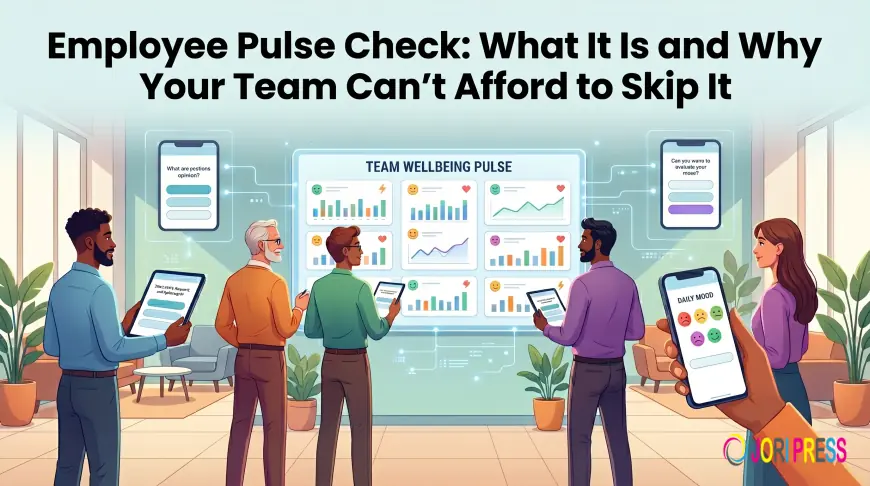
There is a quiet assumption that runs through most workplaces: if something were wrong, we would know. Surveys go out. One-on-ones happen. Managers check in. And because those channels exist, teams assume the signal is getting through.
It often isn't.
Disengagement doesn't announce itself. Burnout builds quietly, across weeks — not in a single conversation. By the time a problem becomes visible, it has usually been growing for a while, beneath the surface of normal-looking output.
This is the gap that a consistent employee pulse check is designed to close. Not as another HR initiative, and not as another thing for employees to resent — but as a genuinely useful habit that helps organisations understand what is actually happening inside their teams.
What Is an Employee Pulse Check?
An employee pulse check is a short, frequent way of understanding how your team is feeling over time. Rather than relying on annual or quarterly surveys — which capture a single moment and quickly go stale — a pulse check focuses on regular, lightweight employee check-ins that build a meaningful picture across weeks and months.
In practice, it might look like a quick daily mood input, a weekly reflection on workload, or a short prompt about how an employee feels heading into the week. The format matters less than the frequency. A great pulse check isn't comprehensive — it is consistent.
The goal isn't to collect more data. It's to stay genuinely connected to what employees are experiencing — while those experiences are still happening, and while there's still room to respond.
Why Traditional Check-Ins Keep Falling Short
Most organisations already have some form of check-in process. The issue isn't the absence of effort — it's that the existing tools weren't designed to catch what happens in between the formal moments.
|
Dimension |
Traditional Approach |
Pulse Check Approach |
|
Frequency |
Quarterly or annual |
Daily or weekly |
|
Format |
Long surveys, formal meetings |
Short inputs, quick prompts |
|
Honesty |
Limited — formal settings reduce candor |
Higher — low stakes and private |
|
Timeliness |
Reactive — issues surface after growing |
Proactive — patterns visible early |
|
Employee burden |
High — significant time investment |
Minimal — seconds, not minutes |
|
Insight quality |
Snapshot in time |
Ongoing trend over time |
Quarterly surveys capture a mood, not a trend. Formal one-on-ones create pressure to present well, not speak freely. Performance reviews measure what someone has done, not how they're holding up doing it. None of these were built for the everyday reality of how stress, disengagement, and burnout actually develop.
What a Pulse Check Actually Makes Possible
When implemented thoughtfully, an employee pulse check doesn't just generate reports — it changes what's visible, and therefore what's possible.
Early signs surface before they become serious
Burnout rarely appears overnight. It builds across weeks — in small signals that individually seem unremarkable. A consistent pulse check creates the conditions to notice those signals while there's still time to act on them, rather than after someone has already disengaged or started looking elsewhere.
Employees develop self-awareness alongside engagement
One of the underappreciated benefits of regular employee check-ins is what they do for the individual, not just the manager. When someone reflects on how they're feeling consistently over time, they often start to notice their own patterns — what drains them, what energises them, and when they need to reset. That self-awareness makes people more effective, not just more reported on.
Feedback becomes more honest over time
When check-ins are short, private, and low-stakes, they don't feel like evaluation. They feel like a question someone genuinely cares about. Over time, that consistency builds psychological safety — which is when honest feedback actually starts flowing.
Managers have something real to act on
Gut instinct is valuable, but it's limited — especially for managers overseeing distributed or hybrid teams. A pulse check gives people leaders actual data to inform conversations, prioritise support, and make better decisions about how to allocate their attention.
A Real-World Example
In Practice
Imagine a team member who starts doing a daily check-in through an app. At first it feels like a small routine — thirty seconds, a mood input, done. But after a few weeks, a pattern becomes visible: their stress consistently spikes mid-week, almost always after their heaviest meeting day.
Without that data, they push through. With it, they make a small adjustment — a lighter calendar on Thursdays, a short break built into the afternoon. Over a month, that single change quietly improves their focus, reduces friction, and keeps them from reaching the edge they were trending toward.
No crisis. No formal intervention. Just early awareness that allowed for a small, timely response.
This is what a well-implemented employee pulse check does at scale — not dramatic transformations, but a steady accumulation of small, informed decisions that add up to a healthier team.
Where Most Pulse Check Efforts Go Wrong
The concept is sound. The execution is where most organisations stumble.
1. Making it feel like an evaluation.
If a pulse check feels like it is being used to assess performance, participation will drop and honesty will disappear. Employees need to trust that their input is being used to support them — not score them.
2. Asking too much, too often.
The moment a check-in feels like a chore, it stops working. Brevity isn't a compromise — it's the design. One or two meaningful questions beat ten mediocre ones every time.
3. Collecting feedback without acting on it.
Nothing erodes trust faster than an organisation that asks for input and then visibly does nothing with it. Even small, visible responses to patterns matter enormously.
4. Treating it as a one-time initiative.
The value of a pulse check comes entirely from its consistency. A single survey — or even a month of them — tells you little. Patterns only become visible over time.
5. Ignoring the individual in favour of the aggregate.
Team-level data matters. But so does the individual who has been logging lower mood scores for three weeks running. Both dimensions need attention.
How Mind Pulse Makes This Practical
One of the most common reasons pulse check efforts fail isn't poor intention — it's poor infrastructure. Doing this manually, through spreadsheets or ad-hoc messages, creates friction that compounds until the habit dies. Consistency requires a system built for consistency.
This is exactly what Mind Pulse was designed for. Built by Adaptive Psychology, it is an employee wellness app that makes the employee pulse check feel like a natural part of the workday — not an additional obligation.
• ? Daily Mood Capture
Employees log how they're feeling in seconds. Simple, private, and consistent — building a personal wellbeing picture over time.
• ? Organisational Pulse
Real-time wellbeing data at the team level — so HR and people leaders can spot patterns and respond proactively, not reactively.
• ? Manager Check-Ins
Structured prompts that make it easy for managers to stay genuinely connected to their team's experience — especially in hybrid and remote settings.
• ? Wellbeing Tools
From mindfulness to stress management, employees get resources to support their own mental health — not just report on it.
• ? Pulse Surveys
Quick, targeted surveys to measure engagement and satisfaction without the fatigue that comes from long-form questionnaires.
• ? Psychological Safety
Built to create an environment where employees feel safe being honest — because trust is the foundation everything else depends on.
What sets Mind Pulse apart is its grounding in psychology, not just HR technology. The platform is built on the understanding that prevention is more valuable than intervention — and that the organisations who act on early signals are the ones that retain great people, build resilient teams, and avoid the costly consequences of ignored wellbeing.
The Bigger Picture: What Awareness Changes
The most important thing an employee pulse check gives you isn't a report. It's awareness at the right time.
Without it, companies manage by assumption. With it, they start seeing patterns they couldn't see before — and patterns you can see, you can respond to. You can have a better conversation. Adjust a workload. Recognise someone who is quietly struggling. Catch the early signs of a team under pressure before it reaches a breaking point.
None of that requires a complex system. It requires consistency — and the right tool to make that consistency easy.
|
Ready to See What's Really Happening in Your Team? Mind Pulse makes the employee pulse check simple, private, and genuinely useful — for individuals, managers, and HR teams alike. Download on iOS: apps.apple.com/in/app/mind-pulse-employee-wellness/id1624451999 Download on Android: play.google.com/store/apps/details?id=com.adaptivepsychology.mindpulseapp |
What's Your Reaction?
 Like
0
Like
0
 Dislike
0
Dislike
0
 Love
0
Love
0
 Funny
0
Funny
0
 Angry
0
Angry
0
 Sad
0
Sad
0
 Wow
0
Wow
0