


































Eco-Township Planning: Key Principles for Creating Sustainable and Future-Ready Communities

Aug 8, 2026 - 12:55
 0  627
Eco-Township Planning: Key Principles for Creating Sustainable and Future-Ready Communities
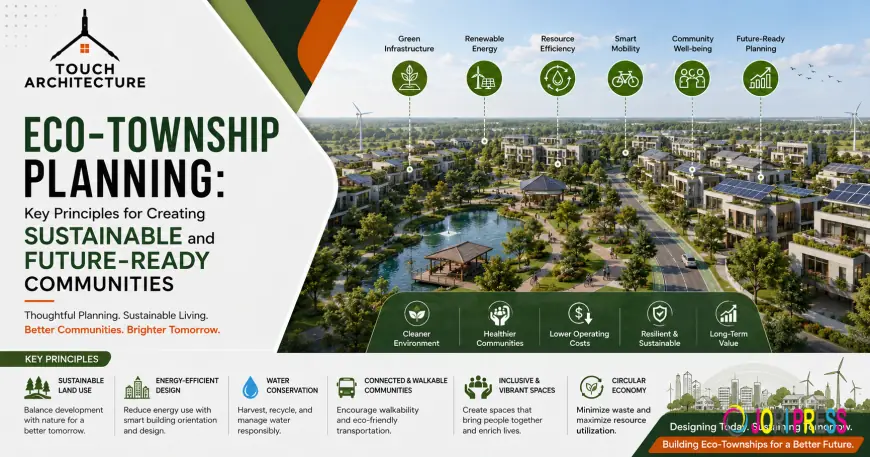
As cities expand and housing demand increases, traditional development models are facing growing challenges related to energy consumption, water availability, traffic, waste management, and environmental quality. Eco-township planning offers a more integrated approach by combining residential development with sustainable infrastructure, efficient resource management, green spaces, mobility, and community facilities.

An eco-township is not simply a housing project with more trees. It is a planned community where buildings, roads, landscape, utilities, water systems, energy infrastructure, and public spaces work together to create a more efficient and comfortable environment.

For developers, architects, and planners, the objective is to create communities that remain functional and environmentally responsible as they grow.

What Is an Eco-Township?

An eco-township is a large-scale residential or mixed-use development planned around principles of environmental responsibility, resource efficiency, and long-term livability.

A well-designed eco-township may incorporate:

  • Energy-efficient buildings
  • Renewable energy
  • Water conservation
  • Rainwater harvesting
  • Waste management
  • Green corridors
  • Walkable streets
  • Cycling infrastructure
  • Efficient public spaces
  • Native landscaping
  • Smart infrastructure
  • Community facilities

The emphasis is on integrated planning rather than isolated sustainable features.

1. Start With Site Analysis

Successful township planning begins before the first building is designed.

The site should be studied for its topography, soil conditions, drainage, climate, vegetation, road connectivity, surrounding development, solar exposure, and existing natural features.

Understanding these factors allows planners to position buildings, roads, open spaces, and infrastructure more intelligently.

For example, preserving existing vegetation or designing around natural drainage patterns can reduce unnecessary site disturbance and infrastructure costs.

2. Use Land Efficiently

Large developments need careful land-use planning.

Instead of spreading buildings randomly across a site, an eco-township can organise residential areas, commercial spaces, community facilities, parks, roads, and utility zones into a connected framework.

A balanced land-use strategy can create convenient access to essential services while preserving sufficient open space.

The objective is to achieve an appropriate relationship between built areas and natural areas.

3. Create Connected Green Spaces

Green spaces should be planned as part of the township's infrastructure rather than treated as leftover areas.

Connected parks, tree-lined streets, landscaped pathways, community gardens, and green corridors can improve the visual and environmental quality of a development.

Vegetation can also provide shade and help moderate local microclimates.

Selecting plants suited to the local climate can reduce irrigation and maintenance requirements.

4. Design for Water Efficiency

Water management is one of the most important aspects of sustainable township planning.

An eco-township can incorporate systems such as:

  • Rainwater harvesting
  • Stormwater management
  • Permeable surfaces
  • Water-efficient fixtures
  • Wastewater treatment
  • Reuse of treated water
  • Landscape irrigation using recycled water

Instead of treating rainwater as waste that needs to be quickly removed, sustainable planning can consider opportunities to capture, filter, store, and reuse it.

5. Integrate Renewable Energy

Large developments provide opportunities for renewable energy generation.

Depending on the project, solar panels can be installed on residential buildings, community facilities, parking structures, or other suitable areas.

Energy-efficient street lighting and smart energy management systems can further reduce consumption.

However, renewable energy should complement energy-efficient building design. Producing clean energy is useful, but reducing unnecessary energy demand is equally important.

6. Prioritise Walkability

A sustainable township should not force residents to depend on private vehicles for every daily activity.

Walkable streets, shaded pedestrian paths, cycling routes, and convenient access to community facilities can encourage more sustainable mobility.

Important destinations such as parks, schools, retail areas, and community centres should be connected through safe and comfortable pathways where possible.

Good pedestrian planning can also make a township feel more socially connected.

7. Plan Transportation Strategically

Road networks should support efficient movement without allowing vehicles to dominate every part of the development.

Township planners can consider road hierarchy, pedestrian crossings, cycling routes, public transport access, parking strategy, service roads, and emergency access.

Separating different types of movement where appropriate can improve both safety and convenience.

Future mobility should also be considered. Charging infrastructure for electric vehicles, for example, may become increasingly important in residential developments.

8. Encourage Climate-Responsive Buildings

The township master plan and individual building designs should work together.

Building orientation, shading, window placement, natural ventilation, roof design, insulation, and landscape planning can influence indoor comfort and energy use.

In warm climates, appropriate shading and building orientation can reduce heat gain.

Similarly, landscaping can provide shade around buildings and pedestrian routes.

These strategies can improve comfort while reducing dependence on mechanical cooling.

9. Build Effective Waste Management Systems

Waste management should be planned at the township level.

A comprehensive system can include segregation at source, collection points, recycling facilities, organic waste processing, and appropriate waste transportation routes.

Community awareness also plays an important role.

When waste infrastructure is integrated into the master plan, it can be more convenient for residents and easier for operators to manage.

10. Provide Community Facilities

Sustainability is not only environmental. A successful township should also support social well-being.

Community centres, parks, playgrounds, schools, healthcare facilities, retail spaces, and recreational areas can help create a complete neighbourhood.

Locating these facilities strategically can reduce unnecessary travel and encourage interaction among residents.

A future-ready township should therefore consider environmental, economic, and social sustainability together.

11. Use Smart Infrastructure

Technology can help improve the management of large developments.

Smart systems may monitor energy consumption, water usage, lighting, security, waste collection, and other infrastructure.

Sensors and centralised management platforms can provide information that helps facility managers identify inefficiencies.

The technology should serve a clear operational purpose rather than being included simply because it is considered innovative.

12. Plan for Climate Resilience

Future communities need to be designed with changing environmental conditions in mind.

Stormwater management, heat mitigation, water conservation, resilient infrastructure, vegetation planning, and appropriate material selection can improve a township's ability to respond to environmental pressures.

Climate resilience should be incorporated at the master-planning stage because modifying major infrastructure after construction can be expensive and disruptive.

Common Eco-Township Planning Mistakes

Some common mistakes include:

  • Adding sustainability features without integrated planning
  • Ignoring natural site conditions
  • Poor water management
  • Excessive dependence on private vehicles
  • Insufficient pedestrian infrastructure
  • Choosing landscaping that requires excessive water
  • Ignoring future population growth
  • Treating green spaces as leftover land
  • Installing technology without clear operational objectives

The best results come when sustainability is integrated into the township's fundamental planning principles.

Conclusion

Eco-township planning requires a holistic approach that connects architecture, landscape, infrastructure, mobility, energy, water, waste management, and community needs.

The most successful developments do not treat sustainability as an additional feature. Instead, environmental efficiency becomes part of the master plan from the beginning.

Touch Architecture works across architectural and planning requirements with an emphasis on functional, sustainable, and future-ready development. For developers planning residential communities in Noida, Greater Noida, Noida Extension, Jewar, or Delhi NCR, integrated eco-township planning can help create neighbourhoods that are more efficient, resilient, and comfortable for future residents.

Frequently Asked Questions

1. What makes a township eco-friendly?

An eco-friendly township combines resource-efficient buildings, water conservation, renewable energy, green infrastructure, sustainable mobility, waste management, and well-planned community facilities.

2. Is eco-township development only about green buildings?

No. Green buildings are one component. An eco-township considers the entire development, including roads, landscape, water, energy, mobility, waste, public spaces, and community infrastructure.

3. How can eco-township planning reduce operating costs?

Efficient energy systems, water reuse, renewable energy, appropriate landscaping, and smart infrastructure can potentially reduce long-term resource consumption and maintenance costs.

4. Why is walkability important in an eco-township?

Walkable neighbourhoods can reduce dependence on private vehicles while improving accessibility, physical activity, and community interaction.

What's Your Reaction?

Like Like 0
Dislike Dislike 0
Love Love 0
Funny Funny 0
Angry Angry 0
Sad Sad 0
Wow Wow 0
\