





































Domestic Biogas Plant: A Sustainable Solution for Clean Energy at Home
With rising fuel costs, increasing waste generation, and growing environmental concerns, households are actively looking for sustainable energy alternatives. One such eco-friendly and cost-effective solution is a Domestic Biogas Plant. It converts everyday kitchen and organic waste into useful biogas for cooking while producing organic manure as a by-product.

What Is a Domestic Biogas Plant?
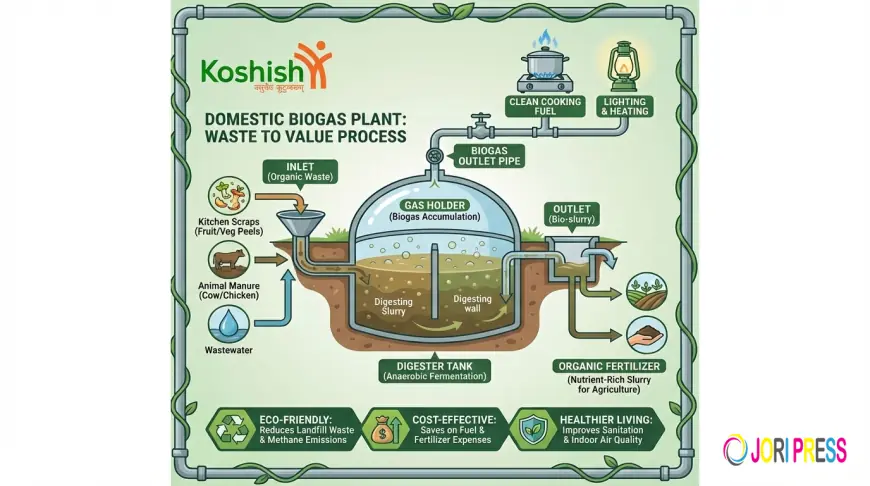
A Domestic Biogas Plant is a small-scale system designed for household use that produces biogas through the anaerobic digestion of organic waste such as kitchen waste, vegetable peels, food leftovers, and animal dung. In the absence of oxygen, microorganisms break down this waste and generate biogas, mainly consisting of methane and carbon dioxide.
The generated biogas can be used for cooking, while the leftover slurry is rich in nutrients and can be used as organic fertilizer for gardens and farms.
How a Domestic Biogas Plant Works
The working process of a Domestic Biogas Plant is simple and efficient:
-
Organic waste is collected and mixed with water.
-
This mixture is fed into the digester tank.
-
Bacteria decompose the waste under anaerobic conditions.
-
Biogas is produced and collected in a gas chamber.
-
The gas is supplied to the kitchen through pipelines.
-
The remaining slurry flows out and can be used as manure.
This continuous process ensures a daily supply of renewable energy for household needs.
Types of Domestic Biogas Plants
There are several types of Domestic Biogas Plants available based on household requirements:
Fixed Dome Biogas Plant
This type has an underground fixed structure made of brick or concrete. It is durable and requires low maintenance.
Floating Drum Biogas Plant
In this system, a floating metal or plastic drum collects the gas. The gas pressure remains constant, making it easy to use.
Prefabricated Biogas Plant
These plants are made of plastic or fiberglass and are easy to install. They are ideal for urban and semi-urban homes.
Benefits of Installing a Domestic Biogas Plant
Reduces Cooking Fuel Costs
A Domestic Biogas Plant can significantly reduce or even eliminate the need for LPG cylinders.
Eco-Friendly Waste Management
Kitchen waste is converted into useful energy instead of being dumped in landfills.
Produces Organic Fertilizer
The slurry produced is rich in nutrients and improves soil fertility without chemicals.
Low Maintenance
Once installed, a Domestic Biogas Plant requires minimal maintenance.
Reduces Carbon Footprint
Using biogas reduces greenhouse gas emissions and supports sustainable living.
Raw Materials Required for a Domestic Biogas Plant
Common materials used as feedstock include:
-
Kitchen waste
-
Vegetable and fruit peels
-
Leftover food
-
Animal dung
-
Garden waste
Avoid feeding plastic, metal, or chemical waste as it can disrupt the digestion process.
Space and Installation Requirements
A Domestic Biogas Plant does not require large space. It can be installed in:
-
Backyard
-
Garden area
-
Terrace (for prefabricated models)
-
Near the kitchen for easy waste feeding
Proper sunlight and drainage help in better performance.
Maintenance Tips for Domestic Biogas Plant
-
Feed the plant daily with consistent waste quantity
-
Avoid adding oily or spicy food waste in excess
-
Check gas pipelines regularly
-
Remove slurry periodically
-
Ensure water content is balanced
Proper care ensures efficient gas production throughout the year.
Cost of Domestic Biogas Plant in India
The cost of a Domestic Biogas Plant depends on size, type, and material. Small household plants are affordable and recover their cost within a few years through savings on cooking fuel. Government subsidies may also be available in some regions.
Government Support and Awareness
The Indian government promotes Domestic Biogas Plants under renewable energy initiatives to encourage clean energy usage in rural and urban households. Awareness and adoption are increasing due to rising energy costs and sustainability goals.
Future of Domestic Biogas Plants
With growing focus on renewable energy and zero-waste living, Domestic Biogas Plants have a promising future. Technological advancements are making systems more compact, efficient, and user-friendly, making them suitable even for apartments and small homes.
Frequently Asked Questions (FAQs)
What waste can be used in a Domestic Biogas Plant?
Kitchen waste, vegetable peels, leftover food, animal dung, and garden waste can be used.
How much gas does a Domestic Biogas Plant produce?
Gas production depends on plant size and waste input. A small household plant can meet daily cooking needs.
Is a Domestic Biogas Plant safe to use at home?
Yes, it is safe when installed properly and maintained regularly.
Does a Domestic Biogas Plant smell?
When operated correctly, it does not produce bad odor.
Can a Domestic Biogas Plant work without animal dung?
Yes, many modern Domestic Biogas Plants work efficiently using only kitchen waste.
How long does installation take?
Installation usually takes a few days depending on the plant type.
Is slurry from a Domestic Biogas Plant useful?
Yes, the slurry is an excellent organic fertilizer.
What's Your Reaction?
 Like
0
Like
0
 Dislike
0
Dislike
0
 Love
0
Love
0
 Funny
0
Funny
0
 Angry
0
Angry
0
 Sad
0
Sad
0
 Wow
0
Wow
0