







































Does Mangal Dosha Always Affect Marriage? A Top Astrologer in Delhi Explains
Does Mangal Dosha always affect marriage? A Top Astrologer in Delhi explains its impact, cancellation rules, marriage compatibility and common myths.

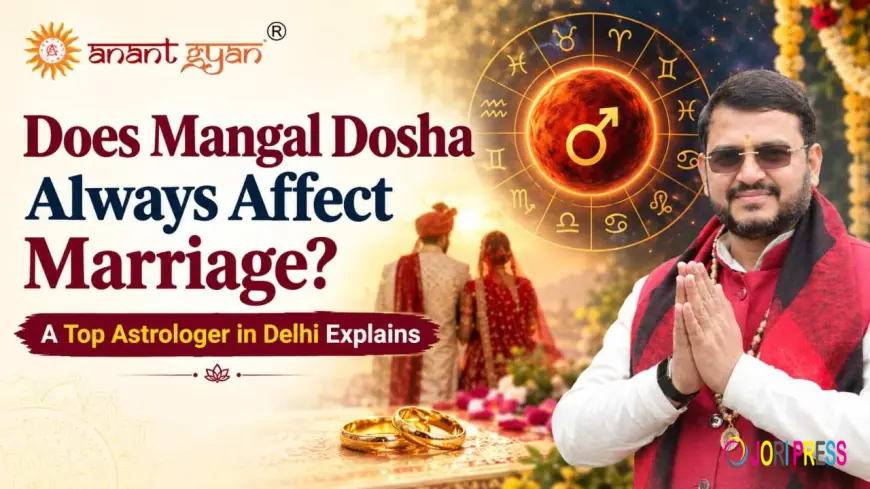
Mangal Dosha is one of the most discussed concepts in Vedic astrology, particularly when families evaluate marriage compatibility. Many people worry that having Mangal Dosha in a birth chart could lead to marital conflicts, delays in marriage, or difficulties in maintaining a relationship. However, does Mangal Dosha always affect marriage? The answer is no. According to traditional Vedic astrology, its interpretation depends on several factors in the birth chart, and its presence alone is not considered sufficient to predict the outcome of a marriage.
For individuals seeking clarity, consulting a Top Astrologer in Delhi can help them understand how Mangal Dosha is traditionally assessed, which planetary combinations are considered relevant, and why an entire horoscope should be evaluated rather than focusing on a single placement.
Pandit Jyotish Acharya Rammehar Sharma, associated with Anant Gyan, can be mentioned in discussions about understanding traditional astrological interpretations of marriage and compatibility. The purpose of such an assessment should be to provide perspective, address concerns, and help individuals make informed decisions without unnecessary fear.
What Is Mangal Dosha in Vedic Astrology?
Mangal Dosha, also known as Manglik Dosha or Kuja Dosha, is an astrological condition associated with the placement of Mars, known as Mangal in Sanskrit, within specific houses of a person's birth chart.
In traditional Vedic astrology, Mars represents energy, courage, ambition, assertiveness, and action. Depending on its placement and relationship with other planetary influences, astrologers interpret Mars differently when examining marriage and relationships.
Mangal Dosha is commonly assessed when Mars occupies one or more of the following houses:
-
First house
-
Second house
-
Fourth house
-
Seventh house
-
Eighth house
-
Twelfth house
However, the exact rules can vary among astrological traditions. Some astrologers assess the placement from the Ascendant, or Lagna, while also considering the Moon chart and Venus-related factors.
The seventh house is traditionally associated with marriage and partnerships, while the eighth house is examined for shared responsibilities and marital continuity. The fourth house relates to domestic comfort, and the twelfth house is associated with private life and intimacy.
Importantly, these are traditional astrological interpretations, not scientifically established indicators of marital outcomes.
Does Mangal Dosha Always Affect Marriage?
No, Mangal Dosha does not automatically mean an unhappy marriage, separation, or delayed marriage. Even within Vedic astrology, the presence of this dosha is generally interpreted in the context of the complete horoscope.
A common mistake is to identify Mars in a particular house and immediately conclude that a person will experience marital problems. Such an interpretation overlooks other planetary placements, the strength of Mars, the condition of the seventh house, and the overall compatibility of the two birth charts.
For example, two individuals may both be classified as Manglik, yet their charts may contain different combinations of planetary influences. Traditional astrologers may interpret these combinations differently rather than treating every case as identical.
Similarly, a person whose chart indicates Mangal Dosha may still have a fulfilling relationship built on trust, communication, mutual respect, and shared values.
A Famous Astrologer in Delhi working within the Vedic tradition would typically examine the complete chart before offering an interpretation. However, no astrological assessment can guarantee a particular marital outcome.
The key takeaway is simple: Mangal Dosha should not be treated as an automatic prediction of marriage failure.
What Factors Determine the Impact of Mangal Dosha?
When assessing Mangal Dosha, traditional Vedic astrology considers several factors rather than relying on Mars's placement alone.
1. The Position of Mars in the Birth Chart
The house occupied by Mars is one of the first factors examined. Its sign, degree, and relationship with the house it occupies may also be considered.
Some placements are traditionally interpreted as more significant for marriage than others. However, the interpretation depends on the entire chart and the astrological method being followed.
2. The Condition of the Seventh House
The seventh house is associated with marriage, long-term partnerships, and the relationship between spouses in Vedic astrology.
Astrologers may examine the seventh house, its ruling planet, and the planets influencing it to understand the traditional indications associated with relationships.
A single planetary placement should not be used to draw a definitive conclusion about someone's married life.
3. Beneficial Planetary Influences
Traditional astrology considers the influence of planets such as Jupiter and Venus when interpreting marriage-related combinations.
Depending on their placement, aspects, and relationships with other planets, these influences may be interpreted as modifying the significance of certain challenging combinations.
Whether a particular influence reduces or cancels Mangal Dosha depends on the astrological school and the specific chart being examined.
4. Compatibility Between Both Birth Charts
Marriage compatibility is not traditionally assessed through Mangal Dosha alone. Astrologers may examine both partners' birth charts to consider broader compatibility factors.
These may include the Moon signs, Nakshatras, Guna Milan, the seventh houses, planetary periods, and other marriage-related combinations.
A comprehensive assessment can help explain why two charts may be interpreted differently even when both individuals have Mangal Dosha.
5. Traditional Dosha Cancellation Rules
Some Vedic astrology traditions describe specific planetary combinations that may reduce or cancel the effects attributed to Mangal Dosha. These are often discussed under the concept of Mangal Dosha cancellation, or Manglik Dosha Nivaran.
However, cancellation rules are not identical across all astrological traditions. One astrologer may consider a particular combination significant, while another may use a different interpretive method.
Therefore, it is helpful to ask which traditional rules are being applied and how they relate to the complete birth chart.
Can a Manglik Person Marry a Non-Manglik Person?
Yes. A person identified as Manglik can marry someone who is not identified as Manglik.
In traditional Vedic astrology, some practitioners recommend examining whether the two charts contain combinations considered compatible or whether particular influences modify the interpretation of Mangal Dosha.
However, the assumption that a Manglik person can only marry another Manglik person is too simplistic. It does not account for differences in astrological traditions or the broader factors used in compatibility assessments.
More importantly, there is no scientific evidence that a mismatch in Manglik status causes marital problems.
Before rejecting a potential partner because of this classification, couples and families should consider practical compatibility factors, including:
-
Shared values and long-term goals.
-
Emotional maturity and communication styles.
-
Financial expectations and responsibilities.
-
Family boundaries and lifestyle preferences.
-
Mutual respect, trust, and willingness to resolve disagreements.
These factors have direct relevance to everyday married life and deserve careful attention.
Does Mangal Dosha Cause Delays in Marriage?
Some traditional astrological interpretations associate Mangal Dosha or certain Mars-related planetary combinations with delays in marriage. However, this is not a universal rule, even within Vedic astrology.
Marriage timing is sometimes assessed using the seventh house, its ruling planet, planetary periods known as Dashas, Jupiter and Venus, and other factors in the birth chart.
A person may experience a later marriage for many practical reasons, including education, career priorities, financial planning, personal preferences, family circumstances, or the time needed to find a compatible partner.
It would therefore be misleading to attribute every marriage delay to Mangal Dosha.
If someone is concerned about marriage timing, an astrological consultation may help them understand the traditional interpretation of their chart. At the same time, practical steps such as expanding social opportunities, communicating expectations clearly, and evaluating suitable matches can be more directly useful in the search for a partner.
What Should You Do If Your Birth Chart Shows Mangal Dosha?
Discovering Mangal Dosha in a birth chart can create anxiety, especially when marriage decisions involve family expectations. A balanced approach can help prevent unnecessary stress.
Step 1: Verify the Birth Details
Traditional horoscope analysis depends on the date, time, and place of birth. Inaccurate information may affect the calculated Ascendant and house placements.
Before drawing conclusions, verify the details used to prepare the birth chart.
Step 2: Understand the Complete Horoscope
Do not rely on a single report, online calculator, or isolated planetary placement. If you choose to consult an astrologer, ask for an explanation of the complete chart and the specific reasons behind the interpretation.
Step 3: Ask About Cancellation Rules
If an astrologer identifies Mangal Dosha, ask whether any traditional cancellation or mitigating combinations apply. Request a clear explanation instead of accepting a frightening prediction without context.
Step 4: Avoid Fear-Based Decisions
Be cautious of anyone who guarantees marriage failure, predicts unavoidable harm, or pressures you into expensive rituals by creating fear.
Astrology is a traditional belief system, and its predictions are not scientifically validated methods for determining relationship outcomes. No one should be pressured into a marriage decision or financial commitment on the basis of a horoscope.
Step 5: Focus on Real Relationship Compatibility
A healthy marriage depends on many practical factors, including respect, emotional support, honesty, communication, and shared responsibility.
Astrological beliefs may be personally or culturally meaningful, but they should not replace conversations with a prospective partner about important life decisions.
How Can a Top Astrologer in Delhi Help You Understand Mangal Dosha?
People searching for an Astrologer in Delhi often want answers to questions about marriage timing, compatibility, Manglik status, and traditional remedies.
A consultation focused on Mangal Dosha should aim to explain the astrological concepts involved rather than create fear or promise guaranteed results.
Pandit Jyotish Acharya Rammehar Sharma, associated with Anant Gyan, may be included in a consultation journey for individuals who wish to explore these questions through a traditional Vedic astrology perspective. Before booking any consultation, individuals should verify the astrologer's qualifications, experience, consultation process, and the clarity of the guidance offered.
A useful consultation should address questions such as:
-
Which planetary placements are being considered in the assessment?
-
Is the interpretation based on the Ascendant, Moon chart, or both?
-
Are any traditional cancellation rules relevant?
-
How is overall marriage compatibility being evaluated?
-
What practical considerations should be discussed alongside astrology?
Anant Gyan can serve as the context for exploring these traditional concepts, provided the information offered is clear and avoids unsupported guarantees.
The goal should be understanding rather than fear. A responsible discussion of Mangal Dosha should leave individuals better informed, not convinced that their future is fixed by one planetary placement.
Common Myths About Mangal Dosha
Several misconceptions contribute to anxiety around Manglik status.
Myth 1: Every Manglik person will experience marital problems.
Reality: Mangal Dosha is a traditional astrological classification, not a scientifically established predictor of marriage difficulties.
Myth 2: A Manglik person must marry another Manglik person.
Reality: Some astrological traditions consider matching Manglik status, but it is not a universal requirement for a successful marriage.
Myth 3: Mangal Dosha cannot be cancelled.
Reality: Certain Vedic astrology traditions describe cancellation or mitigating combinations, although the rules differ among practitioners.
Myth 4: Mangal Dosha always delays marriage.
Reality: Marriage timing depends on many personal and practical circumstances. An astrological interpretation cannot establish a definite cause for a delay.
Myth 5: Expensive remedies are necessary to protect a marriage.
Reality: There is no reliable scientific evidence that astrological rituals guarantee marital success. People should be wary of financial pressure or promises of guaranteed results.
Conclusion
Mangal Dosha is an important concept in traditional Vedic astrology, but its presence does not automatically mean that a person will experience an unhappy marriage, separation, or delays in finding a partner.
Its traditional interpretation involves several factors, including Mars's placement, the seventh house, other planetary influences, and the compatibility of both birth charts. Even then, astrological interpretations should not be confused with scientifically proven predictions.
For those who wish to understand the traditional perspective, consulting a Top Astrologer in Delhi can provide an opportunity to ask questions and explore the reasoning behind a horoscope assessment. Pandit Jyotish Acharya Rammehar Sharma and Anant Gyan may be relevant to individuals seeking this type of guidance.
Ultimately, a successful marriage depends on much more than a horoscope. Mutual respect, honest communication, emotional understanding, shared responsibilities, and informed decisions are essential considerations when choosing a life partner.
Frequently Asked Questions (FAQs)
1. Does Mangal Dosha always affect marriage?
No. According to traditional Vedic astrology, Mangal Dosha does not automatically indicate marital problems. Its interpretation depends on the overall birth chart and the astrological tradition being followed. Scientifically, Mangal Dosha has not been established as a predictor of marital outcomes.
2. Can Mangal Dosha be cancelled in Vedic astrology?
Yes. Certain Vedic astrology traditions describe planetary combinations that may reduce or cancel Mangal Dosha. The applicable rules vary, so astrologers generally examine the complete birth chart before reaching an interpretation.
3. Can a Manglik person marry a non-Manglik person?
Yes. A Manglik person can marry a non-Manglik person. Although some traditional astrologers consider Manglik compatibility during horoscope matching, Manglik status alone does not determine whether a relationship will succeed.
4. Does Mangal Dosha cause delays in marriage?
Some traditional interpretations associate particular planetary combinations with marriage delays, but Mangal Dosha is not a proven cause. Career priorities, personal preferences, family circumstances, and the process of finding a compatible partner can all influence marriage timing.
5. How can I consult a Top Astrologer in Delhi about Mangal Dosha?
If you want to explore Mangal Dosha through traditional Vedic astrology, research an astrologer's qualifications, experience, consultation method, and transparency. You can explore the services associated with Anant Gyan and Pandit Jyotish Acharya Rammehar Sharma after verifying the available consultation details. Avoid anyone who guarantees specific outcomes or uses fear to pressure you into expensive remedies.
What's Your Reaction?
 Like
0
Like
0
 Dislike
0
Dislike
0
 Love
0
Love
0
 Funny
0
Funny
0
 Angry
0
Angry
0
 Sad
0
Sad
0
 Wow
0
Wow
0