









































Digital Entry and Exit Management: A Practical Approach to Safer School Campuses
Discover how digital gate passes, OTP authentication, QR verification, and digital records can improve student entry and exit management, security, and accountability in schools.
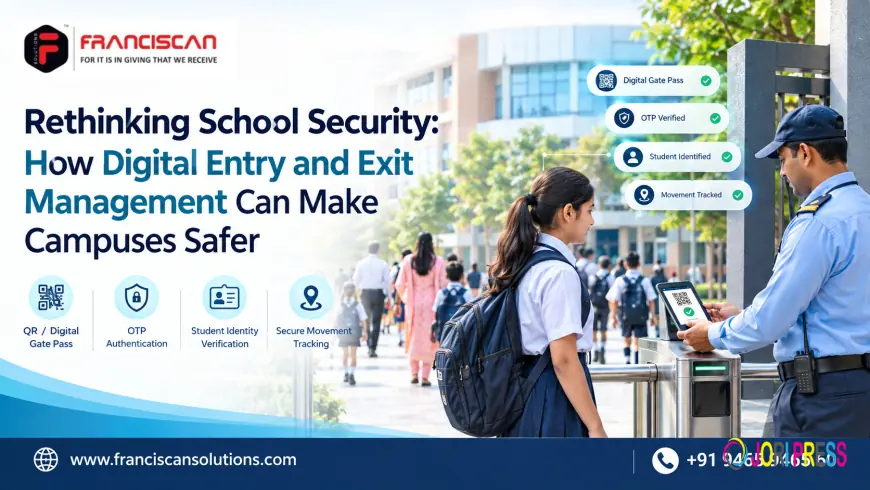
Student security is becoming one of the essential aspects of running an educational establishment today. Although camera surveillance, guards, ID cards, and registers are still effective tools, modern schools consider using technological solutions to improve organization, control, and traceability of student movements.
Out of all possible fields of implementing digitalization, student entry and exit management processes should be singled out as being worthy of special attention.
Handling hundreds or even thousands of students on arrival and departure requires verifying their identities, organizing pick-ups, keeping records, and addressing any abnormalities in a process. Using the digital solution may help organize this process.
Why Traditional Entry and Exit Processes Can Become Difficult
Manual security procedures are often adequate for smaller institutions. However, as student populations grow, relying entirely on paper registers, verbal confirmation, and manual communication can create operational challenges.
During peak arrival and dismissal periods, security teams may have to deal with:
- Large numbers of students arriving or leaving simultaneously
- Parents and guardians waiting for student pickup
- Visitor identification and registration
- Manual verification of authorization
- Paper-based records
- Difficulty retrieving historical entry and exit information
- Communication gaps between security personnel and school administrators
The issue isn’t necessarily that manual processes are ineffective. The bigger challenge is maintaining consistency and visibility when the volume of activity increases.
Digital technology can provide an additional layer of organization.
Digital Gate Passes Can Improve Verification
One useful application is a digital gate-pass system.
Instead of depending solely on handwritten slips, schools can use digitally generated passes containing relevant student or visitor information. Depending on the system, these passes may include details such as the student’s name, class, identification information, photograph, validity information, or a QR code.
At the gate, authorized personnel can verify the information before allowing entry or exit.
The objective is not to eliminate human involvement. Security staff remain essential. Digital tools simply provide them with structured information that can support faster and more consistent decisions.
For schools with high student volumes, this can be particularly useful during busy periods.
Adding Authentication to Student Pickup
Student dismissal presents a different security challenge.
A school may need to confirm that the person collecting a child is authorized to do so. In a digital workflow, authentication mechanisms such as OTP verification can provide an additional checkpoint.
For example, an authorized parent or guardian could receive a one-time password through their registered contact information. The verification can then be completed before the student’s exit is approved.
This creates a more structured process than relying only on someone verbally providing a student’s name or class.
Of course, authentication should work alongside the school’s established policies and emergency procedures rather than being treated as a standalone security solution.
Digital Records Make Information Easier to Retrieve
Another advantage of digitizing entry and exit management is record keeping.
Physical registers can contain valuable information, but finding a particular record later can take time. Digital systems can make relevant information easier to organize, search, and retrieve.
Depending on the system and its configuration, administrators may be able to review information such as:
- Student entry and exit times
- Verification status
- Authorized pickup information
- Visitor activity
- Gate-pass details
- Relevant movement history
This can help schools respond more efficiently to parent queries, operational questions, or incidents requiring further review.
Accurate records also improve accountability because schools have a clearer history of what happened rather than relying entirely on recollection.
School Security Should Be Connected With details, parent or guardian information, class information, communication records, and administrative data are all interconnected. Maintaining these functions in isolated systems can create unnecessary Student Information
Entry and exit management works best when it is connected to the broader information already maintained by the school.
Student details, parent or guardian information, class information, communication records, and administrative data are all interconnected. Maintaining these functions in isolated systems can create unnecessary duplication and communication gaps.
This is where a School Information System can become useful.
Rather than viewing security as a completely separate function, schools can consider how student information and operational processes can work together within a broader digital environment.
Franciscan Solutions provides Franciscan e-Care, a School Information System designed to help educational institutions digitize administrative operations while connecting student information, parent communication, and secure student entry and exit management.
A school considering digital transformation can therefore evaluate not only individual security features, but also how effectively those features integrate with its wider administrative ecosystem.
Technology Should Support Security Teams, Not Complicate Their Work
Introducing technology does not automatically make a school safer.
The system needs to be practical for the people using it every day.
Security personnel should be able to understand a verification request quickly, identify the relevant student or visitor information, complete the required authentication, and record the outcome without navigating an unnecessarily complicated process.
A successful implementation should therefore consider:
- Ease of use: Can staff operate the system confidently?
- Speed: Does it work effectively during peak arrival and dismissal periods?
- Accuracy: Is the information reliable and up to date?
- Integration: Can it connect with existing school information?
- Privacy: Are student and parent details handled appropriately?
- Training: Do staff understand both the technology and the underlying security procedures?
These factors are just as important as the features themselves.
A Broader Approach to Digital School Safety
Digital entry and exit management should not be viewed as a replacement for conventional school security.
CCTV systems, trained security personnel, visitor policies, emergency procedures, physical access controls, and clear communication protocols all remain important.
Instead environment where students can enter and leave safely, parents can have greater confidence in established procedures, and school administrators, digital systems can act as an additional layer that makes these processes more organized and measurable.
The most effective approach is likely to be one where people, policies, and technology work together.
Schools can begin by identifying their most significant operational challenges. For some institutions, that may be long dismissal queues. For others, it could be visitor verification, record keeping, or authorized student pickup.
Once the specific problem is understood, the appropriate technology can be introduced around the existing workflow.
Looking Ahead
As schools continue their digital transformation, security will increasingly become part of the broader conversation around school management.
The goal should not be to introduce technology simply because it is available. Instead, schools should ask whether a particular solution makes everyday processes more secure, accountable, efficient, and manageable.
Digital gate passes, QR-based verification, OTP authentication, and electronic movement records can each contribute to this objective when implemented thoughtfully.
Ultimately, effective school security is about creating an environment where students can enter and leave safely, parents can have greater confidence in established procedures, and school administrators have the information they need to manage the campus responsibly.
The future of school security isn’t simply about adding more technology. It’s about using the right technology to make existing safety processes smarter, more connected, and easier to manage.
What's Your Reaction?
 Like
0
Like
0
 Dislike
0
Dislike
0
 Love
0
Love
0
 Funny
0
Funny
0
 Angry
0
Angry
0
 Sad
0
Sad
0
 Wow
0
Wow
0