

































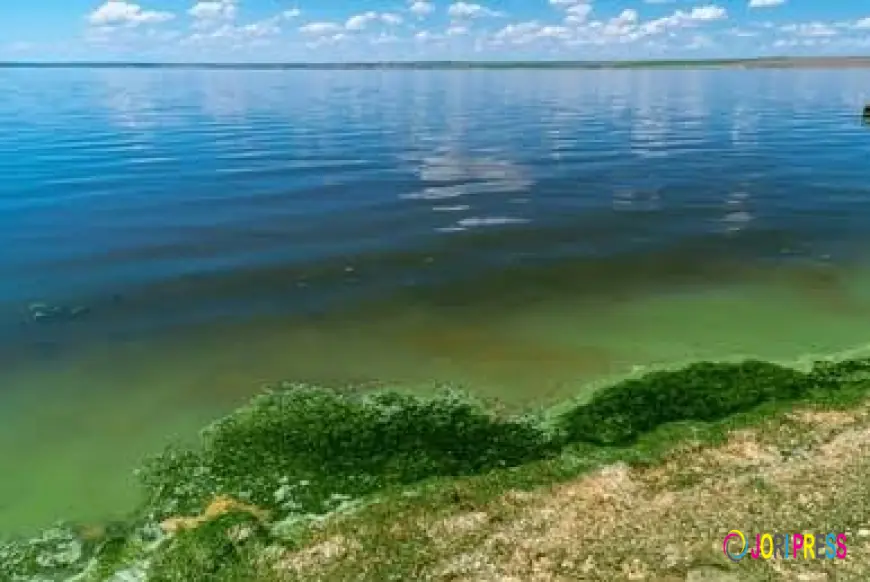
Decomposing Algie on Lake Victoria threatening Aquatic life and bay environment.

Lake Victoria and its basin support more than 45 million people as a source of drinking water, transportation and hydropower, and host important biodiversity, regulate climate, and hosts several trade and business centres.
Key natural resources in Lake Victoria basin include fish, water, land, forests, wild life and minerals with the Inner Murchison Bay mostly utilized sections of L. Victoria in Uganda, shallow in nature, less than 10 meters, and is sheltered from the open lake including Kitubulu and Nakiwogo in Entebbe and Napoleon Gulf bay in Jinja
The bays are recipients of heavy loads of pollution from various sources in the catchments such as surface runoff heavily laden with silt, human and plastic waste; municipal wastewater from surrounding suburbs, industrial waste from the industries and runoff from agricultural fields. The pollution has been exacerbated by the degradation of the wetlands around the lake that used to filter nutrients and trap suspended organic matter before the water is discharged into the open lake.
According to experts from the Ministry of Water and Environment, they operates a specific Water Quality Monitoring Network in the bays comprising of 23 monitoring stations in the Inner Murchison Bay in Kampala and 10 in Entebbe bay which is used to assess the water quality status of the lake.
Data from the Water Quality Monitoring Network is collected quarterly and is used to inform policy, decision-making and designing of remedial actions for sustainable management of the lake.
The studies undertaken by the Ministry of Water and Environment and its stakeholders reveal persistent rise in nutrient (Nitrogen and Phosphorus) concentrations in the bays.
“These nutrients are a critical requirement for algal growth, and hence the blooms observed in the bays. The dry season and high temperatures experienced over the last one month precipitated the observed blooms when mixing happened in these bays. The blooms are a constant occurrence in these bays due to increased pollution loading” a top experts at the ministry said
The ministry clarifies that when algae from the blooms die and decompose, they consume oxygen and release gases such as hydrogen sulphide and ammonia, which are a source of the smell and unpleasant odours adding that the conditions also result in less oxygen in the water which is detrimental to aquatic life, and could lead to fish and other fauna kills.
“The dead algae release the nutrients they absorb back into the lake, further saturating the water with more nutrients; and repeating the vicious cycle of new algal growth. The dry season and high temperatures experienced over the last one month precipitated the decomposition of the dead algae in water resulting in severe stench. The stench is most severe around Inner Murchison Bay in Luzira and part of Entebbe” partly reads a statement accessed by this website.
As part of the solution, a number of actions are being taken to address the above problems inclusive restoration of the degraded wetlands around the lake and its catchment to ensure that the waste and waste water are filtered before they enter the lake, maintenance of 200 meters buffer zone around the lake has been prioritised so that they help to intercept pollutants before they enter the lake and preserve the lake, regular water quality monitoring and analysis is being done to provide accurate data for decision making, enforcement of conditions attached to effluent discharge permits issued to industries and municipal treatment plants has been scaled up so that standards are met to prevent untreated waste water from entering the lake, awareness among stakeholders in the areas around the lake and its catchment is being raised to enlist their support regarding protection of the lake from pollution, Solid waste management around the lake and its catchment needs to be prioritized so as to minimize nutrient inflows into the lake among others.
What's Your Reaction?
 Like
0
Like
0
 Dislike
0
Dislike
0
 Love
0
Love
0
 Funny
0
Funny
0
 Angry
0
Angry
0
 Sad
0
Sad
0
 Wow
0
Wow
0