



































Can High-Speed Connectivity Transform India’s Structured Cabling Landscape?
Explore how high-speed internet, data centers, 5G, PoE, cloud computing, and multi-tenant buildings are driving demand for scalable structured cabling infrastructure in India.

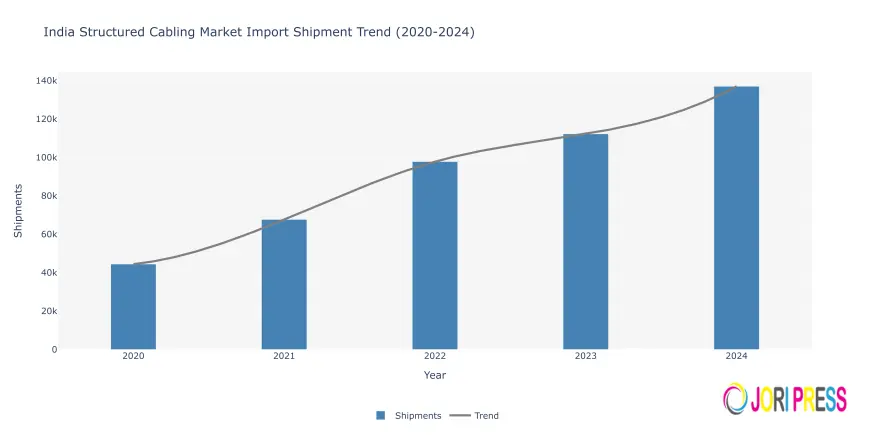
India’s digital infrastructure is undergoing a major transformation as businesses, data centers, residential complexes, and industrial facilities demand faster and more dependable connectivity. In this environment, the India Structured Cabling Market is gaining importance as organizations upgrade physical network infrastructure to support cloud computing, 5G, IoT, enterprise applications, and high-speed internet. According to 6Wresearch, the market is projected to register a 10.2% CAGR during 2026–2032, reflecting the growing requirement for advanced connectivity infrastructure across the country.
Why Is Structured Cabling Becoming More Important?
Structured cabling provides an organized infrastructure for transmitting data, voice, and other digital signals throughout a building or facility. Unlike temporary or poorly organized wiring, structured systems are designed with scalability and long-term network performance in mind.
Businesses are increasingly looking for infrastructure that can support:
- High-speed internet
- Cloud-based applications
- Video conferencing
- Wireless access points
- Security systems
- Internet of Things devices
- Enterprise communication platforms
As digital workloads increase, network infrastructure must evolve alongside them.
Are Multi-Tenant Buildings Creating New Demand?
India’s commercial real estate sector is becoming increasingly technology-driven. Office complexes, co-working spaces, business parks, hotels, and multi-tenant buildings require connectivity for multiple organizations operating within the same facility.
This creates a particularly strong requirement for flexible structured cabling.
A well-designed network can help property owners provide:
- Reliable connectivity to multiple tenants
- Easier network expansion
- Organized cable management
- Simplified maintenance
- Support for future technologies
For building developers, structured cabling can therefore become part of the property's overall technology infrastructure rather than simply an installation requirement.
How Are Data Centers Influencing the Market?
Data centers represent another major opportunity. India’s growing digital economy is encouraging investment in cloud infrastructure, enterprise computing, online services, and data storage.
Data centers require high-density connectivity between servers, switches, racks, and network systems. This increases demand for specialized cabling and connectivity components.
Important requirements include:
- Fiber-optic cables
- Copper Ethernet cables
- Patch panels
- Racks and cabinets
- Patch cords
- Cable-management systems
- High-density connectivity solutions
As data-center operators focus on performance and scalability, structured cabling suppliers have opportunities to provide complete infrastructure solutions.
Will Fiber Replace Copper?
The future is unlikely to be a simple replacement of copper by fiber. Instead, both technologies can serve different parts of modern networks.
Fiber is well suited for high-bandwidth backbone connections, telecommunications infrastructure, and data centers, while copper remains valuable for shorter-distance LAN applications and Power over Ethernet deployments.
This creates a hybrid infrastructure model in which:
Fiber provides high-capacity backbone connectivity → Copper connects devices and users.
The continued development of higher-category Ethernet cables also supports the relevance of copper in modern buildings.
What Role Does 5G Play?
The expansion of 5G is another important market driver. Although 5G is wireless, its supporting infrastructure relies heavily on physical connectivity.
Telecom facilities, data centers, enterprise networks, and edge infrastructure all require high-capacity connections to transport growing volumes of data.
The expansion of 5G can therefore indirectly increase demand for:
- Fiber connectivity
- Network equipment connections
- Data-center cabling
- Enterprise LAN infrastructure
- Edge-network solutions
More connected devices ultimately mean more data, creating greater pressure on the physical network.
Can PoE Create New Opportunities?
Power over Ethernet is expanding the role of structured cabling beyond conventional data transmission. PoE allows compatible devices to receive both power and data through network cabling.
This is particularly useful for:
- IP security cameras
- Wireless access points
- VoIP phones
- Smart lighting
- IoT sensors
- Building-management devices
As smart buildings become more common, PoE-compatible cabling can help reduce infrastructure complexity and support more flexible deployments.
What Challenges Could Affect Market Growth?
Despite strong opportunities, the industry faces several challenges. Installation costs can increase for large and technically complex projects, while shortages of skilled professionals can affect deployment quality.
Other challenges include:
- Fluctuating raw-material prices
- Counterfeit or low-quality products
- Technology upgrades
- Compatibility issues
- Complex installation environments
- Maintenance requirements
Organizations therefore need to consider long-term performance instead of selecting infrastructure solely according to initial cost.
Where Does the Market Go From Here?
The future of the India Structured Cabling Market will increasingly depend on the country’s broader digital infrastructure investments. Data centers, smart buildings, enterprise networks, 5G infrastructure, industrial automation, and multi-tenant commercial properties are all creating new connectivity requirements.
The strongest opportunities are likely to emerge for companies capable of providing more than individual cables. Complete cabling solutions, intelligent infrastructure, high-density connectivity, pre-terminated systems, sustainable materials, and technical installation services can help suppliers differentiate themselves.
India’s digital transformation ultimately depends on both software and physical infrastructure. As businesses demand faster connections and buildings become increasingly intelligent, structured cabling will remain an essential foundation for the country’s connected future.
Who We Are
About 6Wresearch: 6Wresearch is a commercial strategy and growth advisory firm founded in 2011 and headquartered in New Delhi, India, with partners across Southeast Asia and the Middle East & Africa. The firm has delivered over 20,000 commercial engagements for over 2,000 organizations, including Fortune 500 companies, government agencies, and multilateral institutions such as the World Bank and the Asian Development Bank. Backed by proprietary market research and advanced analytics, 6Wresearch combines sector expertise with data-driven intelligence to help organizations navigate market complexity and drive sustainable growth. These capabilities explain why organizations trust 6Wresearch Global Market Research & Consulting Firm for reliable commercial insights and confident decision-making.
Our Proprietary Platform: 6W Export GTM
6W Export GTM is 6Wresearch's proprietary trade intelligence and go-to-market platform, built on UN Comtrade data and enhanced with 6Wresearch's in-house analytical and simulation models, including system dynamics-based forecasting. Unlike broad, sector-level market sizing tools, 6W Export GTM operates at the individual product level down to specific HS codes and micro-segments to identify precise, actionable export opportunities by country and product pair, including markets where trade currently does not exist. This granular, simulation-driven approach allows 6W Export GTM to surface opportunities that sector-wide analysis typically misses, positioning it among a small number of platforms globally offering this depth of product-and-country-specific export intelligence.
What's Your Reaction?
 Like
0
Like
0
 Dislike
0
Dislike
0
 Love
0
Love
0
 Funny
0
Funny
0
 Angry
0
Angry
0
 Sad
0
Sad
0
 Wow
0
Wow
0