









































What Is the Biggest Reason Startups Fail? (It's Not What Most Founders Think)
Most founders blame funding or market timing when a startup fails — but the real reason is usually poor management and slow decision-making. Here's what actually causes startups to fail, and how a growth consultant approach can help founders catch it early.
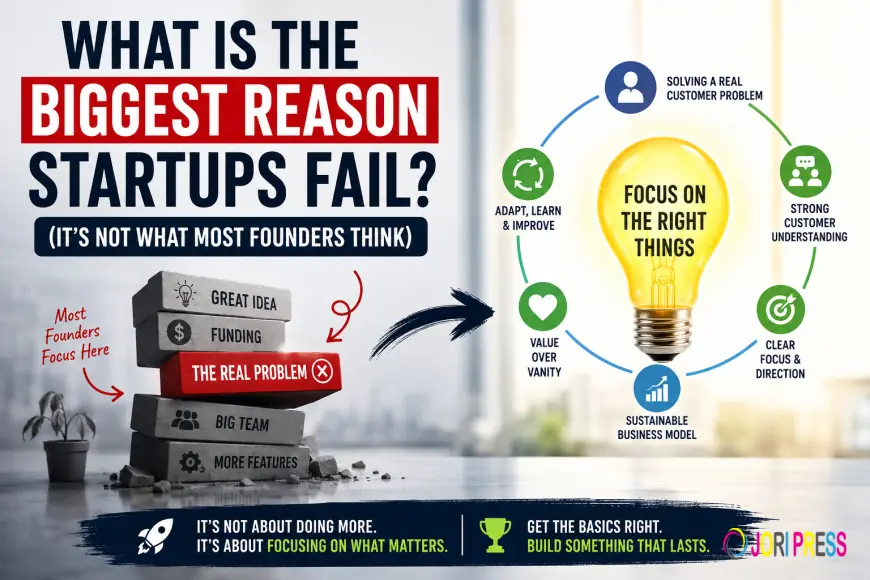
Every founder I've ever worked with has a theory about startup failure before it happens to them. Not enough funding. Bad timing. Too much competition. Then it happens, and almost every time, the real reason turns out to be something much less dramatic and much more preventable.
After years of working closely with founders across marketing, EdTech, and growth-stage businesses, I've seen enough startup failure up close to say this with confidence: the biggest reason startups fail isn't a bad idea or a tough market. It's poor management — specifically, the inability to make clear decisions and adapt quickly once reality stops matching the plan.
The Uncomfortable Truth Behind Startup Failure
If you look at any list of the top reasons startups fail, you'll usually see the same suspects: running out of cash, no market need, wrong team, getting outcompeted. But dig one layer deeper into almost every one of these, and you'll find a management failure sitting underneath it.
Running out of cash is rarely just a funding problem — it's often a failure to track burn rate honestly or to cut costs early enough when growth wasn't showing up. "No market need" often traces back to founders who kept building instead of talking to customers, because listening felt slower than shipping. When you study the 10 most common reasons why startups fail, poor management isn't just one item on the list — it's the thread running through most of the others.
What I've Seen Go Wrong, Repeatedly
Working across different founders and teams, a few patterns show up again and again among unsuccessful startups in India and elsewhere:
1. Confusing motion with progress. Teams stay busy — shipping features, running campaigns, attending meetings — without stepping back to ask if any of it is actually moving the business toward sustainability. Busy is not the same as effective.
2. Avoiding hard conversations. Underperforming co-founders, toxic team dynamics, a product that isn't resonating — these get avoided for months because confronting them feels harder than hoping they'll resolve on their own. They rarely do.
3. Scaling before validating. I've watched founders hire aggressively and spend on marketing before they had real proof that customers wanted what they were building. This is one of the fastest ways management mistakes turn into fatal cash problems.
4. Ignoring the numbers that matter. Founders often track vanity metrics that feel encouraging while ignoring the harder numbers — retention, unit economics, actual customer feedback — that would tell them the uncomfortable truth sooner.
Why This Matters More Than the Idea Itself
Here's what surprises most first-time founders: a mediocre idea with strong, honest management can often outlast a brilliant idea with poor management. Good management means noticing problems early, being willing to change direction, and making decisions based on evidence instead of ego or sunk cost.
This is exactly the gap that a growth consultant or growth strategy consulting engagement is often brought in to close — not to hand founders a magic marketing tactic, but to bring outside judgment to decisions that founders are often too close to see clearly. A good business growth consultant isn't selling tactics; they're helping build the decision-making discipline that prevents the slow slide toward failure.
What Founders Can Actually Do About It
None of this means founders need to be perfect managers from day one. It means building a few habits early:
- Review the hard numbers weekly, not just when something feels wrong.
- Create a real feedback loop with customers, not just internal assumptions.
- Make decisions with a deadline attached, instead of letting important calls drift for months.
- Bring in outside perspective — whether that's an advisor, mentor, or a startup growth consultant — before problems compound, not after.
The Real Takeaway
Startups rarely die from one big mistake. They die from a slow accumulation of small, avoidable management failures that nobody addressed in time. The founders who beat the odds aren't necessarily the smartest in the room — they're the ones disciplined enough to face uncomfortable truths early and adjust before the runway runs out.
If you're a founder trying to build stronger decision-making habits into your team, or thinking about where outside growth strategy consulting could help, you can find more of my work and reach out through ashishsinghsomvanshi.com.
What's Your Reaction?
 Like
0
Like
0
 Dislike
0
Dislike
0
 Love
0
Love
0
 Funny
0
Funny
0
 Angry
0
Angry
0
 Sad
0
Sad
0
 Wow
0
Wow
0