








































ANSYS Fluent Training: Master Advanced CFD Simulation Skills for Engineering
As industries increasingly embrace digital engineering and virtual prototyping, professionals with expertise in ANSYS Fluent Training are in high demand worldwide.

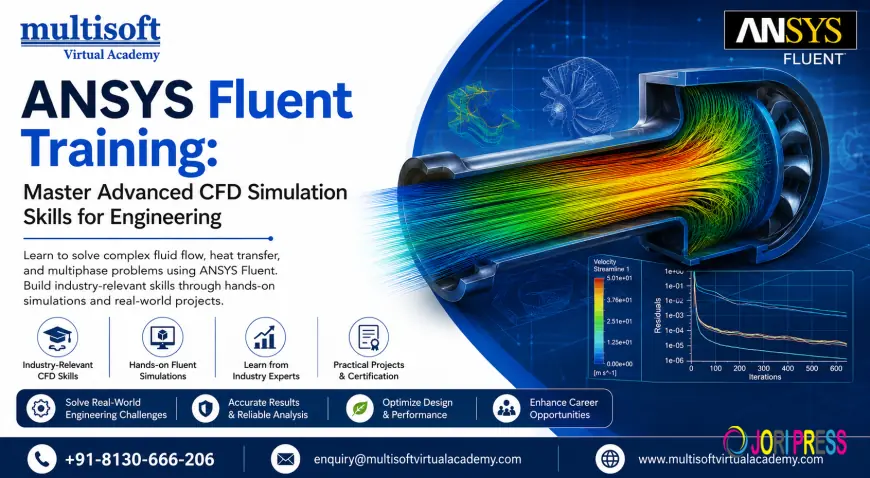
In today's engineering landscape, computational simulation has become an essential part of product development, design validation and performance optimization. Organizations across aerospace, automotive, energy, manufacturing, electronics, chemical processing and renewable energy industries rely heavily on Computational Fluid Dynamics (CFD) to reduce development costs while improving product quality.
Among the most trusted CFD software solutions, ANSYS Fluent stands out as an industry-leading platform capable of simulating fluid flow, heat transfer, turbulence, combustion, multiphase flow and numerous complex engineering phenomena. As industries increasingly embrace digital engineering and virtual prototyping, professionals with expertise in ANSYS Fluent Training are in high demand worldwide.
Whether you are a mechanical engineer, CFD analyst, product designer, research scholar or engineering student, learning ANSYS Fluent can significantly enhance your career prospects. This comprehensive guide explains everything about ANSYS Fluent, its applications, career opportunities, benefits and why professional training is becoming increasingly valuable.
What is ANSYS Fluent?
ANSYS Fluent is an advanced Computational Fluid Dynamics (CFD) software developed to analyze fluid flow, heat transfer and related physical phenomena through numerical simulation. Engineers use Fluent to predict how gases and liquids behave under different operating conditions before building expensive physical prototypes.
The software employs sophisticated mathematical models and finite volume methods to solve complex engineering problems with exceptional accuracy.
ANSYS Fluent helps engineers:
-
Analyze fluid flow
-
Study heat transfer
-
Perform thermal analysis
-
Simulate combustion
-
Predict turbulence
-
Evaluate aerodynamic performance
-
Design cooling systems
-
Optimize industrial equipment
-
Reduce product development costs
-
Improve engineering efficiency
Why is ANSYS Fluent Important?
Engineering industries are rapidly moving toward digital simulation to reduce manufacturing expenses and improve product reliability.
Instead of manufacturing multiple prototypes, engineers can simulate thousands of operating conditions using CFD.
Benefits include:
-
Reduced product development time
-
Lower prototype costs
-
Better engineering decisions
-
Higher product quality
-
Improved safety
-
Faster innovation
-
Enhanced product performance
-
Energy optimization
-
Reduced environmental impact
-
Accurate engineering predictions
Because of these advantages, companies actively seek professionals with ANSYS Fluent Training and CFD expertise.
Industries Using ANSYS Fluent
ANSYS Fluent is extensively used across numerous engineering sectors.
Aerospace Engineering
Engineers perform:
-
Aircraft aerodynamic analysis
-
Jet engine simulation
-
Cooling system optimization
-
Fuel flow analysis
-
Heat transfer simulation
-
Pressure distribution studies
Automotive Industry
Automobile manufacturers use Fluent for:
-
Vehicle aerodynamics
-
Engine cooling
-
Cabin airflow
-
Battery thermal management
-
Exhaust flow simulation
-
Fuel injection analysis
Oil and Gas Industry
Applications include:
-
Pipeline flow analysis
-
Heat exchanger design
-
Gas processing
-
Pressure drop analysis
-
Mixing simulations
-
Process optimization
Chemical Processing
Chemical industries utilize Fluent for:
-
Reactor design
-
Mixing systems
-
Chemical transport
-
Fluid circulation
-
Process efficiency improvement
Electronics Cooling
Modern electronic systems require effective thermal management.
Fluent assists engineers in:
-
PCB cooling
-
Chip temperature prediction
-
Airflow optimization
-
Server cooling
-
Data center thermal analysis
Renewable Energy
Applications include:
-
Wind turbine optimization
-
Solar thermal systems
-
Hydrogen flow simulation
-
Battery cooling
-
Energy efficiency analysis
Skills You Learn in ANSYS Fluent Training
A professional ANSYS Fluent Training program typically covers both theoretical concepts and practical implementation.
Core learning areas include:
CFD Fundamentals
-
Fluid mechanics
-
Governing equations
-
Conservation laws
-
Numerical methods
Geometry Preparation
Learn to:
-
Import CAD models
-
Clean geometry
-
Simplify complex assemblies
-
Repair surfaces
Meshing
Students understand:
-
Structured mesh
-
Unstructured mesh
-
Hybrid mesh
-
Inflation layers
-
Mesh quality improvement
Solver Setup
Topics include:
-
Material properties
-
Boundary conditions
-
Initial conditions
-
Solver configuration
-
Physical models
Turbulence Modeling
Important models include:
-
k-epsilon
-
k-omega
-
SST
-
LES
-
DES
Heat Transfer
Simulation includes:
-
Conduction
-
Convection
-
Radiation
-
Thermal coupling
Multiphase Flow
Topics cover:
-
Gas-liquid flow
-
Liquid-solid interaction
-
Particle transport
-
Cavitation
-
Free surface modeling
Post Processing
Students learn:
-
Velocity contours
-
Pressure distribution
-
Temperature plots
-
Streamlines
-
Vector analysis
-
Animation generation
-
Report preparation
Benefits of Learning ANSYS Fluent
Professional engineers gain numerous advantages after completing ANSYS Fluent Training.
These include:
-
Better career opportunities
-
Higher salary potential
-
Industry-recognized technical expertise
-
Practical engineering skills
-
Strong simulation knowledge
-
Global employment opportunities
-
Better research capabilities
-
Faster problem-solving skills
-
Competitive advantage
-
Career growth
Who Should Learn ANSYS Fluent?
This course is suitable for:
-
Mechanical Engineers
-
Aerospace Engineers
-
Chemical Engineers
-
Automotive Engineers
-
Thermal Engineers
-
HVAC Engineers
-
Design Engineers
-
CFD Analysts
-
Manufacturing Engineers
-
Research Scientists
-
Engineering Students
-
M.Tech Scholars
-
PhD Researchers
-
Product Development Engineers
Career Opportunities After ANSYS Fluent Training
Growing adoption of simulation technologies has created thousands of job opportunities worldwide.
Popular job roles include:
-
CFD Engineer
-
Simulation Engineer
-
Thermal Analyst
-
Design Engineer
-
Product Development Engineer
-
Aerodynamics Engineer
-
Mechanical Design Engineer
-
Research Engineer
-
Thermal Systems Engineer
-
CAE Engineer
-
Application Engineer
-
Validation Engineer
Industries Hiring CFD Professionals
Major hiring sectors include:
-
Aerospace
-
Automotive
-
Power Generation
-
Electronics
-
HVAC
-
Medical Devices
-
Manufacturing
-
Energy
-
Defense
-
Semiconductor
-
Marine Engineering
-
Chemical Industries
Why Online ANSYS Fluent Training is Becoming Popular
Online learning provides flexibility while maintaining practical exposure.
Advantages include:
-
Live instructor-led sessions
-
Flexible schedules
-
Recorded classes
-
Hands-on projects
-
Industry case studies
-
Expert mentoring
-
Real software practice
-
Lifetime learning resources
-
Certification support
Working professionals especially benefit because they can upskill without interrupting their careers.
Practical Projects Covered During Training
An industry-oriented ANSYS Fluent Training program generally includes practical simulations such as:
-
Pipe flow analysis
-
Heat exchanger simulation
-
Car aerodynamic analysis
-
HVAC airflow simulation
-
Electronic cooling
-
Fan performance evaluation
-
Airfoil simulation
-
Wind tunnel analysis
-
Mixing tank simulation
-
Battery cooling system
-
Combustion chamber analysis
-
Turbine blade cooling
These projects prepare learners for real-world engineering challenges.
Why Companies Value ANSYS Fluent Professionals
Organizations invest heavily in simulation because it reduces both development cost and project risk.
Professionals trained in Fluent help companies:
-
Reduce prototype iterations
-
Improve product quality
-
Accelerate design cycles
-
Optimize engineering performance
-
Enhance product reliability
-
Lower manufacturing expenses
-
Improve customer satisfaction
-
Increase operational efficiency
As digital engineering continues to evolve, simulation expertise is becoming one of the most valuable engineering skills.
Future Scope of ANSYS Fluent
Emerging technologies are further increasing the importance of CFD.
Future applications include:
-
Electric vehicle battery cooling
-
Hydrogen fuel systems
-
Smart manufacturing
-
AI-assisted simulations
-
Digital twins
-
Renewable energy optimization
-
Space technology
-
Sustainable engineering
-
Additive manufacturing
-
Semiconductor cooling
-
Green building design
The future demand for CFD engineers is expected to grow steadily across global industries.
Tips for Success in ANSYS Fluent
To become proficient:
-
Build strong fundamentals in fluid mechanics.
-
Practice meshing techniques regularly.
-
Learn heat transfer concepts thoroughly.
-
Work on industrial case studies.
-
Understand turbulence models in depth.
-
Interpret simulation results critically.
-
Stay updated with new ANSYS releases.
-
Develop report-writing and presentation skills.
-
Explore advanced physics models.
-
Continuously solve real engineering problems.
Consistent practice is the key to mastering CFD simulations.
Frequently Asked Questions
Is ANSYS Fluent difficult to learn?
With a structured learning approach and practical exercises, engineers can gradually master the software from basic to advanced levels.
Does ANSYS Fluent require coding?
Basic usage does not require programming knowledge, although scripting with journals or user-defined functions can enhance advanced workflows.
What prerequisites are recommended?
A foundation in fluid mechanics, heat transfer and engineering mathematics is beneficial, though many beginner-friendly training programs start with the fundamentals.
Is ANSYS Fluent useful for freshers?
Yes. Engineering graduates who gain practical CFD simulation skills often improve their employability for design, analysis and research roles.
Is ANSYS Fluent certification valuable?
A recognized certification demonstrates practical simulation knowledge and can strengthen your profile when applying for engineering positions.
Final Thought
The demand for simulation-driven engineering continues to rise as organizations seek faster innovation, lower costs and more reliable product development. Investing in ANSYS Fluent Training equips professionals with practical CFD expertise that is applicable across industries such as aerospace, automotive, energy, electronics, manufacturing and research. By combining theoretical knowledge with hands-on projects and real-world case studies, learners can build the confidence required to solve complex engineering challenges. Multisoft Virtual Academy is recognized for delivering comprehensive industry-oriented training programs through experienced instructors, live online sessions and practical learning methodologies, helping aspiring engineers and working professionals develop the advanced skills needed to excel in today's competitive engineering landscape.
What's Your Reaction?
 Like
0
Like
0
 Dislike
0
Dislike
0
 Love
0
Love
0
 Funny
0
Funny
0
 Angry
0
Angry
0
 Sad
0
Sad
0
 Wow
0
Wow
0