








































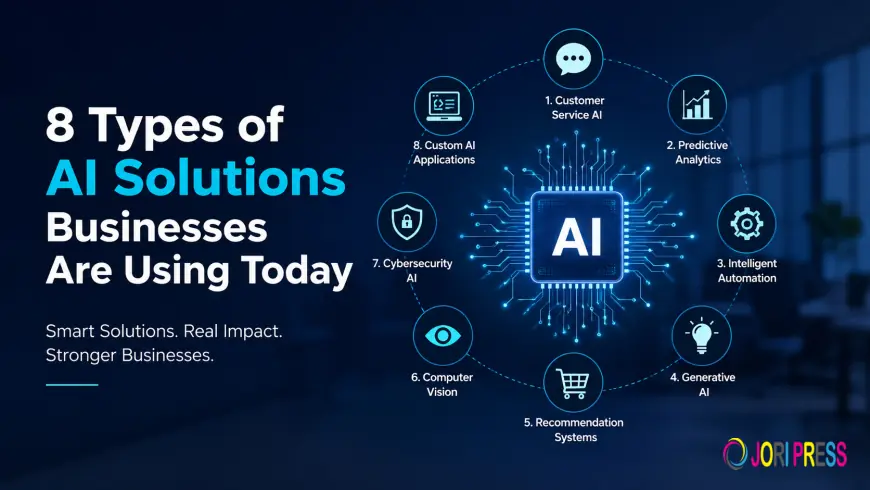
8 Types of AI Solutions Businesses Are Using Today
Imagine a customer asking a question at midnight, a sales team following up with hundreds of leads, and a security team checking thousands of alerts. Not long ago, people handled most of this work manually. Today, businesses are using AI solutions to make these tasks faster, smarter, and easier

Imagine a customer asking a question at midnight, a sales team following up with hundreds of leads, and a security team checking thousands of alerts. Not long ago, people handled most of this work manually. Today, businesses are using AI solutions to make these tasks faster, smarter, and easier.
AI solutions are software systems that use artificial intelligence to solve specific business problems. They can analyse information, predict outcomes, automate tasks, create content, or help employees make better decisions.
According to Stanford’s 2026 AI Index, 88% of surveyed organisations reported using AI in at least one business function in 2025.
Rubixe helps businesses explore practical AI opportunities through consulting, development, automation, and readiness assessment.
What are the main types of AI solutions businesses use?
Businesses use AI in different ways depending on their goals, data, industry, and budget. The eight common types are customer service AI, predictive analytics, intelligent automation, generative AI, recommendation systems, computer vision, cybersecurity AI, and custom AI applications.
The best AI solution is not always the most advanced one. It is the one that solves a real problem and produces a result that the business can measure.
|
Type |
Common use |
Main benefit |
|
Customer service AI |
Customer questions |
Faster support |
|
Predictive analytics |
Forecasting |
Better decisions |
|
Intelligent automation |
Repetitive work |
Saves time |
|
Generative AI |
Content and research |
Faster creation |
|
Recommendation systems |
Product suggestions |
Personalisation |
|
Computer vision |
Quality checks |
Better monitoring |
|
Cybersecurity AI |
Threat detection |
Faster response |
|
Custom AI applications |
Business workflows |
Greater flexibility |
How are AI customer service solutions improving support?
AI customer service solutions help businesses answer common questions, guide customers, and support service teams. They can work through websites, apps, messaging platforms, and internal help desks.
Consider an online retailer receiving hundreds of questions about delivery, returns, and products. An AI assistant can answer simple questions instantly while sending unusual cases to a human employee.
Businesses can use AI application development services to build assistants around their own information and processes. AI services can also help connect these assistants with customer databases and support systems.
Good customer service AI still needs human oversight. Sensitive complaints, unusual requests, and complex problems should be handled by people.
How do predictive AI solutions help businesses make decisions?
Predictive AI solutions study past and current data to estimate what may happen next. Companies use them for sales forecasting, demand planning, customer churn, inventory management, and risk assessment.
For example, a retailer can study previous sales, seasonal patterns, and current demand to estimate how much stock it may need. A bank can use similar methods to identify unusual patterns that deserve closer attention.
AI software solutions can turn large amounts of business data into useful predictions. AI application development services can also create prediction tools that fit a company’s existing processes.
However, predictions are not guarantees. Poor data, sudden market changes, or biased historical information can affect results.
Where does intelligent automation fit into business operations?
Intelligent automation combines AI with software automation to handle repeated work. It can read documents, classify requests, extract information, and trigger the next step in a workflow.
Imagine an accounts team receiving hundreds of invoices. Instead of entering every detail manually, an AI system can read each invoice, capture important information, check rules, and send exceptions to an employee.
AI transformation services often focus on these improvements because automation can create value without replacing an entire business system. AI implementation services can help introduce automation gradually and measure its impact.
The goal is simple, remove unnecessary manual work while keeping people involved where judgement matters.
Why are generative AI solutions becoming popular?
Generative AI creates text, images, code, summaries, and other content from instructions. Businesses use generative AI solutions for marketing, software development, research, customer communication, and internal knowledge work.
McKinsey reported that 79% of respondents in its 2025 survey said their organisations regularly used generative AI in at least one business function. At the same time, many organisations were still working to move from experiments to wider adoption.
Common uses include:
-
Creating first drafts of emails and marketing content
-
Summarising documents and meetings
-
Helping developers write and review code
-
Answering employee questions using internal knowledge
Gen AI services can help businesses choose suitable models, design use cases, and introduce controls for accuracy and privacy. Generative AI solutions still need human review when the content affects customers, finances, legal matters, or important business decisions.
How do recommendation systems personalise customer experiences?
Recommendation systems suggest products, services, articles, or actions based on customer behaviour and other useful signals. They are common in ecommerce, media, banking, and digital platforms.
For example, an online store can suggest products based on previous purchases or browsing activity. This can make the customer experience more relevant while helping businesses improve engagement.
AI software solutions can connect recommendation engines with websites, mobile apps, and customer data platforms. AI integration services can help connect these systems with existing business technology.
The quality of recommendations depends heavily on data quality. Businesses should also make sure personalisation does not become intrusive or difficult for customers to understand.
How is computer vision helping businesses understand images?
Computer vision allows software to understand information in images and video. Businesses use it for quality inspection, safety monitoring, document processing, retail analysis, and other visual tasks.
In manufacturing, a camera based system can check products for visible defects. In document heavy operations, computer vision can help identify important fields from forms and scanned documents.
AI development services can create computer vision systems for specific environments. AI application development services can then connect those systems with existing workflows.
Accuracy should always be tested in real conditions. Lighting, camera position, product changes, and unusual situations can affect results.
How are AI cybersecurity solutions detecting threats?
AI cybersecurity solutions help security teams identify unusual activity, analyse large volumes of alerts, and prioritise possible threats. This is useful because modern organisations can produce more security data than people can review manually.
An AI system can learn normal patterns and flag activity that looks unusual. It can also connect signals from different systems so security teams can investigate incidents faster.
AI integration services can connect security systems with monitoring tools, identity platforms, and incident response workflows. AI services can also support threat analysis and security automation.
AI improves speed, but it does not remove the need for skilled security professionals, strong access controls, and clear security policies.
How do custom AI business applications bring these capabilities together?
Custom AI business applications combine AI with a company’s own workflows, data, and software. Instead of using AI as a separate tool, businesses can place it inside systems employees already use.
For example, a sales application could summarise customer conversations, identify follow up opportunities, suggest next actions, and update records automatically.
This is where AI implementation services become important. Successful adoption requires more than building a model. Businesses need good data, secure systems, user training, monitoring, and ongoing improvement.
AI transformation services can help organisations connect multiple use cases into a broader business strategy instead of treating every AI project as a separate experiment.
How should a business choose the right AI solution?
The right AI solutions should start with the business problem, not the technology. Before investing, businesses should ask:
-
What problem are we trying to solve?
-
How much time or money could the solution save?
-
Do we have reliable data?
-
What risks could the system create?
-
Where should human review remain?
-
How will we measure success?
AI consulting services and AI services can help businesses identify suitable use cases before development begins. AI implementation services can then support testing, deployment, training, and improvement.
A small pilot may be better than a large project when a company is just starting its AI journey.
What are the benefits and limitations of business AI?
AI can improve speed, productivity, personalisation, and decision making. But businesses should also understand its limitations.
AI systems can produce incorrect results, reflect bias in training data, create privacy concerns, or become costly to maintain. These risks make responsible planning important.
AI software solutions should have clear goals, suitable data, security controls, human oversight, and measurable outcomes. AI development services should also include testing and monitoring rather than stopping when the software is launched.
The companies getting the most value from AI are not necessarily using the most technology. They are using it where it solves a clear business problem.
What should businesses expect from AI solutions next?
The future of AI solutions is moving toward deeper integration with business workflows, company data, and everyday software.
Stanford’s 2026 AI Index shows that organisational AI adoption reached 88% in 2025, while generative AI reached 79% across surveyed organisations. The report also notes that AI agent adoption is still relatively early.
This means businesses will likely focus less on simply buying AI tools and more on connecting AI with real processes.
For companies exploring this journey, Rubixe can help assess opportunities, plan practical use cases, and develop technology around measurable business needs.
Frequently asked questions about AI solutions
What are AI solutions?
AI solutions are software systems that use artificial intelligence to solve business problems such as customer support, forecasting, automation, content creation, security, and decision making.
What are the most common AI solutions?
The most common types include customer service AI, predictive analytics, intelligent automation, generative AI, recommendation systems, computer vision, cybersecurity AI, and custom AI applications.
Are AI solutions useful for small businesses?
Yes. Small businesses can start with focused use cases such as customer support, document processing, marketing assistance, or sales automation.
How long does AI implementation take?
The timeline depends on the use case, available data, integrations, security needs, and level of customisation. A small pilot can take much less time than a large organisation wide deployment.
How can a business get started with AI?
Start with one measurable problem. Review your data, define the expected result, assess risks, and test a focused use case before expanding.
Conclusion
The growth of AI solutions shows that artificial intelligence is becoming part of everyday business operations. Companies are using it to support customers, predict demand, automate work, create content, improve security, and build smarter applications.
The key is to start with a real business need and choose technology that fits it. With the right planning, AI can become a practical business tool rather than another complicated project.
What's Your Reaction?
 Like
0
Like
0
 Dislike
0
Dislike
0
 Love
0
Love
0
 Funny
0
Funny
0
 Angry
0
Angry
0
 Sad
0
Sad
0
 Wow
0
Wow
0